


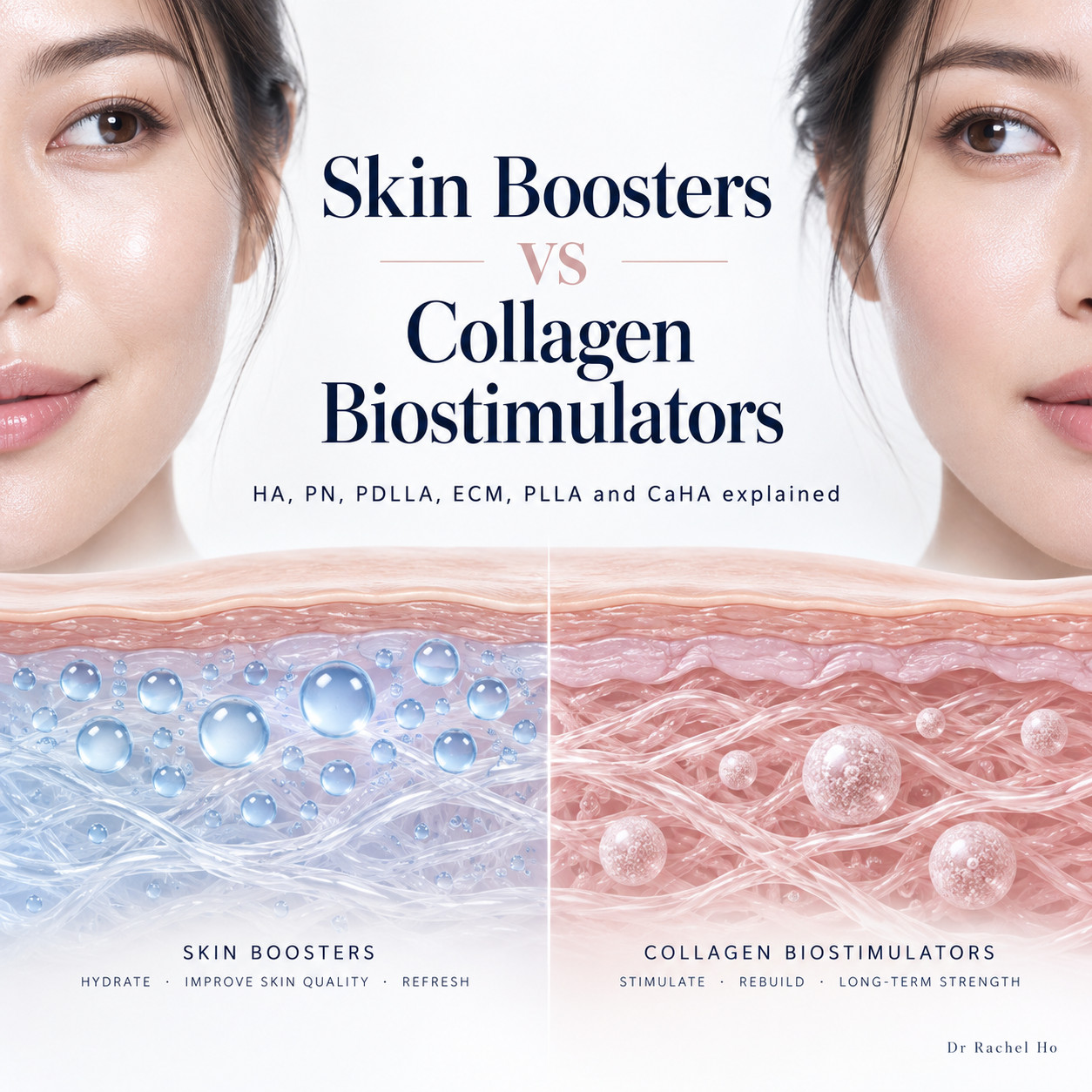
15 Sep Skin Boosters vs Collagen Biostimulators
Skin Boosters vs Collagen Biostimulators: What Is the Difference?
Among my patients, the distinction between “skin booster” and “collagen biostimulator” can be confusing. To be fair, both treatments offer overlapping skin benefits, and with the diverse options of skin boosting, collagen banking treatments available in Singapore today, it can be hard to know which one to choose for skin.
To understand how skin boosters and collagen biostimulators work, I find it helpful to first understand their different treatment roles and administration. Broadly speaking, skin booster are distributed across a broad skin layer to optimise overall skin quality. A collagen biostimulator is introduced deeper to that stimulates host fibroblasts to produce new collagen over time for lifting and tightening¹,².
In the realm of skin boosters, we have options like hyaluronic acid (HA), polynucleotides (PN), PDLLA, extracellular matrix (ECM) preparations. For collagen biostimulators in Singapore, we have PLLA, and calcium hydroxylapatite (CaHA). This is an indepth guide to understand the science behind these individual collagen building treatments.
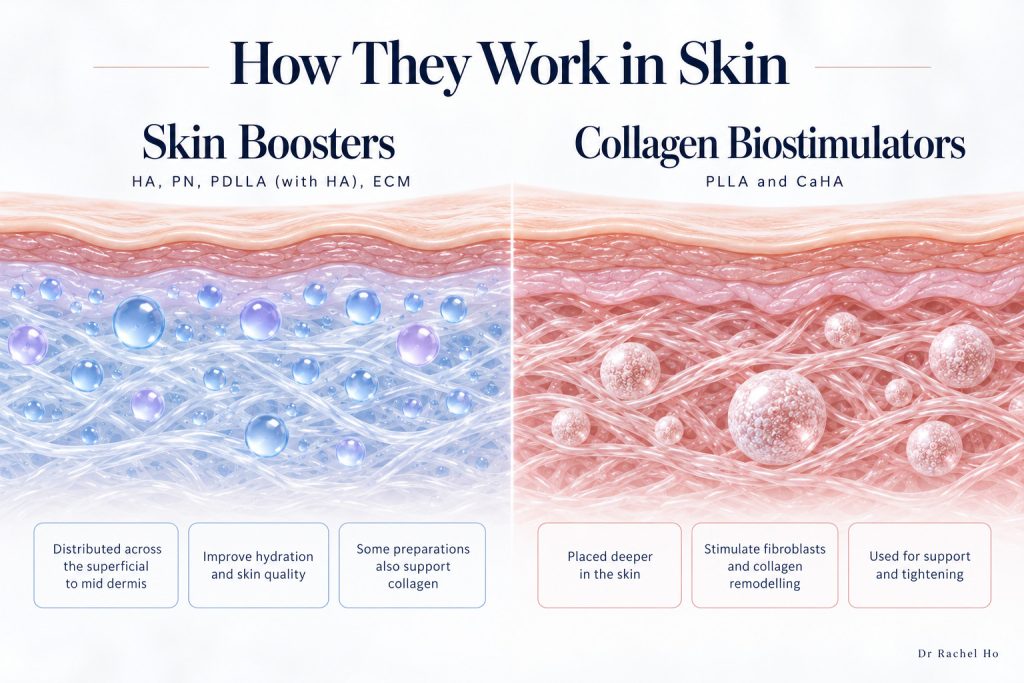
This illustration introduces how material placement and tissue response relate to skin quality and collagen remodelling. It is a conceptual diagram rather than a guide to injection depth or a demonstration of patient results.
Skin Quality, Collagen, Lifting and Facial Volume
When it comes to choosing between skin boosters versus collagen biostimulators, it is essential to distinguish patients’ priorities. Skin quality improvements in the form of reduced pore size, fine wrinkles and scars, skin hydration, firmer skin and radiance are different from results of collagen biostimulators, which confer lifting and tightening of saggy skin.
In general, skin boosters restore collagen and hydration in the skin to improve skin quality and texture; collagen biostimulators are better for lifting and tightening to improve sagging.
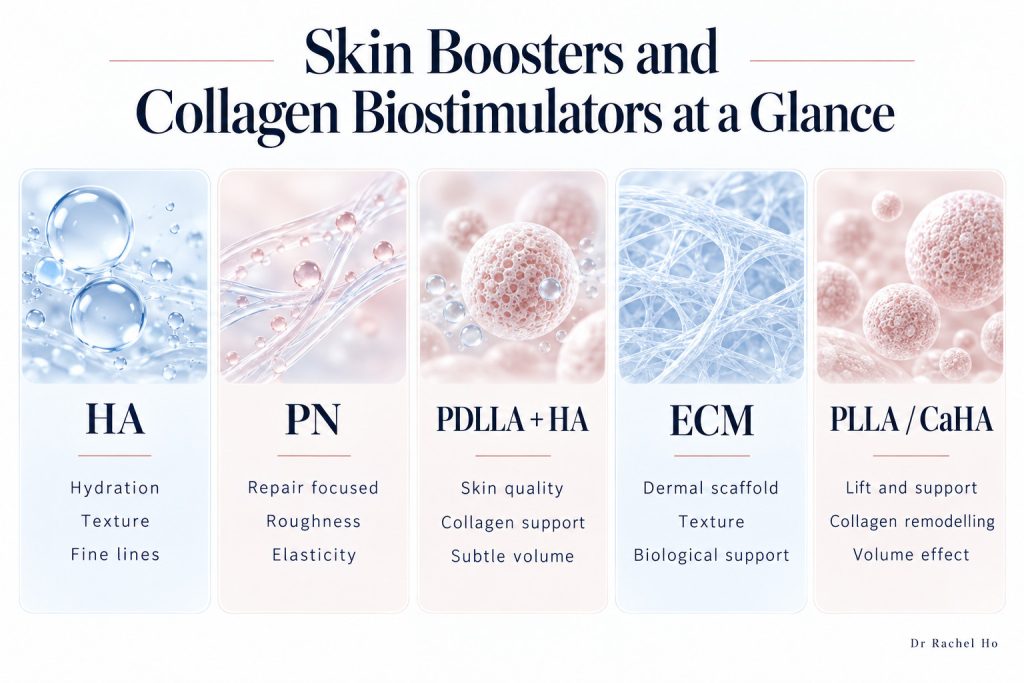
The chart places the materials discussed in skin boosters and collagen biostimulators side by side. Formulation, treatment goals and the evidence for each preparation remain important when interpreting these broad categories.
Skin Boosters and Collagen Biostimulators at a Glance
Skin Boosters VS Collagen Biostimulators at a Glance
| Product category | Primary Active Ingredient | Main Treatment benefit | Volume Effect | Considerations |
|---|---|---|---|---|
| HA skin boosters | Hyaluronic acid | Superficial hydration, texture, fine lines, and elasticity | Minimal to none | Formulations vary widely³,⁴ |
| PN skin boosters | Polynucleotides (purified salmon or trout DNA) | Dermal repair, fine wrinkles, roughness, and elasticity | Minimal to none | Promising data, though published studies vary in protocols and quality⁵,⁶ |
| PDLLA + HA skin boosters | Poly-D,L-lactic acid with non-crosslinked HA | Early hydration with gradual collagen induction | Subtle to modest | Clinical findings are specific to the studied formulation and protocol⁷ |
| ECM skin boosters | Acellular dermal matrix scaffold | Dermal scaffolding, texture, and biological ECM support | Product and technique dependent | Trial data was based on one specific device⁸ |
| PLLA collagen biostimulators | Poly-L-lactic acid | Progressive neocollagenesis and structural volume restoration | Progressive and significant | Long-term facial studies document gradual collagen synthesis⁹,¹¹ |
| CaHA collagen biostimulator | Calcium hydroxylapatite | Immediate mechanical lift + secondary tissue remodelling | Immediate and progressive | Dilution ratio and depth dictate whether it acts as a filler or a skin conditioner¹⁰,¹¹ |
Doctor’s Note: Every study evaluates different endpoints, so product selection must always align with your specific anatomical diagnosis.³,⁵,⁷,⁸,¹¹
What Are Hyaluronic Acid Skin Boosters?
Hyaluronic acid skin boosters deliver micro-droplets of hyaluronic acid directly into the superficial or mid-dermis. The primary goal of HA skin boosters is skin hydration, with secondary improvements in skin turgor, smoother micro-texture, and reduced skin crepiness by binding water within the skin matrix.²
In Singapore, HA formulations vary considerably due to the diversity of brands available in local clinics. Broadly speaking, HA skin boosters typically available in clinics in Singapore consist of non-crosslinked HA gels. The non-cross linked nature of these HA molecules allows for the hyaluronic acid to spread rapidly through the dermal plane to provide immediate, superficial hydration, vis-a-vis stabilised or crosslinked HA gels which resist enzymatic breakdown to maintain tissue presence for several months.²,⁴,⁵
Can HA Skin Boosters Stimulate Collagen?
Yes, HA skin boosters demonstrate biological activity that extends well beyond passive moisture retention.⁴
In a histological trial evaluating eight participants, micro-injections of HA skin booster into photoaged forearm skin significantly increased Type I collagen deposition and epidermal thickness compared to saline controls.⁴ This confirms that micro-stretching dermal fibroblasts with crosslinked HA can trigger new collagen formation⁴
More recently in 2026, a randomised controlled trial of a HA skin boosters evaluated 420 participants over six months.³ Researchers reported improvements in skin hydration, elasticity and texture, with benefits sustained for six months under the study conditions³.
To explore how hyaluronic acid interacts with dermal biology, read my personal guide to HA skin boosters in Signapore. My clinic guide to hyaluronic acid skin boosters covers the details about the treatment procedure in Singapore.
What Are Polynucleotide (PN) Skin Boosters?
Polynucleotides (PN) are nucleotide-based biopolymers derived from purified salmon or trout DNA.¹ In clinical research, PN injectables have been evaluated for their capacity to promote tissue repair, improve elastic recoil, smooth rough texture, and refine superficial wrinkles⁵. A systematic review analyzing nine clinical studies (219 total patients) documented consistent improvements in skin quality metrics⁵.
In Singapore, polynucleotide skin boosters are typically used to treat concerns similar to hyaluronic acid skin boosters such as acne scars, enlarged pores and early signs of ageing. In my clinic, PN skin boosters are administered through micro injections or through a cannula approach, depending on the indication. My guide to PDRN and PN Skin Boosters discusses in depth the benefits, results and risks of this treatment.
PN vs HA Skin Boosters
While both PN and HA are deployed as skin boosters, their biological mechanisms are different¹,⁶.
A randomised split-face study involving 27 participants compared PN skin boosters against non-crosslinked HA skin boosters around the eyes⁶.The PN-treated side demonstrated greater statistically significant reductions in skin roughness and pore volume.⁶ However, overall aesthetic improvement scores and dermal density measurements showed no statistically significant difference between the two groups, which suggests that PN skin boosters is not superior replacement for HA skin boosters⁶.
To understand the procedure for polynucleotides skin boosters, please see my clinic’s polynucleotide skin booster guide.
What Are PDLLA Skin Boosters?
Poly-D,L-lactic acid (PDLLA) is a biodegradable, synthetic polymer¹. Certain hybrid skin boosters combine porous PDLLA microparticles with a non-crosslinked HA carrier, introducing a biostimulatory polymer into a fluid skin booster format⁷.
A preliminary clinical trial evaluated this hybrid PDLLA-HA skin booster protocol across 16 Asian participants receiving two to three sessions at four-week intervals⁷. Investigators recorded visible improvements in skin texture and fine wrinkles, while skin biopsies confirmed increased dermal collagen and elastic fiber density post-treatment after administration of this PDLLA- HA skin booster⁷.
PN vs PDLLA: What Is the Difference?
PN is a nucleotide-derived biological repair polymer, whereas PDLLA is a synthetic biodegradable polymer¹. Furthermore, hybrid PDLLA injectables contain an HA carrier, giving them a distinct physical and biological profile compared to pure PN formulations.⁷
Because published PN and PDLLA trials utilised different methodologies and endpoints, direct head-to-head comparisons are limited⁵,⁷. The choice between skin boosters really depends on your specific skin concern⁵,⁷. For more about PDLLA skin boosters in skin rejuvenation, please visit my clinic’s PDLLA skin booster guide.
View this post on Instagram
What Are ECM Skin Boosters?
ECM skin boosters are the newest and one of the most popular categories of skin boosters in Singapore and Korea. ECM stands for extracellular matrix. ECM is the intricate structural network of collagen, elastin, proteoglycans, and glycosaminoglycans supporting dermal cells¹. ECM skin boosters deliver processed matrix material directly into the dermis to serve as a natural biological scaffold for cellular migration and tissue remodelling.⁸
Most ECM skin booster brands available in Singapore consist of human acellular dermal matrix (ADM), produced by processing donor dermal tissue. The cellular components are removed while retaining the structural matrix architecture, hence the name “acellular”⁸.
What Does the Clinical Evidence for ECM Skin Boosters Show?
A 2026 double-blinded, randomised split-face trial evaluated a particulate human acellular dermal matrix preparation against a control HA skin booster in 20 adults with moderate cheek roughness.⁸
Over a 20-week follow-up, the ECM skin booster side demonstrated statistically superior improvements in ultrasonic dermal density, tissue volume, skin elasticity, hydration, and barrier function.⁸ Complementary in vitro and animal models demonstrated enhanced fibroblast proliferation and matrix synthesis.⁸
While these findings are promising, the clinical arm evaluated a small cohort of 20 subjects over 20 weeks, and trial authorship included advisory ties to the product’s manufacturer⁸.
Are All ECM Preparations Equivalent?
No. “ECM skin boosters” are a categorical label, with several brands available. Differences in tissue sourcing, decellularisation, particle sizing, and carrier gels significantly alter how an ECM material integrates within human tissue across different brands.
For a read about my experience with ECM skin boosters and some of the controversies surrounding this viral treatment, please read ECM Skin Boosters Explained and ECM Skin Booster Controversies.
How Do PLLA and CaHA Collagen Biostimulators Work?
PLLA and CaHA represent the gold standard in deep particulate biostimulation. When PLLA and CaHA are injected into the deep dermal or subdermal planes, they address progressive tissue laxity, structural thinning, and loss of facial volume.⁹,¹⁰,¹¹
What is a PLLA collagen biostimulator?
PLLA stands for Poly-L-Lactic Acid (PLLA). PLLA microparticles elicit a controlled, sub-clinical tissue response involving macrophage recruitment and fibroblast activation⁹. As the polymer bioresorbs, host cells synthesise a new matrix of Type I collagen, leading to progressive dermal thickening and subtle volume recovery⁹. Because this relies on cellular growth, visible results develop gradually over several months.⁹
What is a CaHA collagen biostimulator?
CaHA stands for Calcium Hydroxylapatite (CaHA). CaHA consists of calcium hydroxylapatite microspheres suspended in a carboxymethylcellulose carrier gel¹⁰. The carrier provides immediate physical support, while the microspheres act as a scaffold that promotes long-term neocollagenesis, angiogenesis, and elastin production.¹⁰
Injected at full concentration, CaHA corrects deep structural deficits. When hyper-diluted, CaHA collagen biostimulator can be spread across the mid-to-superficial dermal plane to target surface laxity and crepiness without adding unwanted volume¹⁰.
PLLA vs PDLLA
PLLA and PDLLA refer to the base polymers in the product. While PLLA and PDLLA are related biodegradable polymers, they possess different stereochemical structures and degradation kinetics¹.
PLLA and PDLLA differ in their particle size, morphology, and carrier ingredients. These biochemical differences and differences in administration in the skin determine how PLLA and PDLLA perform inside human tissue. For example,hybrid PDLLA/HA skin booster are used for surface texture collagenesis, as opposed to a deep PLLA biostimulator used for structural volumisation⁷,⁹.
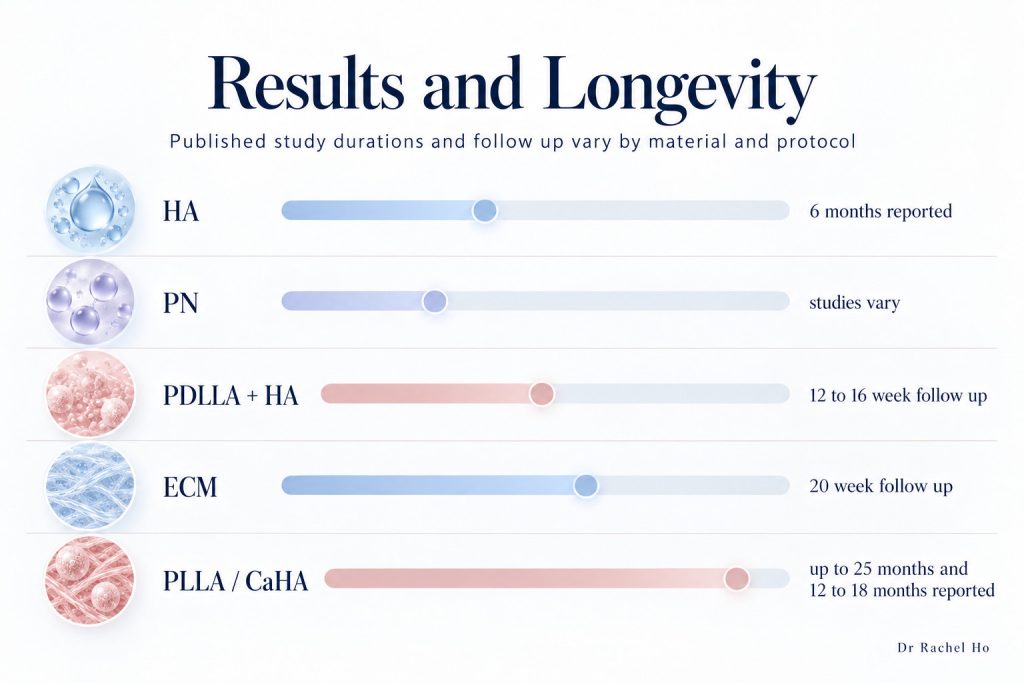
The studies summarised here used different formulations, treatment courses and outcome measures
How Long Do Skin Boosters and Collagen Biostimulators Last?
Published longevity figures reflect specific trial protocols, formulations, and endpoints. Due to differences in formulation and individual metabolism, the longevity of results for specific skin booster and collagen biostimulators can differ. These are some of the published timeline of results for skin boosters and collagen biostimulators:
- HA Skin Boosters: The 2026 randomised trial documented sustained clinical improvements through 6months³
- PLLA & CaHA: A systematic review of 14 facial studies reported sustained effects up to 25 months for certain PLLA formulations and 12 to 18 months for CaHA¹¹.
- PDLLA & ECM: The preliminary PDLLA trial evaluated patients at 12–16 weeks post-series, while the oneECM trial tracked endpoints over 20 weeks⁷,⁸.
How Many Treatment Sessions Are Needed for Skin Boosters and Collagen Biostimulators?
Recommend treatment protocol for skin boosters and collagen biostimulators depend on the specific formulation, tissue depth, and anatomical goals:
- HA Skin Boosters: Standard consensus guidelines recommend an initial series of up to three sessions, followed by maintenance every 4 to 6 months.³
- Juvelook (PDLLA + HA): Clinical trials utilized two to three sessions spaced four weeks apart⁷.
- PN, ECM, PLLA, & CaHA: Protocols must be tailored to baseline dermal health, age, and individual tissue response.
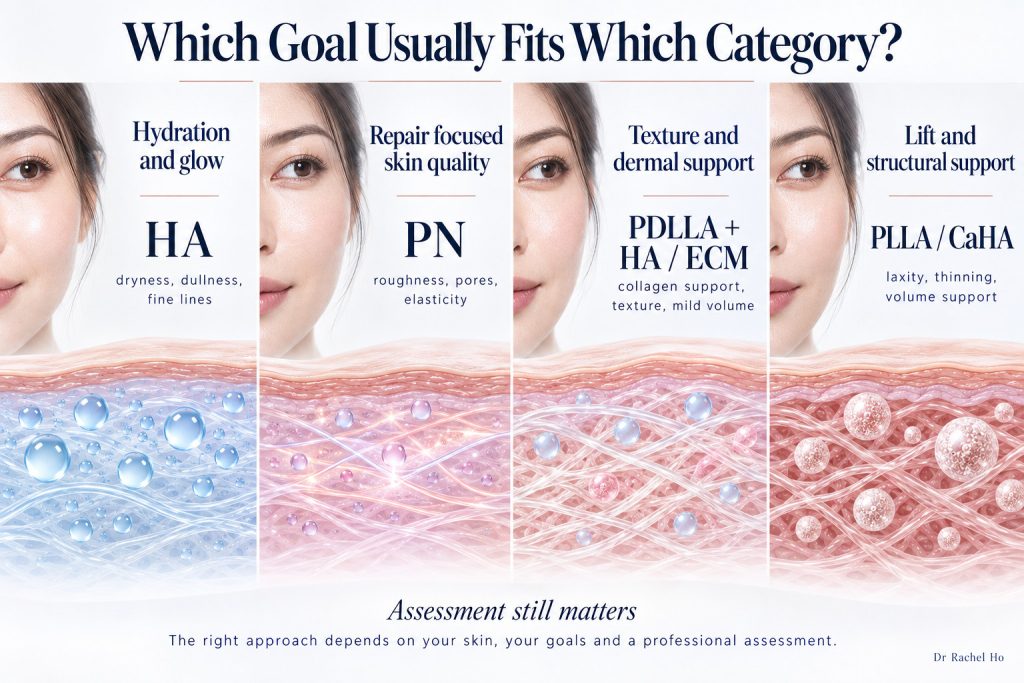
The comparison distinguishes concerns about hydration and texture from concerns about facial structure. An individual assessment is needed before translating these broad categories into a treatment plan.
What Else Can Address Dryness, Fine Lines, and Loss of Firmness?
Injectables are only one component of a modern skin longevity strategy. Dryness, dullness, and fine crepiness also respond well to skincare such as barrier-repairing moisturisers, and targeted active ingredients like vitamin C and azelaic acid and consistent broad-spectrum sun protection¹³. I’ve shared more about these skincare ingredients in these individual guide to vitamin C skincare, azelaic acid and sunscreen reviews.
In-clinic treatments like chemical peels, PRX plus, pico laser and radiofrequency microneedling also offer non-injectable options for textural refinement¹³. Conversely, severe structural sagging or laxity may require surgical evaluation¹³.
To strengthen your skin foundation please check out my guide to Skin Longevity Routine: Evidence Based Skincare for Asian Skin.
Side Effects, Risks, and Recovery Considerations of Skin Boosters and Collagen Biostimulators
Common, expected reactions across all facial injectables include localised tenderness, redness, swelling, micro-bruising, and temporary raised papules (injection bumps) at injection sites³,⁵,⁷. Their severity and duration of these injection related reactions depend on material viscosity, total volume, and injection depth⁵,⁷.
In particular, particulate biostimulators (PDLLA, PLLA, CaHA) require precise reconstitution, dilution, and depth control when injected into patients. Inappropriate superficial placement or uneven distribution can lead to visible papules, subcutaneous nodules, or delayed inflammatory responses¹¹,¹².
While small clinical trials—such as the 20-week Re2O ECM study—report zero serious adverse events, small sample sizes cannot rule out rare or delayed complications⁷,⁸. In my opinion, all facial injectables carry vascular risks if material is inadvertently introduced into a blood vessel, regardless of whether the injectable is a dermal filler, skin booster or collagen biostimulator¹². Although all procedures carry their own inherent risks, an in-depth knowledge of anatomy, appropriate patient selection and administering the correct injection techniques are central to ensuring safe outcomes and reducing side effects in my clinic.
Can Skin Boosters Be Combined with Collagen Biostimulators?
Combining skin boosters with collagen biostimulators is clinically rational strategy to address multi-layered facial aging. A patient presenting with dehydration, dermal thinning, and deep mid-face volume loss can benefit from a staged treatment plan that addresses each anatomical layer with an appropriate mechanism.
My take on combining treatments in general, is that the staging must be safe and synergistic. Some combinations, such as energy based devices may instead risk burns, so some treatments may need to be spaced apart.
Conclusion and Dr Rachel Ho’s takeaway on Skin Boosters and Collagen Biostimulators
Both skin boosters and collagen biostimulators have rightfully earned their place as two of the most popular, trending collagen-building treatments in Singapore today. While both offer overlapping benefits, they approach skin health from different depths and mechanisms. Skin boosters provide hydration, matrix repair, and micro-refinement, and collagen biostimulators result in deep, gradual structural support and neocollagenesis.
Ultimately, there is no single “best” treatment option. Achieving your best outcome depends entirely on a precise clinical diagnosis of your skin’s unique needs, choosing the right material formulation, and placing it with the expert technique and anatomical understanding of an experienced doctor. By understanding how each treatment works and its benefits, you can make an informed, confident choice that works in harmony with your long-term skin longevity goals.
References
- Yi KH, Kang H, Song JK, et al. Skin Boosters: 2026 Updated. Journal of Cosmetic Dermatology. 2026;25(6):e70875.
- Rho NK, Kim HS, Kim SY, Lee W. Injectable Skin Boosters in Aging Skin Rejuvenation: A Current Overview. Archives of Plastic Surgery. 2024;51(6):528–541.
- Liao Z, Hong W, Wang S, et al. Efficacy and Safety of Sodium Hyaluronate Gel for Facial Skin Rejuvenation. Dermatologic Surgery. 2026;52(8):776–782.
- Hsieh DM, Bi X, Zhong S, Wu Y. Biostimulatory and rejuvenating effects of small particle crosslinked HA injections in photoaged human skin. Aesthetic Surgery Journal. 2023;43(5):595–608.
- Lampridou S, Bassett S, Cavallini M, Christopoulos G. The Effectiveness of Polynucleotides in Esthetic Medicine: A Systematic Review. Journal of Cosmetic Dermatology. 2025;24(2):e16721.
- Lee YJ, Kim HT, Lee YJ, et al. Comparison of polynucleotide and hyaluronic acid fillers for periocular rejuvenation. Journal of Dermatological Treatment. 2022;33(1):254–260.
- Seo SB, Park H, Jo JY, Ryu HJ. Skin rejuvenation effect of combined PDLLA and noncrosslinked hyaluronic acid: A preliminary study. Journal of Cosmetic Dermatology. 2024;23(3):794–802.
- Lee YI, Chau NH, Nguyen NH, et al. Injectable particulated human acellular dermal matrix booster for skin restoration. International Journal of Molecular Sciences. 2026;27(5):2193.
- Haykal D, Haddad A, Cartier H, Avelar L. Poly-L-lactic acid in aesthetic dermatology: Beyond volume restoration toward regenerative biostimulation. Aesthetic Surgery Journal. 2025;45(10):1065–1072.
- Van Loghem J. Calcium Hydroxylapatite in Regenerative Aesthetics: Mechanistic Insights and Mode of Action. Aesthetic Surgery Journal. 2025;45(4):393–403.
- Ferreira ACM, Silva LR, Espasandin I, et al. Efficacy, durability and safety of PLLA and CaHA collagen biostimulators in the face: A systematic review. Aesthetic Plastic Surgery. 2026;50:1291–1300.
- Goodman GJ, Liew S, Callan P, Hart S. Facial aesthetic injections in clinical practice: Pretreatment and posttreatment consensus recommendations to minimise adverse outcomes. Australasian Journal of Dermatology. 2020;61(3):217–225.
- Ganceviciene R, Liakou AI, Theodoridis A, Makrantonaki E, Zouboulis CC. Skin antiaging strategies. Dermatoendocrinology. 2012;4(3):308–319.

No Comments