


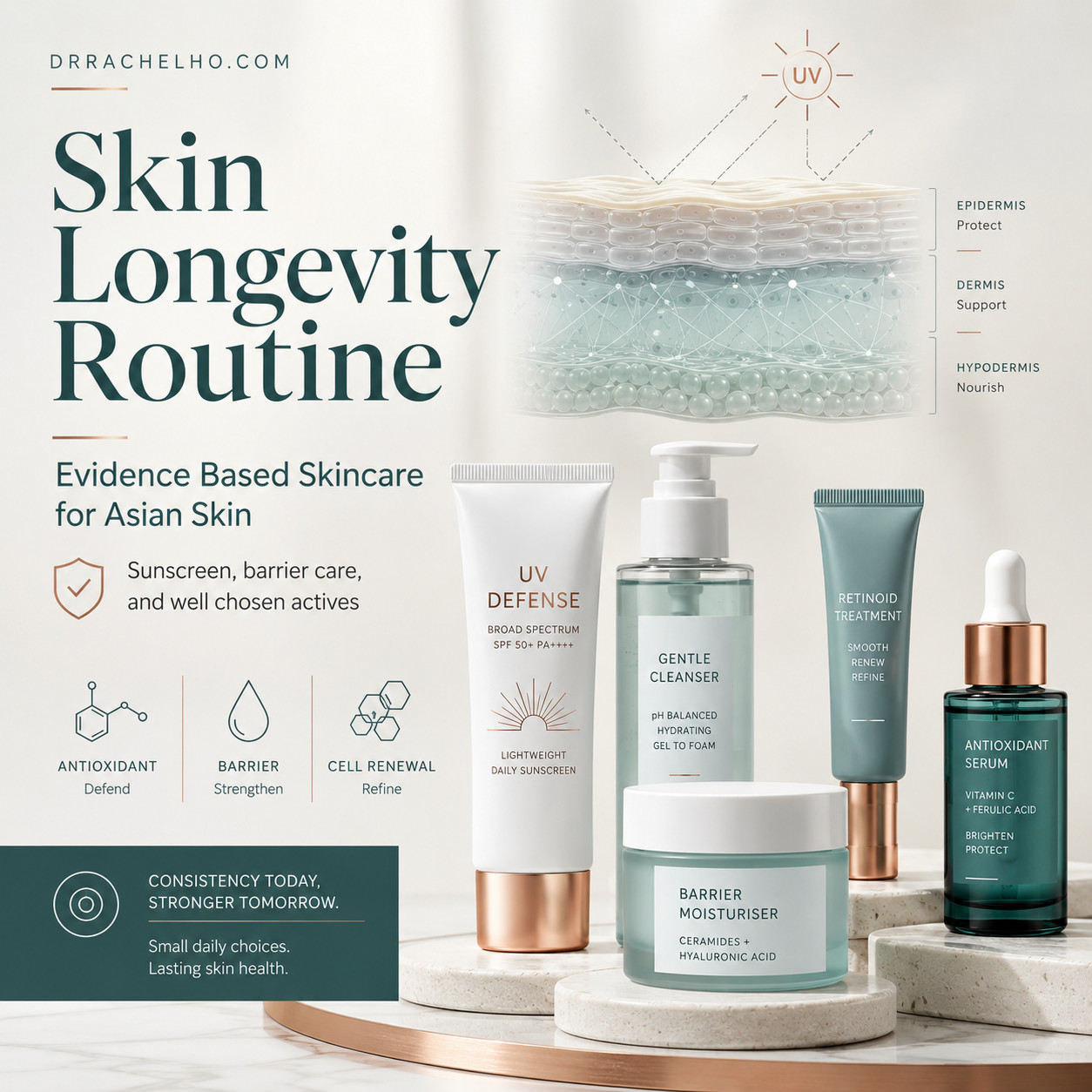
23 Aug Skin Longevity Routine: Evidence Based Skincare for Asian Skin
An Evidence Based Skin Longevity Routine
By Dr Rachel Ho | Updated August 2026
Skin longevity is not as complicated as some clinics or skincare brands make it seem to be. You do not actually need an expensive ten step routine, but simply, a framework that is evidence based and established. This skincare framework begins with daily photoprotection, a retinoid (where appropriate), selected antioxidants and consistent care of the skin barrier¹.
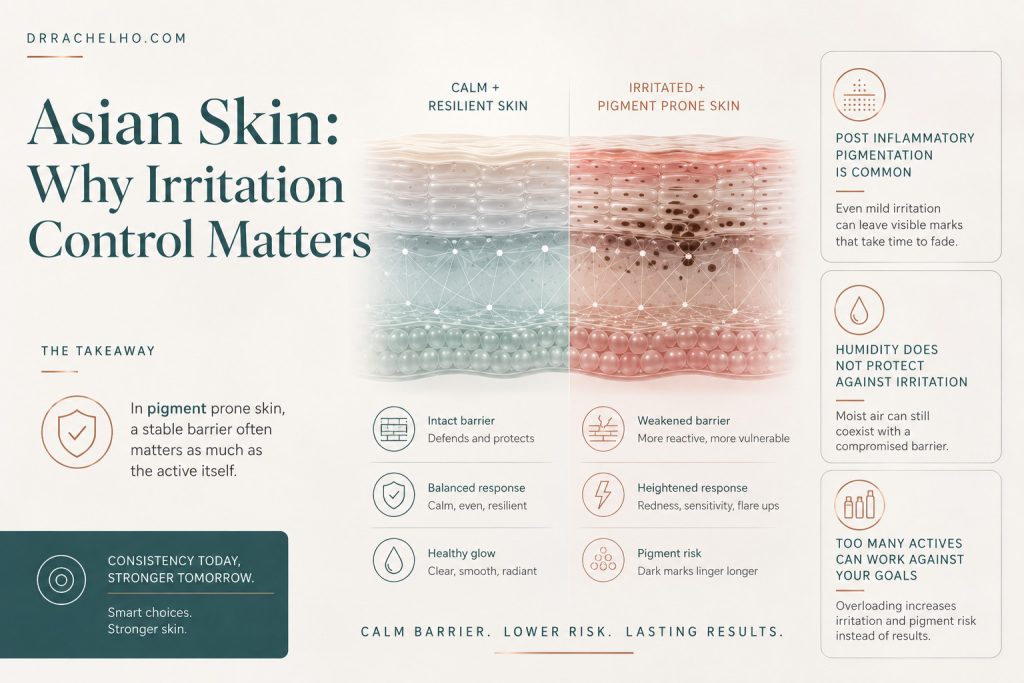
The routine should also reflect the person using it. Asian skin includes a wide range of skin tones and biological characteristics, but pigmentation after inflammation is a frequent concern across many Asian populations². In Singapore’s bright, humid environment, repeatedly irritating the skin while trying to improve it can leave redness, sensitivity and dark marks that outlast the initial reaction⁹.
A practical skin longevity routine has four priorities: protect the skin from ultraviolet exposure, maintain a stable barrier, use one or two evidence-based active ingredients, and treat active acne, eczema, rosacea or pigmentation rather than cosmetic coverage of the symptoms.
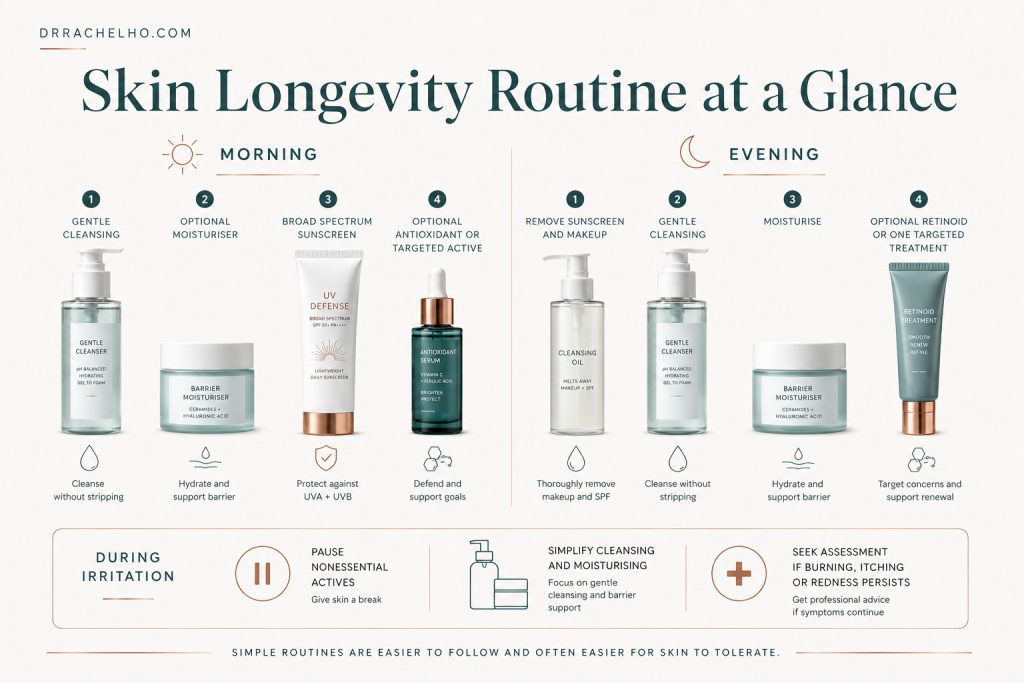
How do you build a complete skin longevity routine? Keep the morning focused on protection and the evening focused on cleansing, barrier support and one targeted treatment. During irritation, pause nonessential actives and simplify the routine.
Skin longevity routine at a glance
Skin longevity skincare routine at a glance
| Time | Core steps | Optional step |
|---|---|---|
| Morning | Gentle cleansing, moisturiser where needed, broad spectrum sunscreen | One antioxidant or concern specific active |
| Evening | Remove sunscreen and makeup, cleanse, moisturise | Retinoid or one targeted treatment |
| Active inflammation, infection, irritation | Pause non-essential active ingredients, simplify skincare routine to focus on skin barrier function | Seek medical assessment if symptoms persist |
| Before a procedure | Treat inflammation or infection and strengthen the skin barrier | Review risks of hyperpigmentation, scarring and complications, recovery time and aftercare |
This routine is deliberately simplified. There is no clinical evidence that a longer skincare routine is better for skin longevity.
What makes a skin longevity routine evidence based?
An evidence based skincare routine separates essential skincare steps from optional ones. This routine also distinguishes ingredients that improve a measured skin concern versus unsubstantiated marketing claims with no or limited human evidence.
Sun protection has the clearest preventive role for skin longevity. In a randomised trial lasting four and a half years, adults assigned to daily sunscreen had 24 percent less progression of visible skin ageing than those who used sunscreen at their own discretion³.
Among topical treatments, tretinoin has the strongest body of evidence for photo ageing. Studies report improvements in fine wrinkles, mottled pigmentation, texture and other visible signs of ultraviolet damage, although irritation commonly limits how quickly it can be introduced⁵.
Moisturisers, antioxidants and other active ingredients can support these foundations. Their value depends on the diagnosis, formulation, concentration and whether the skin can tolerate regular use.
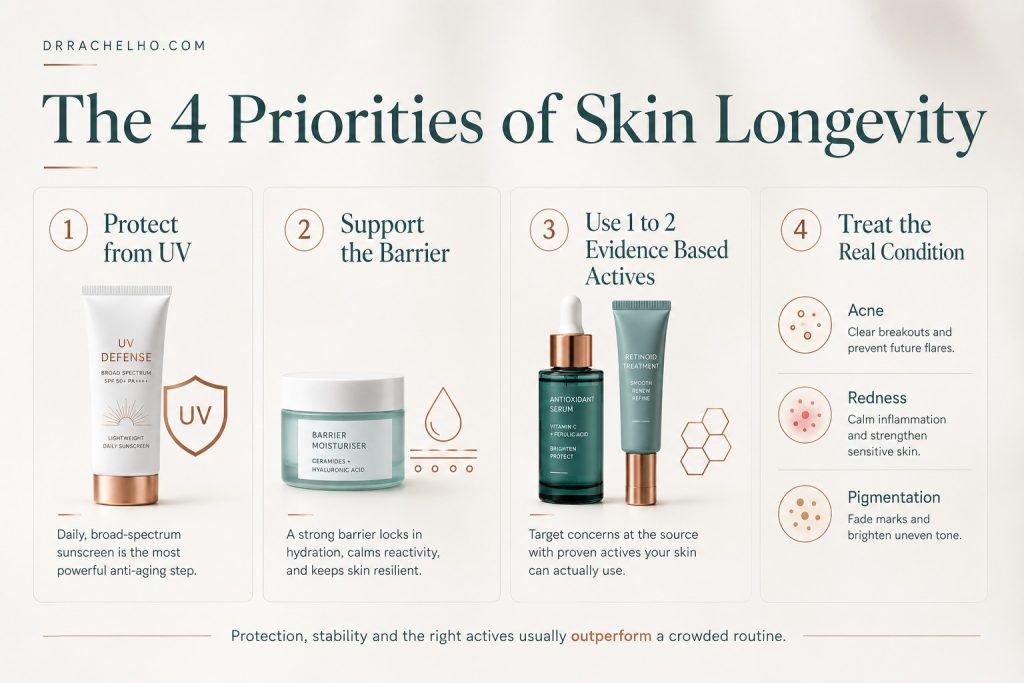
What are the four priorities of skin longevity? Protect the skin from ultraviolet exposure, support the barrier, use one or two evidence based actives and treat acne, redness or pigmentation according to the diagnosis.
Morning skin longevity routine
1. Cleanse according to your skin, not a fixed rule
A morning cleanser is useful when the skin is oily, acne prone or carrying residue from an overnight product. Dry or reactive skin may only need a water rinse or a small amount of gentle cleanser.
Cleansing prepares the skin for the routine but does not reverse skin ageing. A cleanser that leaves the face tight, rough or stinging is usually too aggressive for everyday use.
2. Add one antioxidant or targeted active
Vitamin C is one option for people concerned about uneven tone and photo ageing. A systematic review found that topical vitamin C may improve pigmentation and signs of photo ageing, but the studies varied considerably in formulation, concentration and treatment duration⁷.
Niacinamide may be easier to tolerate when mild oiliness, redness, barrier sensitivity and post acne marks overlap. Clinical studies using 5 percent niacinamide reported improvements in fine lines, hyperpigmented spots, texture and red blotchiness over approximately twelve weeks⁶. Higher percentages are not automatically more effective and can increase irritation in some users.
Azelaic acid is another useful option when acne, redness and post inflammatory pigmentation occur together. A 2023 systematic review found that topical azelaic acid was more effective than inactive vehicle for acne, rosacea and melasma, although results varied across formulations and conditions⁸.
There is no need to use vitamin C, niacinamide and azelaic acid in the same morning routine. Choose the ingredient that best matches the main concern and introduce it gradually.
Related guides:
3. Use moisturiser where the skin needs it
A moisturiser should reduce dryness and improve comfort without causing persistent congestion. Most formulations combine humectants such as glycerin with emollients, occlusive ingredients or barrier lipids for more complete moisturising effects.
I usually recommend looking for ceramide containing skincare for my patients. Ceramides are important components of the stratum corneum lipid structure and topical ceramide formulations can help restore disorganised barrier lipids⁴.
Individuals with Oily skin may prefer more lightweight lotions and gel, while dry or eczema prone skin may need a richer cream. Moisturiser should be adjusted to the skin tyyo than omitted because of a fear that all creams clog pores.
Related blogposts:
Vitamin C for Skin: Benefits, Best Form and Serum Guide
Ceramides in Skincare
How to Repair Your Skin Barrier
4. Apply sunscreen every morning
Sunscreen is the most important preventive step in a skin longevity routine. Choose a broad spectrum, high protection product that can be applied generously and worn consistently in Singapore’s heat and humidity³.
People with melasma or recurrent post inflammatory pigmentation may benefit from a tinted sunscreen that includes visible light protection. Randomised studies have found better melasma control with ultraviolet and visible light protection than with ultraviolet protection alone¹⁰. Tinted sunscreens are not essential for everyone, and shade availability remains a practical limitation.
Sunscreen does not need to be expensive, but it does need to be applied in an adequate amount and reapplied during prolonged outdoor exposure, sweating or water activity.
See my sunscreen reviews for guidance on textures and wearability.
Evening skin longevity routine
1. Remove sunscreen, makeup and surface debris
A gentle cleanser is usually sufficient for most routines. Double cleansing may be useful for water resistant sunscreen or heavy makeup, but it is not a requirement for every person.
Excessive cleansing, hot water and frequent scrubbing can worsen tightness and irritation. Skin that remains comfortable after cleansing is more likely to tolerate active treatment.
2. Consider a retinoid if it suits your skin
Retinoids can improve photo ageing, uneven texture, fine lines and selected forms of pigmentation. Tretinoin has the strongest evidence, while retinol and retinaldehyde may be easier to tolerate but are supported by a smaller and more variable body of research⁵.
Begin with a low frequency, such as two evenings each week, and increase only when the skin remains comfortable. A small amount is enough for the face, and moisturiser can be applied before or after the retinoid to reduce irritation.
Do not begin a retinoid during active dermatitis, a rosacea flare or immediately after a procedure that has disrupted the skin surface. Topical retinoids are also generally avoided during pregnancy as a precaution¹¹.
Related blogposts:
Retinol for Skin: Benefits, Percentage and How to Use It
Retinol vs Retinal vs Tretinoin: Which Should You Use?
3. Finish with moisturiser
Moisturiser can reduce dryness and make a retinoid routine more sustainable. Sensitive skin may benefit from applying moisturiser first, then adding the retinoid once the skin is dry.
Persistent burning, swelling, itching or dermatitis is not a sign that a product is working. Stop the new active, simplify the routine and seek medical advice if the reaction does not settle.
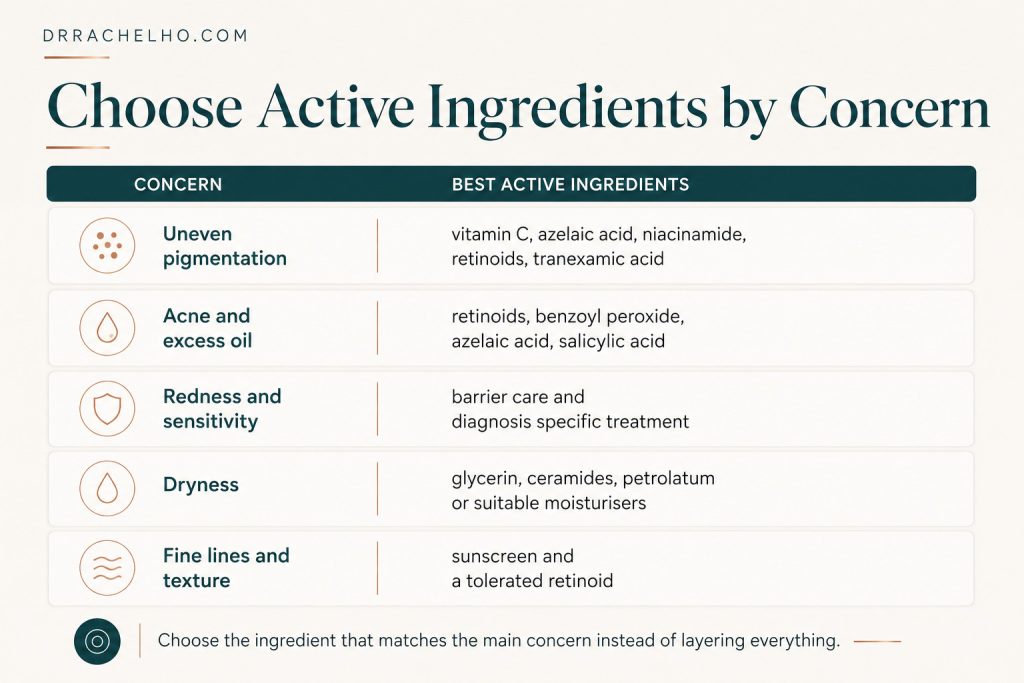
Which active ingredient should you use? Match the ingredient to the main concern: pigment regulating actives for uneven tone, acne treatments for blocked pores, barrier care for redness and richer moisturisers for dryness. More layers do not automatically produce better results.
Choose active ingredients by concern
Skincare active for specific concerns
| Main concern | Skincare actives that may be considered | Main limitation |
|---|---|---|
| Dullness and dark spots | Vitamin C, azelaic acid, niacinamide, retinoids or tranexamic acid | Melasma, sun spots and post inflammatory pigmentation often in-clinic treatments like pico lasers and chemical peels. |
| Acne and excess oil | Retinoids, benzoyl peroxide, azelaic acid or salicylic acid | Painful, persistent or scarring acne needs medical treatment |
| Redness and sensitivity | Barrier care and diagnosis specific treatment such as azelaic acid | Redness may represent rosacea, eczema, allergy or irritation |
| Dryness | Glycerin, ceramides, petrolatum or other suitable moisturisers | Hydrating serums do not replace a damaged lipid barrier |
| Fine lines and texture | Sunscreen and a tolerated retinoid | Results are gradual and irritation can offset the benefit |
| Indented acne scars or laxity | Skincare can support the surface | Topical products cannot rebuild substantial dermal loss or lift loose skin |
The main principle is to treat the dominant concern without creating a second problem. In pigment prone Asian skin, irritation from excessive layering can contribute to post inflammatory hyperpigmentation⁹.
Related blogposts:
What are Active Ingredients in Skincare & How do They Work?
How to Layer Skincare Correctly
What should an evening skin longevity routine include? Remove sunscreen and makeup, cleanse without stripping the skin, introduce a retinoid gradually when suitable and finish with moisturiser to support tolerance.
How many skincare products do you need?
Most people can build an effective routine with four to six products across the morning and evening. A longer routine is not automatically harmful, but it increases the number of fragrances, preservatives and active ingredients that the skin must tolerate.
It also becomes difficult to identify the cause when redness or breakouts appear. My guide to 10, 12 and 14 step skincare routines explains why more steps do not necessarily produce healthier skin.
What about peptides, exosomes, PDRN and longevity skincare?
Peptides, growth factors, PDRN, exosome products, NAD themed skincare and other regenerative ingredients are increasingly marketed for skin longevity. Some have plausible mechanisms or early clinical data, but formulations vary and long term human outcomes remain less established than those for sunscreen and retinoids¹.
These products may be considered optional additions after the foundation is established. They should not replace photoprotection, treatment of active skin disease or a routine that the skin can tolerate.
Related blogposts:
PDRN Skincare: Benefits, Evidence and Popular Serums
Does Exosome Skincare Really Work?
Peptides for Skin: Benefits, Types and Serum Guide
When skincare is not enough
Skincare can improve hydration, inflammation, pigmentation and early photo ageing. It cannot fully correct deep acne scars, substantial laxity, fixed wrinkles or all forms of dermal pigmentation.
Depending on the diagnosis, in clinic options may include Pico laser for selected pigment concerns or radiofrequency microneedling or ECM skin boosters for acne scars, texture and enlarged pores. These procedures target specific problems, but they have not been proven to stop biological skin ageing or extend skinspan as a measurable clinical outcome.
A Skin Longevity Assessment is be useful when the diagnosis is unclear, several concerns overlap or previous routines have caused persistent irritation.
A simple way to begin a skincare routine for skin longevity
Start with cleanser, moisturiser and sunscreen for two weeks. Once the skin is comfortable, introduce one active ingredient and use it consistently before deciding whether another product is necessary.
Assess gradual changes over eight to twelve weeks rather than changing the routine every few days. Stop earlier if burning, itching, swelling or a worsening rash occurs.
What a skin longevity routine cannot promise
No skincare routine has been proven to stop biological ageing permanently. The realistic goal is to reduce preventable damage, preserve barrier function, control inflammation and improve selected signs of photo ageing¹.
Skin longevity should also not become another term for skin whitening. Healthy skin can exist at every natural skin tone, and treatment should focus on abnormal pigment variation rather than making the complexion lighter.
Related blogposts:
What Is Skin Longevity? A Doctor’s Guide to Healthier Skin Aging
Skin Longevity for Asian Skin: Pigmentation, Barrier Health and Inflammation
Dr Rachel’s takeaway on skincare routine for Asian skin longevity
I build skin longevity routines around protection, barrier stability and one or two well chosen active ingredients. Active acne, eczema, rosacea and dermatitis should be controlled before the routine becomes more complex.
The best routine is not the longest or most expensive one. It is the routine that addresses the correct concern, can be used consistently and does not create inflammation that works against the original goal.
Frequently asked questions
What is the best skin longevity routine?
A strong basic routine consists of gentle cleansing, moisturiser where needed, daily broad spectrum sunscreen and a retinoid when suitable. One additional active can be selected for pigmentation, acne or redness.
Do I need both vitamin C and niacinamide?
No. Both may be useful, but neither is essential for every person. Choose according to the main concern, formulation and skin tolerance.
Is retinol essential for skin longevity?
Retinoids have strong evidence for photo ageing, but they are not suitable for everyone. Sensitive skin, active dermatitis and pregnancy may require a different approach.
How long does a skin longevity routine take to work?
Protection begins as soon as sunscreen is used correctly, but visible changes from topical actives are gradual. Many clinical studies assess pigmentation, texture and fine lines after approximately eight to twenty four weeks.
Is a skin longevity routine different for Asian skin?
The foundations remain the same, but pigment stability and control of irritation deserve particular attention. Melasma, post inflammatory pigmentation and deeper pigment disorders should be diagnosed before aggressive treatment²,⁹.
References
- Kream E, et al. Skinspan: A Holistic Roadmap for Extending Skin Longevity With Evidence Based Interventions. Journal of Cosmetic Dermatology. 2025. PMID 40913411.
- Chan IL, et al. Characteristics and Management of Asian Skin. International Journal of Dermatology. 2019. PMID 30039861.
- Hughes MCB, et al. Sunscreen and Prevention of Skin Aging: A Randomized Trial. Annals of Internal Medicine. 2013. PMID 23732711.
- Schild J, et al. The Role of Ceramides in Skin Barrier Function and Skin Disease. International Journal of Cosmetic Science. 2024. PMID 39113291.
- Siddiqui Z, et al. Comparing Tretinoin to Other Topical Therapies in the Treatment of Skin Photoaging. American Journal of Clinical Dermatology. 2024. PMID 39348007.
- Bissett DL, et al. Niacinamide: A B Vitamin That Improves Aging Facial Skin Appearance. Dermatologic Surgery. 2005. PMID 16029679.
- Correia G, et al. Efficacy of Topical Vitamin C in Melasma and Photoaging. Journal of Cosmetic Dermatology. 2023. PMID 37128827.
- King S, et al. A Systematic Review to Evaluate the Efficacy of Azelaic Acid in Acne, Rosacea, Melasma and Skin Ageing. Journal of Cosmetic Dermatology. 2023. PMID 37550898.
- Mar K, et al. Treatment of Post Inflammatory Hyperpigmentation in Skin of Colour. Journal of Cutaneous Medicine and Surgery. 2024. PMID 39075672.
- Polena H, et al. Comparison of Visible Light Protective Tinted Sunscreen to Untinted Sunscreen in Melasma. Journal of Cosmetic Dermatology. 2025. PMID 41014037.
- Refsum E, et al. Topical Retinoid Use in Women of Reproductive Age and Risk of Major Congenital Malformations. British Journal of Dermatology. 2026. PMID 41365815.

No Comments