


08 Aug Skin Longevity for Asian Skin: Pigmentation, Barrier Health and Inflammation
Updated August 2026
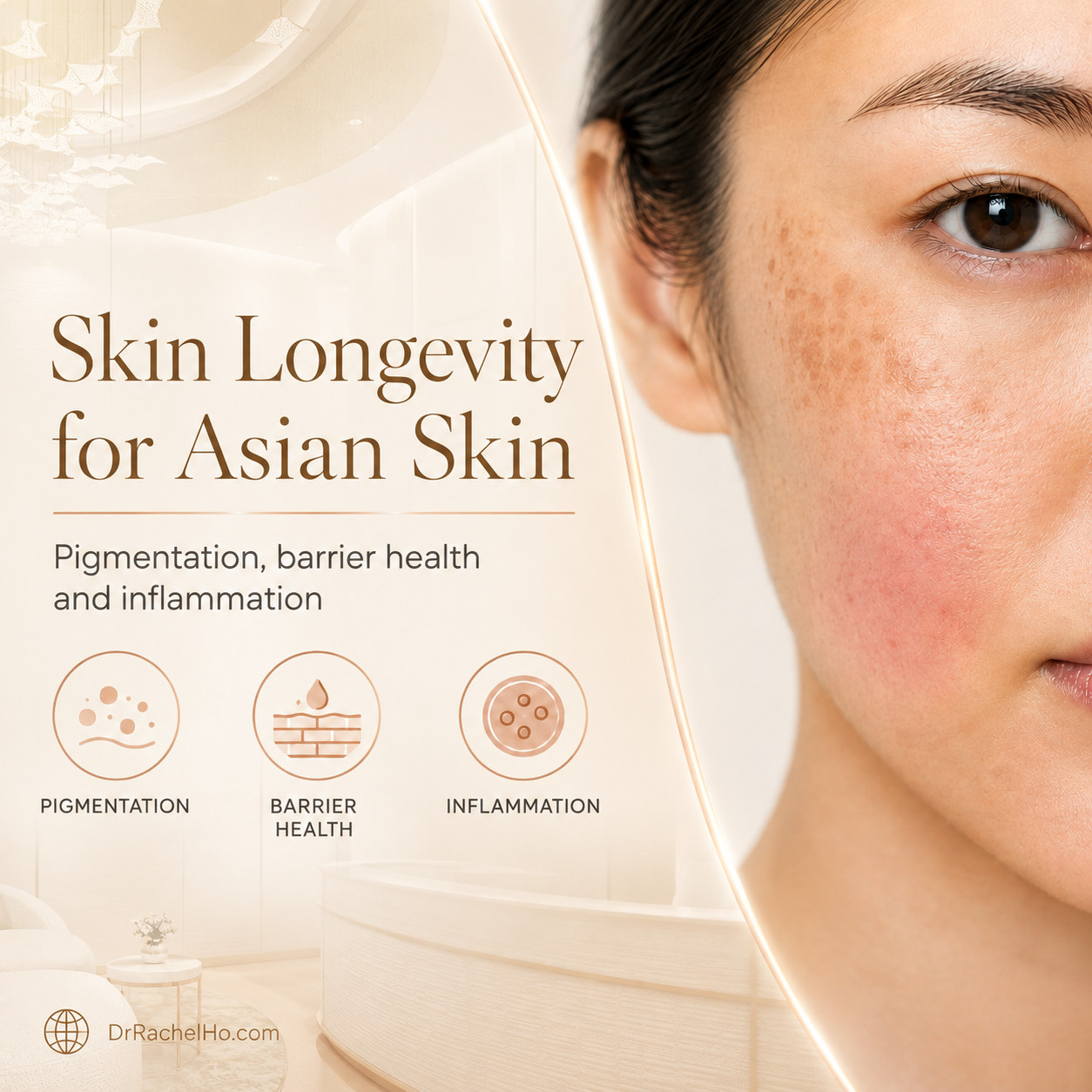
Skin longevity is the preservation of healthy skin function, resilience and recovery over time. For Asian skin, the most important priorities are pigment stability, barrier tolerance and control of inflammation, because irritation or an unsuitable procedure can leave discoloration that lasts much longer than the original redness¹,².
Asian skin consists of a diverse range of biological skin types and behaviors. East, Southeast and South Asian populations include a wide range of skin tones, genetics and treatment responses, so an individual assessment is more useful than assuming that every Asian patient has the same risks² ³.
Skin longevity for Asian skin means keeping inflammation controlled, maintaining barrier function and choosing treatments that the skin can recover from. The aim is stable, resilient skin, and optimised skin barrier function.
Related blogpost:
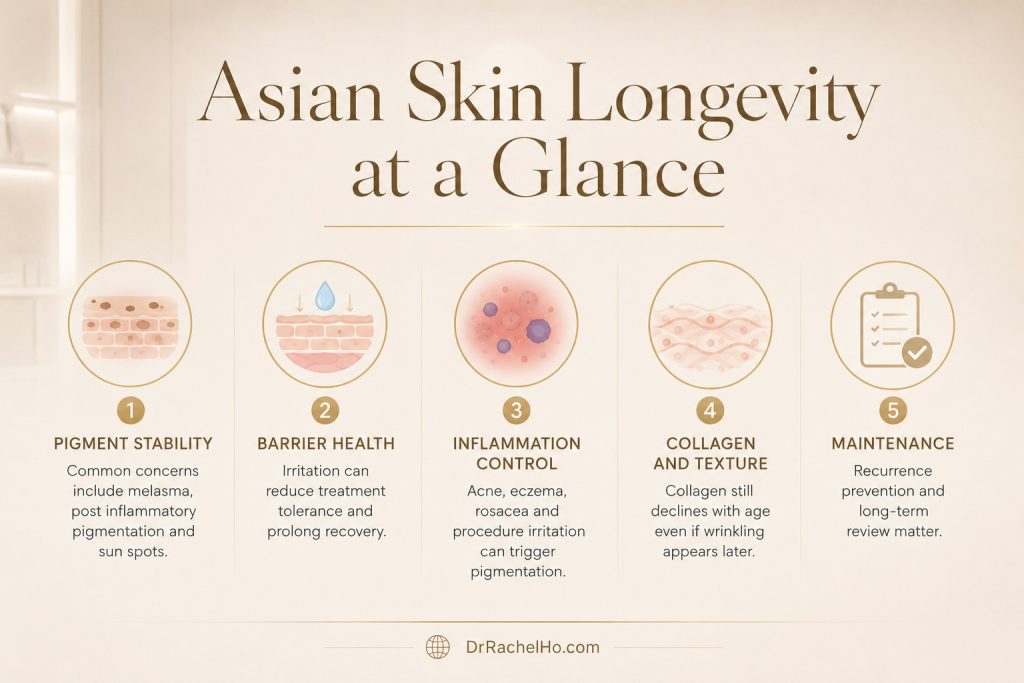
Asian skin longevity involves more than treating visible ageing. Long-term care should consider pigmentation, barrier tolerance, inflammation, collagen and the risk of recurrence after treatment.
Asian skin longevity at a glance
Asian skin longevity at a glance
| Priority | Why it is relevant | First step |
|---|---|---|
| Pigment stability | Melasma, post inflammatory pigmentation and sun spots are common concerns | Establish the diagnosis and use daily photoprotection |
| Barrier health | Irritation can reduce treatment tolerance and prolong recovery | Simplify skincare and repair active barrier disruption |
| Inflammation control | Acne, eczema, rosacea and procedure related irritation can trigger pigmentation | Treat the inflammatory condition before elective procedures |
| Collagen and texture | Wrinkles may appear later than pigment change, but collagen still declines with age | Use evidence based skincare and carefully selected procedures |
| Maintenance | Pigmentation and inflammation may recur after improvement | Plan long term protection and review |
How does Asian skin age differently?
Many Asian populations show visible pigmentary change before prominent wrinkling compared to Western populations. Greater epidermal melanin provides some natural protection from ultraviolet injury, but it also means inflammation can produce a stronger or more persistent pigment response².
The term Asian skin still covers many phototypes and ethnic groups. Research on barrier function is inconsistent, and studies comparing transepidermal water loss across ethnic groups have produced conflicting results.³ This is why we should not generalise Asian skin types and behavior such as barrier function, skin oiliness or response to laser treatments.
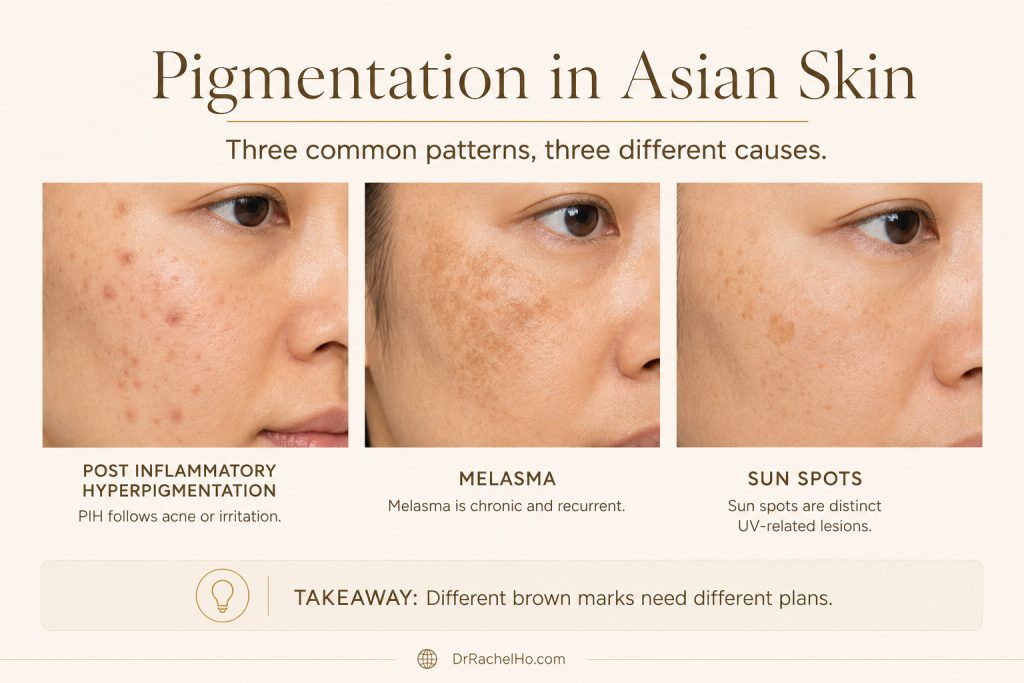
Pigmentation in Asian skin is not one diagnosis. Post-inflammatory hyperpigmentation, melasma and sun spots have different causes, recurrence patterns and treatment considerations
Pigmentation is often the main clinical concern among Asians
Post-inflammatory hyperpigmentation can follow acne, eczema, irritation, picking, burns or aesthetic procedures. In a 2024 systematic review of 1,356 people with skin of colour, inflammatory conditions caused 89 percent of cases and the face was affected in 83 percent. Twenty seven percent of participants were Asian⁴.
Melasma, on the other hand, behaves differently from the most sun-related hyperpigmentation. Melasma is a chronic, recurrent pigment disorder influenced by ultraviolet radiation, visible light, hormones and other biological factors, so removing visible pigment does not remove every driver. Current international guidance places daily broad spectrum sunscreen and medical topical therapy before procedural treatments, with lasers reserved for selected or resistant cases¹⁰.
For melasma and selected forms of post-inflammatory pigmentation, tinted sunscreen containing iron oxides may add protection against visible light. A 2025 randomised study found better control of melasma related colour change with a visible light protective tinted sunscreen than with a comparable untinted sunscreen, although product shades and visible light protection are not standardised across the market⁶.
Related blogpost:
Hyperpigmentation Disorders: Causes, Types, Treatments
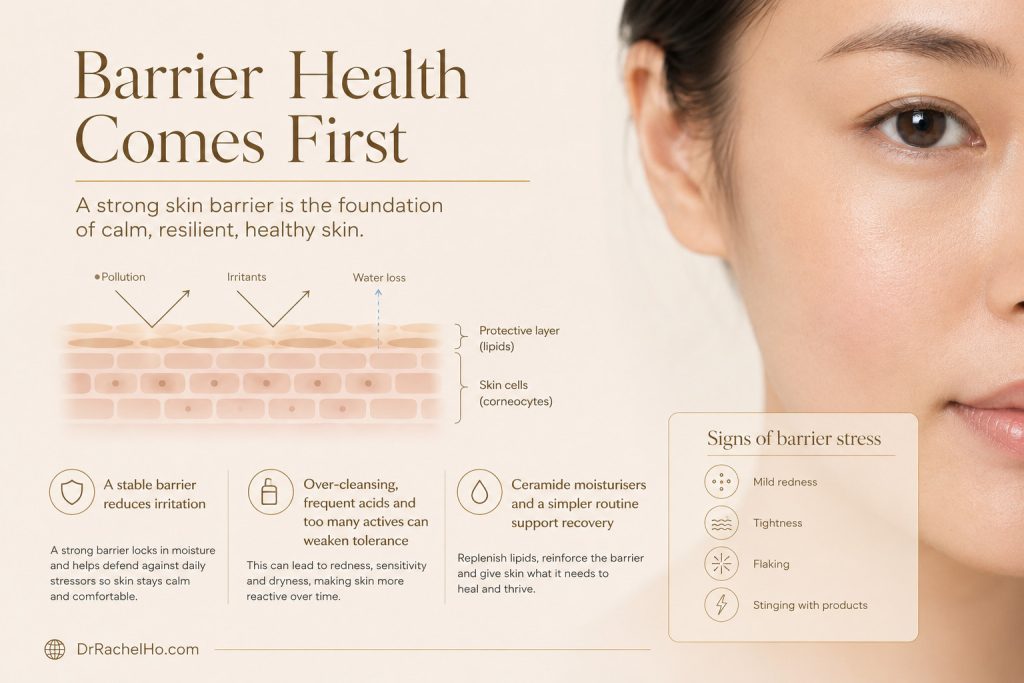
A stable skin barrier helps reduce water loss and irritation while improving tolerance of skincare and procedures. Burning, tightness, flaking and stinging may indicate that barrier recovery should come before stronger treatment.
Barrier health should come before aggressive treatment especially for Asian skin
The skin barrier reduces water loss, limits irritant penetration and supports normal immune function. Ceramides are central components of the stratum corneum lipid matrix, and ceramide containing moisturisers can support barrier repair in dry or inflamed skin⁷.
Related blogposts:
How to Repair Your Skin Barrier
A complicated routine is not automatically a better longevity routine. Frequent acids, scrubs, retinoids, strong cleansers and repeated procedures can create burning, tightness, flaking or dermatitis, particularly when several are introduced together. Active barrier disruption should be stabilised before lasers, chemical peels or energy based treatments are considered.
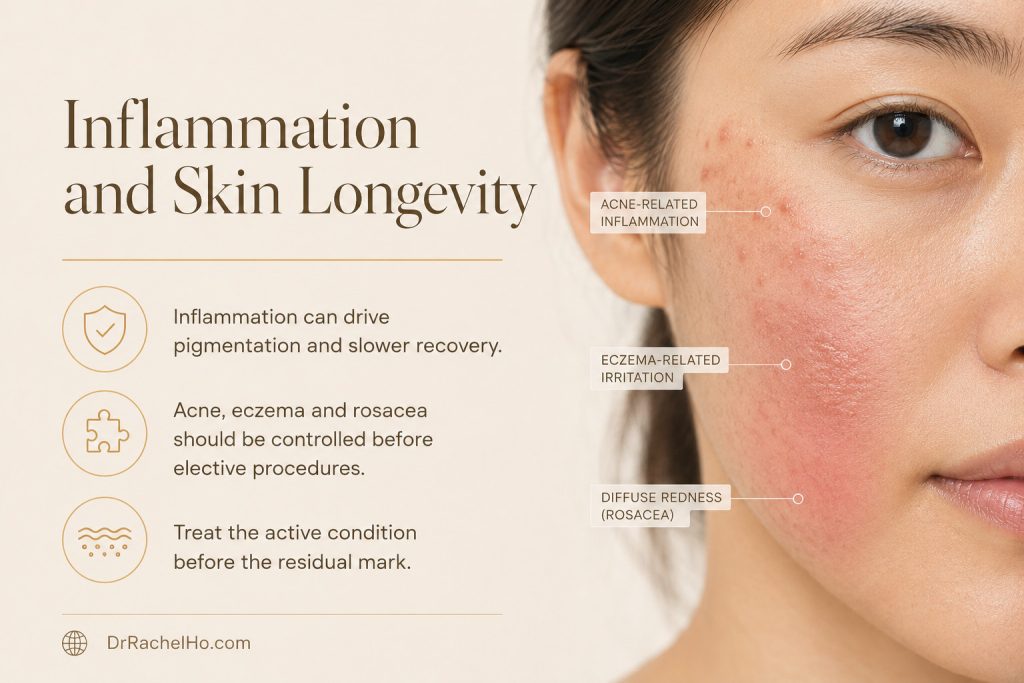
Acne, eczema and rosacea can cause persistent inflammation and pigmentation in Asian skin. Treating the active condition first may reduce residual marks and provide a safer foundation for elective procedures.
Inflammation can drive both pigmentation and ageing
Acne, eczema, rosacea and contact dermatitis can leave persistent colour change even after the initial flare has settled. Chronic low grade inflammation is also one component of inflammaging, a process linked with impaired barrier function, slower repair and changes in the dermal extracellular matrix⁸.
For skin longevity, controlling the inflammatory condition is usually more useful than repeatedly treating the mark it leaves behind. A 2025 systematic review of post procedure pigmentation prevention included only Asian participants and found that sunscreen was the only measure that consistently reduced the incidence of post inflammatory hyperpigmentation. Interestingly, more aggressive intervention did not reliably provide better prevention in that study⁵.
Skin treatment options for Asians
| Main goal of treatment | Treatment options | Important limitations |
|---|---|---|
| Prevent new pigment | Broad spectrum sunscreen, visible light protection where relevant, treatment of acne or dermatitis | Sunscreen cannot remove established pigment and must be used consistently |
| Improve dullness | Azelaic acid, retinoids, niacinamide, vitamin C, tranexamic acid or prescribed pigment treatment | Irritation can worsen pigmentation, and results are gradual |
| Treat selected sun spots or hyperpigmentation | Pico laser or another pigment specific laser after diagnosis | Post inflammatory pigmentation, incomplete clearance and recurrence can occur |
| Improve acne scars and texture | Fractional resurfacing, collagen biostimulators, radiofrequency microneedling or subcision according to scar type | Several sessions may be needed |
| Support dry or reactive skin | Barrier skincare, injectable moisturisers and ECM skinboosters | Underlying cause of barrier compromise like eczema should also be medically treated |
| Improve collagen and firmness | Retinoids, radiofrequency and collagen biostimulators | Improvement is usually gradual, device protocols vary and results are not equivalent to surgery |
Treatment options for Asian skin in Singapore
Treatment for patients should be selected according to the indication or diagnosis, current barrier condition, inflammation and risk of pigmentation. For example, hyperpigmentation can be due to melasma, a lentigo or post inflammatory pigmentation or dermal pigment, and their responses to treatments and prognosis are very different.Pigment lasers can be useful for lesions after the correct diagnosis. However, patients with darker phototypes have a higher risk of post inflammatory colour change after laser injury⁹. Conservative settings, appropriate treatment intervals and careful aftercare can reduce risk, along with combination therapies as required.
Radiofrequency microneedling has growing body evidence for acne scars, texture and facial rejuvenation across different phototypes¹¹. However, the available studies remain heterogeneous, with outcomes varying by device and indication.
Topical retinoids have established evidence for photoageing and can improve mottled pigmentation, fine lines and texture over time. Tolerance remains a limitation, especially when retinoids are introduced too quickly or layered with several other irritating products¹².
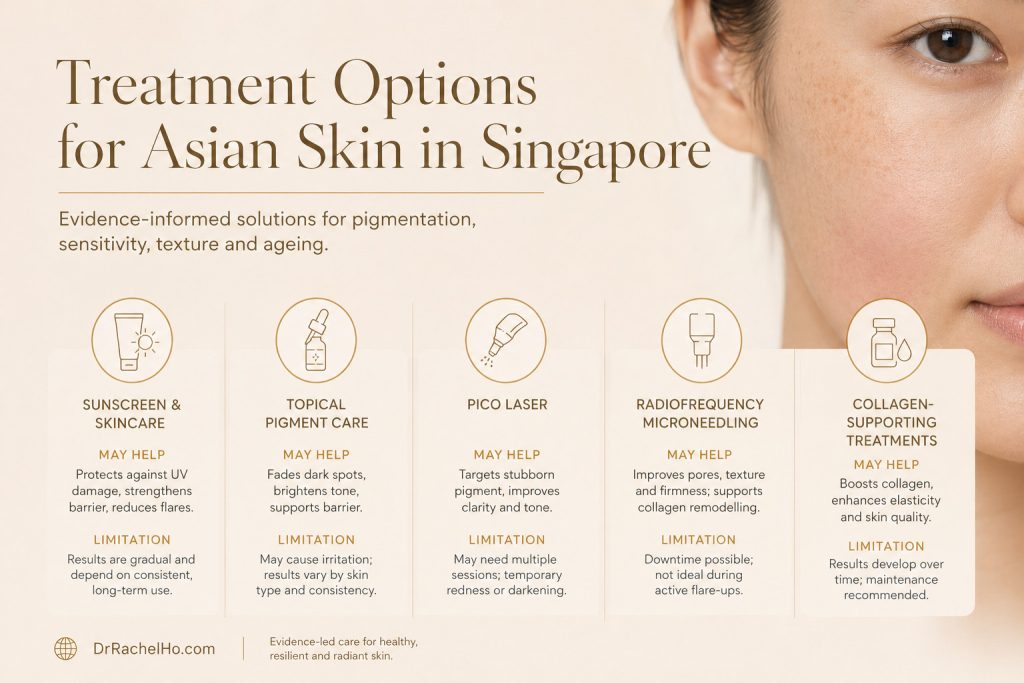
Treatment options for Asian skin in Singapore may include photoprotection, topical pigment care, Pico laser, radiofrequency microneedling and collagen-supporting procedures. Suitability depends on the diagnosis, barrier condition, active inflammation and risk of post-inflammatory pigmentation.
A practical treatment sequence for Asian skin longevity
A skin longevity plan for Asian skin usually follows five stages. The order can be adjusted, but the principle is to stabilise the skin before adding treatment intensity.
- Confirm the diagnosis and identify active triggers.
- Control acne, eczema, rosacea, irritation or cause of skin barrier dysfunction
- Establish daily sunscreen and a tolerable skincare routine.
- Embark on necessary procedures only when the skin is stable and the expected benefit justifies the risk.
- Review the response before escalating treatments
This sequence for treating Asian skin should not be about stacking or layering multiple treatments together in the same session. Planning for Asian skin requires consideration for the tendency for Asian and darker skin patients to develop post inflammatory hyperpigmentation and reactivity. Recovery capacity should always be considered as part of treatment selection and not an afterthought.
What skin longevity treatments cannot promise
The goal of skin longevity is to preserve the patient’s natural tone, reduce abnormal pigment variation and support healthy function. No skincare product, laser or injectable has been proven to stop biological skin ageing. A procedure may improve pigment, texture, hydration or firmness, but that does not mean it extends skinspan in a measurable clinical sense at this point in time¹.
Who should delay an in-clinic procedures?
Aesthetic treatments should be deferred when there is active dermatitis, a rosacea flare, painful inflammatory acne, infection, recent tanning, significant burning from skincare or an unclear diagnosis. Pregnancy, medication, previous pigment reactions and a history of keloids can also alter treatment plans for safety and wound recovery.
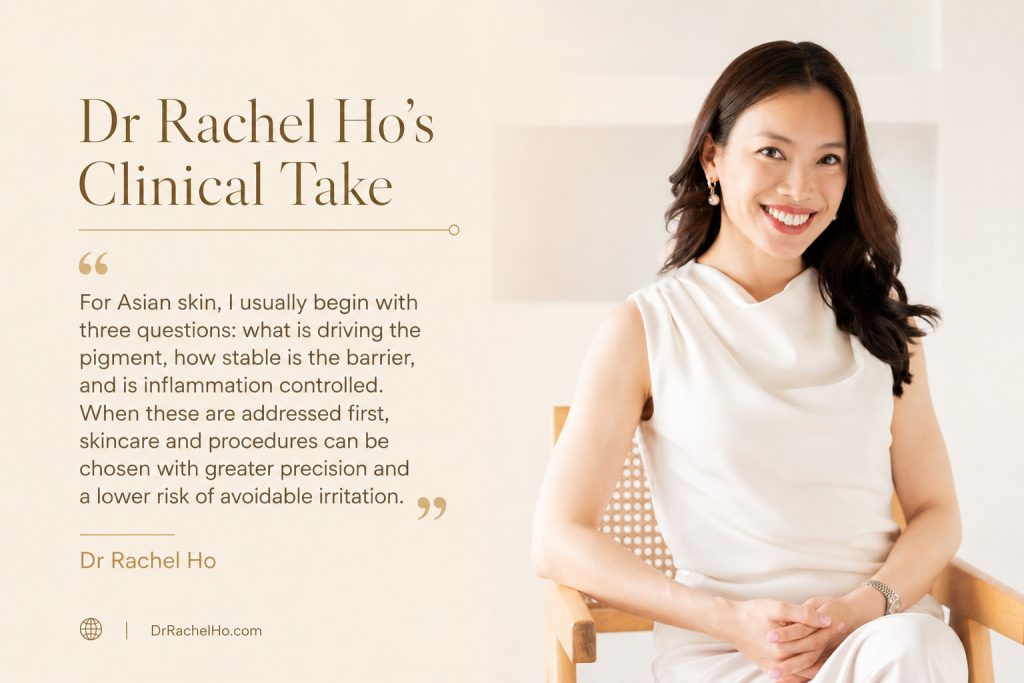
Dr Rachel Ho’s takeaway on skin longevity for Asian skin
I approach skin longevity for Asian skin with a three pronged approach: what is driving the pigment, how stable is the barrier and is inflammation controlled. When these are addressed first, skincare and procedures can be selected with greater precision and a lower risk of avoidable irritation.
The best treatment is not necessarily the newest or strongest one. It is the option that addresses the correct problem while preserving the skin’s ability to recover.
Frequently asked questions about skin longevity for Asian skin
Does Asian skin age more slowly?
Many Asian populations develop prominent wrinkling later than lightly pigmented populations because melanin provides some protection from ultraviolet injury. Pigmentation may become visible earlier, and individual ageing still depends on genetics, sun exposure, smoking, hormones, inflammation and skincare.²
What is the best treatment for pigmentation in Asian skin?
There is no single best treatment because melasma, sun spots, post inflammatory pigmentation and dermal pigment require different plans. Diagnosis, sunscreen and control of inflammation should come before choosing a peel or laser.
Is Pico laser safe for Asian skin?
Pico laser is effective for treating hyperpigmentation such as melasma, post acne marks and solar lentigenes⁹. Pico laser can also be combined with other modalities for treating dark spots including chemical peels, PRX Plus, intradermal tranexamic acid and radiofrequency microneedling.
How can I improve skin longevity in Singapore?
Use sunscreen daily, keep the routine tolerable, treat acne and dermatitis early, avoid excessive exfoliation and allow enough recovery time between procedures. A stable barrier and controlled inflammation create a safer foundation for pigment and collagen treatments.
References
- Kream E, et al. Skinspan: A Holistic Roadmap for Extending Skin Longevity With Evidence Based Interventions. Journal of Cosmetic Dermatology. 2025. PMID 40913411.
- Chan IL, et al. Characteristics and Management of Asian Skin. International Journal of Dermatology. 2019. PMID 30039861.
- Peer RP, et al. Did Human Evolution in Skin of Colour Enhance the Transepidermal Water Loss Barrier? Archives of Dermatological Research. 2022. PMID 33635415.
- Mar K, et al. Treatment of Post Inflammatory Hyperpigmentation in Skin of Colour: A Systematic Review. Journal of Cutaneous Medicine and Surgery. 2024. PMID 39075672.
- Mar K, et al. Prevention of Post Inflammatory Hyperpigmentation in Skin of Colour: A Systematic Review. Australasian Journal of Dermatology. 2025. PMID 39953770.
- Polena H, et al. Comparison of Visible Light Protective Tinted Sunscreen to Untinted Sunscreen to Protect Melasma Patients During Summer. Journal of Cosmetic Dermatology. 2025. PMID 41014037.
- Schild J, et al. The Role of Ceramides in Skin Barrier Function and Skin Disease. Journal of Clinical Medicine. 2024. PMID 39113291.
- Agrawal R, et al. The Skin and Inflamm Aging. Biology. 2023. PMID 37997995.
- Kono T, et al. Theoretical Review of the Treatment of Pigmented Lesions in Asian Skin. Laser Therapy. 2016. PMID 27853342.
- Sarkar R, et al. Delphi Consensus on Melasma Management by International Experts. Journal of the European Academy of Dermatology and Venereology. 2026. PMID 40996222.
- Kumar N, et al. Effectiveness of Radiofrequency Microneedling in the Treatment of Dermatological Conditions: A Systematic Review. Aesthetic Plastic Surgery. 2026. PMID 42047762.
- Siddiqui Z, et al. Comparing Tretinoin to Other Topical Therapies in the Treatment of Skin Photoaging: A Systematic Review. American Journal of Clinical Dermatology. 2024. PMID 39348007.
Suggested author box
Dr Rachel Ho is an aesthetic doctor in Singapore with more than 16 years of clinical experience and the founder of The Skin Longevity Clinic. Her work focuses on skin longevity, pigmentation, facial anatomy and evidence based aesthetic medicine, with an emphasis on diagnosis, treatment sequencing and natural looking results.

No Comments