


12 Oct Hyaluronic Acid Skin Boosters in Singapore: Benefits, Results and Recovery
By Dr Rachel Ho, MBBS, MMed
Aesthetic doctor and founder of The Skin Longevity Clinic, Singapore
Last clinically reviewed: 4th October 2026
Skin boosters are injectable treatments intended to improve skin quality. This doctor’s guide focuses on hyaluronic acid, or HA, skin boosters, which have been studied for improvements in hydration, texture and elasticity¹.The term “skin booster” also covers injections containing other materials and in Singapore, there is a wide diversity of skin booster types available in aesthetic clinics. These different skin boosters differ in their active ingredients, formulation, injection techniques as well as their intended dermatological benefits. When considering skin booster treatment, I find it helpful for my patients to be specific about the improvement that they wish to achieve so that the selection process of skin booster type is best suited for their concerns and skin type. Below, I review the evidence for HA skin boosters, their limitations and what to consider before treatment in Singapore.
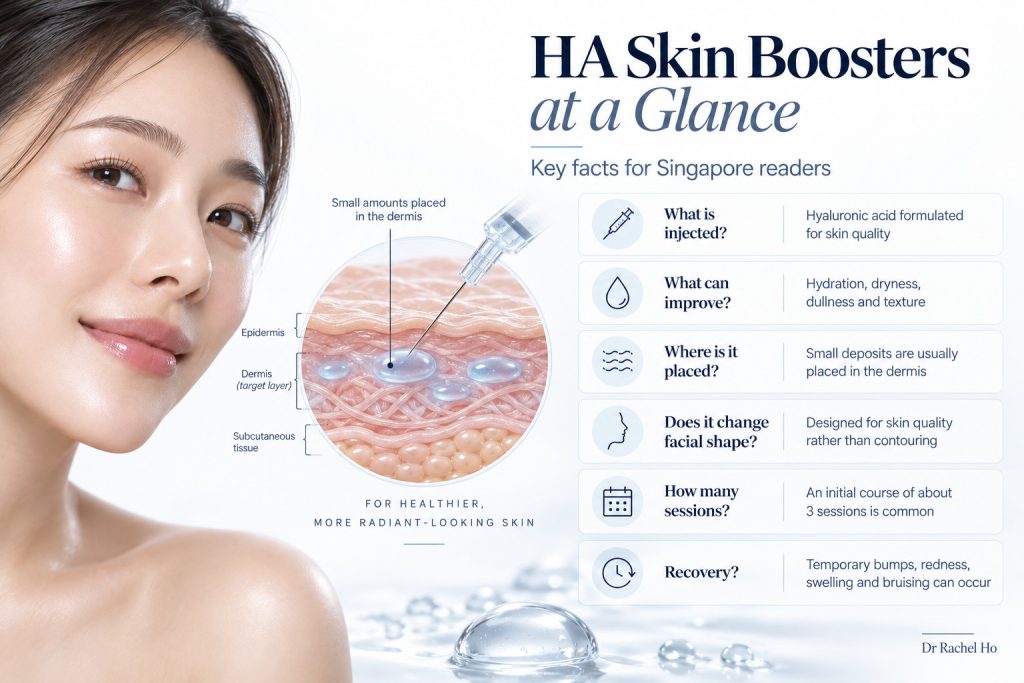
Hyaluronic acid skin boosters place small deposits within the skin to improve hydration and selected aspects of skin quality. Their main purpose is skin quality improvement rather than the facial contouring associated with conventional dermal fillers.
Hyaluronic acid skin boosters at a glance
FAQ on skin boosters
| Question about skin booster treatments | What to know |
|---|---|
| What is injected in hyaluronic acid skin boosters? | Hyaluronic acid, or HA, in a skin injectable formulation for improving skin quality¹,² |
| What can hyaluronic acid skin boosters improve? | Hydration, dryness, dullness, smoother texture, firmness and elasticity²,⁵,⁶. |
| Where are hyaluronic acid skin boosters placed? | Small deposits of hyaluronic acid typically placed within the dermis, with the technique adapted to the specific product and treatment area¹,⁷. |
| Do hyaluronic acid skin boosters change facial shape? | Hyaluronic acid skin booster injections aim to improve skin quality rather than provide the contouring associated with conventional dermal fillers¹,². |
| How many sessions of hyaluronic acid skin boosters are needed? | Several studied protocols of hyaluronic acid skin boosters use an initial course of three sessions, although the schedule varies²,⁵,⁶. |
| How long do results of hyaluronic acid skin boosters last? | Benefits lasting six months have been reported for a particular noncrosslinked HA gel skin boosters⁵. |
| What recovery should I expect from hyaluronic acid skin boosters? | Temporary injection bumps, redness, swelling, tenderness and bruising can occur after skin booster injections¹,⁸. |
| Is maintenance needed for hyaluronic acid skin boosters? | An expert consensus for stabilised HA recommends maintenance at four to six month intervals, adjusted to the treatment plan². |
What are HA skin boosters?
Hyaluronic acid is a naturally occurring component of the skin that binds water and contributes to its supporting structure³. Injectable HA formulations include noncrosslinked gels and stabilised or crosslinked gels, whose physical properties and persistence differ across these products¹,³.
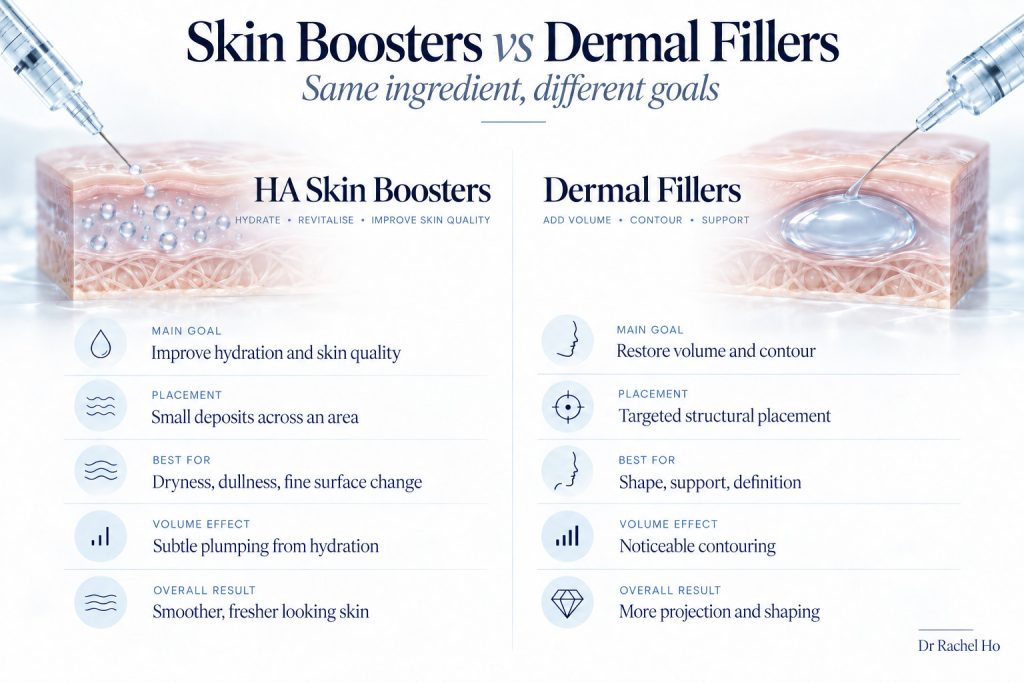
HA skin boosters and conventional HA fillers can share an ingredient while serving different purposes: improving skin quality or restoring targeted volume and contour. Some plumping can accompany hydration, so the distinction concerns the intended result rather than an absolute absence of volume change.
How are skin boosters different from dermal fillers?
Both skin boosters and dermal filler treatments can contain HA, but differences in the rheology and composition in these respective products give these products different effects and benefits¹,². Conventional dermal fillers restore volume (e.g. chin, cheek, tear trough) or contour specific features (e.g. lips and nose), whereas skin boosters distribute small amounts across an area to improve hydration and skin quality¹,².
For a more detailed explanation of injectable treatment categories, read my guide to skin boosters and collagen biostimulators.
Do skin boosters work? What the studies on skin boosters show
Hydration and reduced dull appearance after hyaluronic acid skin boosters
A randomised trial published in 2026 enrolled 420 Chinese participants to evaluate a noncrosslinked HA gel for facial skin rejuvenation⁵. Participants receiving treatment had three facial injection of HA skin boosters sessions at three week intervals, while the control group received no intervention⁵.
Results from the 420 participant HA trial
Results from the 420 participant HA trial
| Study outcome | HA treatment group | Untreated control group |
|---|---|---|
| Participants meeting the Global Aesthetic Improvement Scale response criteria | 90.63% | 3.65% |
| Participants meeting the combined dryness and dullness improvement criteria | 83.20% | 3.65% |
Note that the results of this study on hyaluronic acid skin boosters describe the proportion of participants who met the study’s improvement criteria, rather than the percentage by which their skin improved⁵. The researchers also reported improved hydration and elasticity, with benefits sustained over six months and mild, transient adverse events⁵.
The study on hyaluronic acid skin boosters provides useful evidence for the tested formulation, particularly for dryness and dullness⁵. Its untreated comparison group means the findings establish benefit over no intervention rather than superiority over another skin booster⁵.
Firmness and skin texture after hyaluronic acid skin boosters
A smaller randomised study involving 15 participants assessed HA skin boosters combined with glycerol, comparing one treatment with three treatments given four weeks apart⁶. Both groups showed improved skin firmness, while repeated treatment also improved skin density and its response to repeated mechanical deformation⁶.
Collagen and changes within the skin after hyaluronic acid skin boosters
An eight participant study compared repeated injections of a small particle crosslinked HA gel with saline in photoaged forearm skin⁴. Improvements in appearance and measured skin function began at eight weeks, while biopsies at 12 and 24 weeks showed increased collagen deposition, fibroblast proliferation and epidermal thickness⁴.
The researchers also identified increased activity in genes involved in extracellular matrix production and growth factor signalling⁴. These findings support a biological effect beyond water binding, although the study examined forearm skin and not the face⁴.
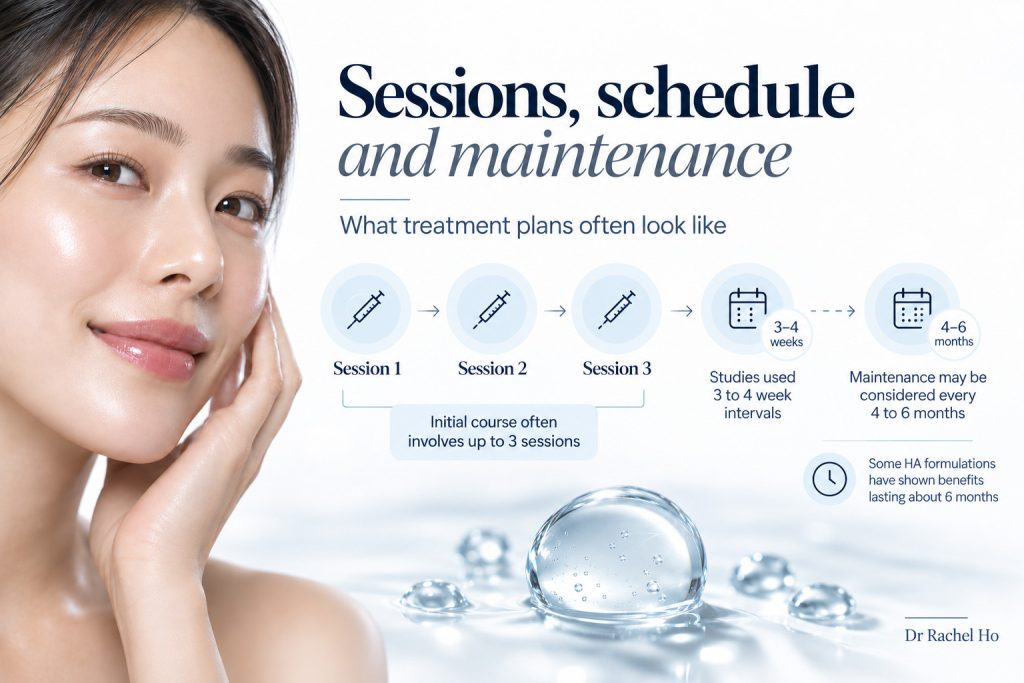
Several studied HA protocols use three initial sessions, with treatments spaced three or four weeks apart. An expert consensus for stabilised HA recommends maintenance at four to six month intervals, with the treatment plan adjusted to the formulation and individual response.
How many sessions of skin booster are typically needed?
Recommended skin booster protocols and treatment schedules vary for different formulations and intended outcomes²,⁵,⁶. An expert panel consensus on nonanimal stabilised HA skin boosters recommends an initial course of up to three sessions, followed by maintenance at four to six month intervals². I also use this expert consensus on hyaluronic acid skin boosters to guide my patients in the clinic.
How long do skin booster results last?
Clinical research has documented benefits lasting six months for a particular noncrosslinked HA gel⁵. The stabilised HA expert consensus I quoted early also describes progressive improvement over 12 months when treatment is repeated at four to six month intervals².

What happens during skin booster injections?
In my clinic, I first begin with patient assessment during the consultation. Before the treatment begins, treatment area is cleansed before the injections. Topical numbing cream is also applied before the injections are administered to improve my patient’s experience.
Hyaluronic acid skin boosters involve precise placement of the hyaluronic acid gel into the dermis. These injections can be done using a needle, microinjector or with a cannula, depending on the indication and hyaluronic acid skin booster product. For information about assessment and the procedure, please refer to my clinic’s hyaluronic acid skinbooster treatment page.
Are you suitable for HA skin boosters?
HA skin boosters can be considered for patients who have dryness, dullness and changes in surface skin quality e.g. crepiness²,⁵. When evaluating patients, I also check in their medical history for previous injectable treatments, allergies, medicines and any active inflammation or infection in the treatment area that could influence safety and recovery¹⁰.
Downtime and side effects of skin boosters
Small raised bumps, redness, swelling, tenderness and bruising can occur after skin booster injections¹,⁸. These symptoms typically last for a few days to one week
How do HA skin boosters compare with other injectable treatments?
The category of skin boosters has evolved in the last decade to include different active ingredients besides its original hyaluronic acid form¹. Below is a guide to different skin booster types available in Singapore. My clinic’s comparison of skin booster treatments also explains how different skin booster options in Singapore are used to treat different individual skin concerns.
Rejuran, polynucleotides and PDRN
Rejuran is a polynucleotide, or PN, injectable rather than a conventional HA skin booster¹. PN and polydeoxyribonucleotide, known as PDRN, are related DNA derived materials with different molecular characteristics, so their names and clinical evidence should be distinguished¹.
A systematic review identified nine studies involving 219 patients and found encouraging results¹¹. The studies were of low to moderate quality, and differences in treatment methods limit firm conclusions about effectiveness¹¹.For a more detailed explanation of this treatment, please read my Rejuran review and my clinic’s polynucleotide skin booster guide.
PDLLA skin boosters
PDLLA skin boosters contain biodegradable poly D,L lactic acid, sometimes combined with noncrosslinked HA, and have been studied for skin rejuvenation and collagen production¹². A preliminary study involving 16 participants reported improvements in several clinical skin measures, with increased collagen and elastic fibres in the biopsies examined¹².
My clinic’s PDLLA skin booster article discusses the treatment and its evidence in more detail.
Hybrid cooperative complex injectable moisturiser
Hybrid cooperative complex injectable moisturisers combine high and low molecular weight HA in a formulation with a distinct treatment protocol consisting of standardised injection points¹³. A 64 participant study reported improvements in clinical and instrumental skin measurements over 16 weeks, although it did not include an untreated comparison group¹³.
Hybrid cooperative complex injectable moisturiser shares HA as a common ingredient with conventional skin boosters, although the formulation, rheology and delivery differ¹³. I’ve shared my personal experience with hybrid cooperative complex injectable moisturisers in my review. My clinic’s hybrid cooperative complex injectable moisturiser guide shares more treatment details for patients.
View this post on Instagram
ECM skin boosters
Extracellular matrix or ECM skin boosters use particulated human acellular dermal matrix, a processed tissue derived material ¹⁴. A 2026 randomised study involving 20 participants compared one such preparation with HA on opposite sides of the face¹⁴. ECM skin boosters are a growing trend in Singapore and Korea for patients exploring treatments for acne scars, enlarged pores, smoother skin and under eye rejuvenation. My guide to ECM skin boosters explains the research behind ECM skin boosters and my clinic’s ECM skin booster treatment guide will share more treatment details.
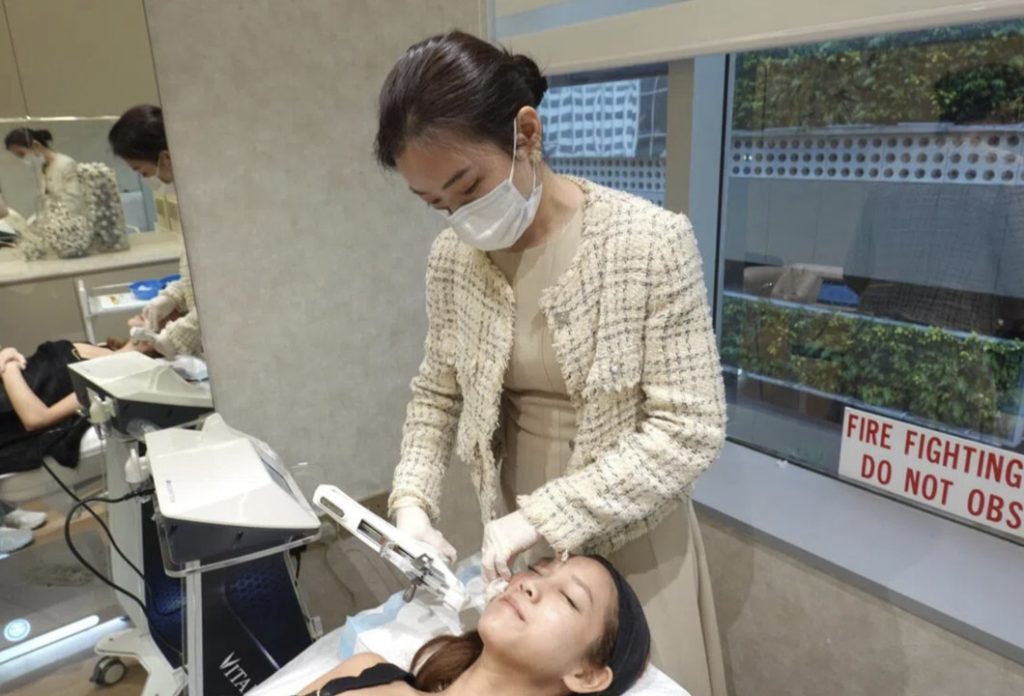
Dr Rachel Ho’s takeaway and conclusion on skin booster treatments in Singapore
HA skin boosters are evidence based improving hydration and skin quality, with results influenced by the formulation, delivery or injection technique treatment course²,⁵,⁶. It can be confusing with the wide range of skin booster treatments available in Singapore. My advice to patients is to let your doctor know your primary concerns and results that you hope to achieve so that we can help you to select a skin booster that is best aligned with your goals.
References
- Rho NK, Kim HS, Kim SY, Lee W. Injectable Skin Boosters in Aging Skin Rejuvenation: A Current Overview. Archives of Plastic Surgery. 2024;51(6):528 to 541. PMID: 39544509.
- Belmontesi M, De Angelis F, Di Gregorio C, et al. Injectable Nonanimal Stabilized Hyaluronic Acid as a Skin Quality Booster: An Expert Panel Consensus. Journal of Drugs in Dermatology. 2018;17(1):83 to 88. PMID: 29320592.
- Bukhari SNA, Roswandi NL, Waqas M, et al. Hyaluronic acid, a promising skin rejuvenating biomedicine: A review of recent updates and preclinical and clinical investigations on cosmetic and nutricosmetic effects. International Journal of Biological Macromolecules. 2018. doi:10.1016/j.ijbiomac.2018.09.188.
- Hsieh DM, Bi X, Zhong S, Wu Y. In Vivo Investigation of the Biostimulatory and Rejuvenating Effects of Small Particle Crosslinked Hyaluronic Acid Injections in Photoaged Human Skin. Aesthetic Surgery Journal. 2023;43(5):595 to 608. doi:10.1093/asj/sjac333.
- Liao Z, Hong W, Wang S, et al. Efficacy and Safety of Sodium Hyaluronate Gel for Facial Skin Rejuvenation. Dermatologic Surgery. 2026;52(8):776 to 782. doi:10.1097/DSS.0000000000005042.
- Kleine Börger L, Hofmann M, Kerscher M. Microinjections with hyaluronic acid in combination with glycerol: How do they influence biophysical viscoelastic skin properties? Skin Research and Technology. 2022;28(4):633 to 642. doi:10.1111/srt.13167.
- Yi KH, Lee B, Kim MJ, et al. Observation on cadavers and through ultrasonography using a 2 mm needle length for intradermal injections. Skin Research and Technology. 2023;29(11):e13529. doi:10.1111/srt.13529
- Cox SE, Adigun CG. Complications of injectable fillers and neurotoxins. Dermatologic Therapy. 2011;24(6):524 to 536. PMID: 22515668.
- Cruz VMS, Sousa Neto SS, Pedroso CM, et al. Adverse Events in Nonsurgical Facial Aesthetic Procedures: A Systematic Review and Meta Analysis. Oral Diseases. 2026;32(2):384 to 394. doi:10.1111/odi.70109.
- Goodman GJ, Liew S, Callan P, Hart S. Facial aesthetic injections in clinical practice: Pretreatment and posttreatment consensus recommendations to minimise adverse outcomes. Australasian Journal of Dermatology. 2020;61(3):217 to 225. doi:10.1111/ajd.13273.
- Lampridou S, Bassett S, Cavallini M, Christopoulos G. The Effectiveness of Polynucleotides in Esthetic Medicine: A Systematic Review. Journal of Cosmetic Dermatology. 2025;24(2):e16721. doi:10.1111/jocd.16721.
- Seo SB, Park H, Jo JY, Ryu HJ. Skin rejuvenation effect of the combined PDLLA and noncrosslinked hyaluronic acid: A preliminary study. Journal of Cosmetic Dermatology. 2024;23(3):794 to 802. doi:10.1111/jocd.16085.
- Sparavigna A, Tenconi B. Efficacy and tolerance of an injectable medical device containing stable hybrid cooperative complexes of high and low molecular weight hyaluronic acid: A monocentric 16 weeks open label evaluation. Clinical, Cosmetic and Investigational Dermatology. 2016;9:297 to 305. doi:10.2147/CCID.S114450.
- Lee YI, Chau NH, Nguyen NH, et al. Injectable Particulated Human Acellular Dermal Matrix Booster for Skin Restoration: An Integrated Randomized, Split Face, Double Blinded Clinical Trial and Preclinical Study. International Journal of Molecular Sciences. 2026;27(5):2193. doi:10.3390/ijms27052193.

No Comments