


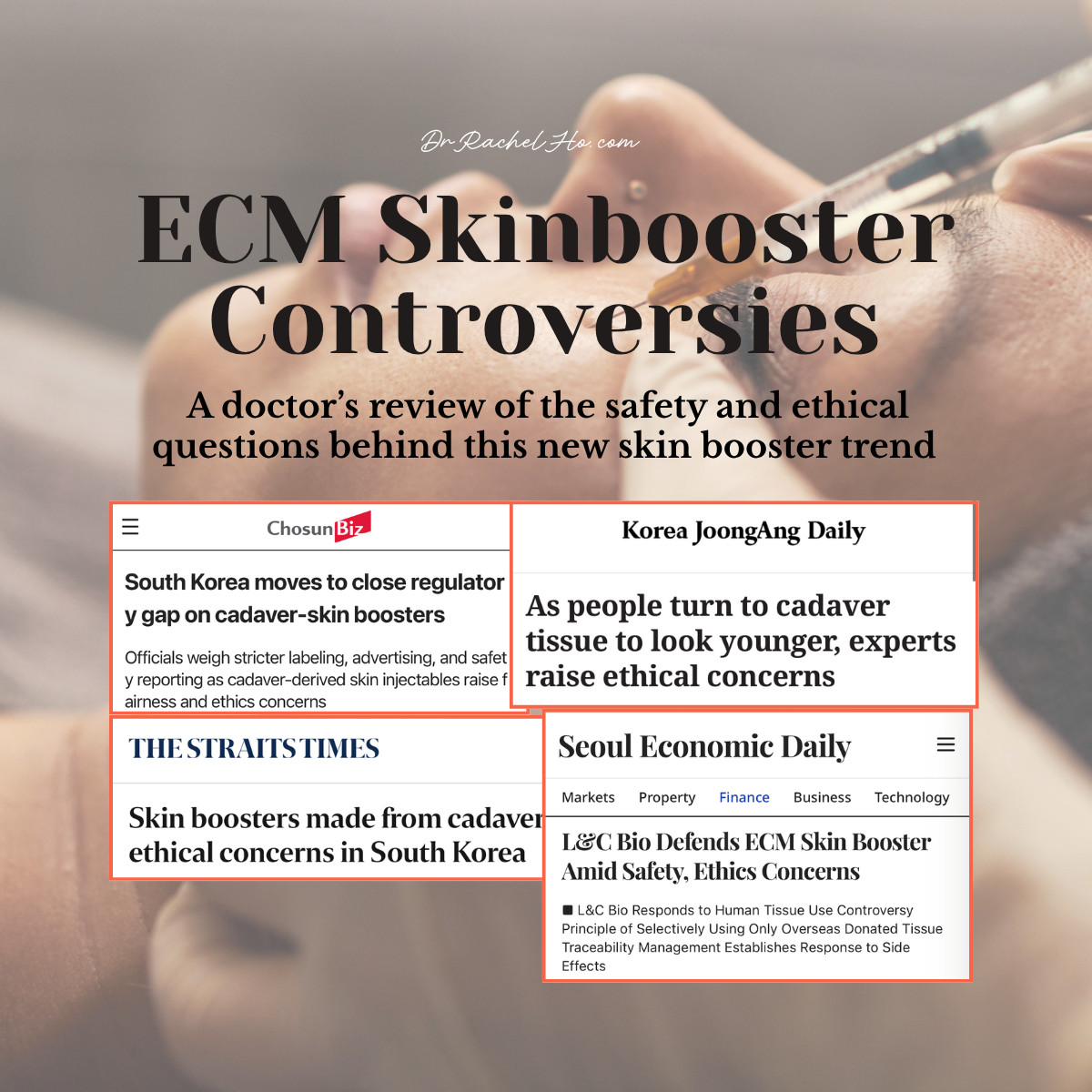
22 May ECM Skin Booster Controversies: Safety, Ethics and What Patients Should Know
ECM skin boosters have become one of the most discussed skin booster trends in Korea and Singapore. As the 5th generation of skin boosters, ECM skin boosters are exciting. By replenishing the dermal matrix that has diminished with age, ECM skin boosters support the skin’s dermal framework to restore strength, elasticity, hydration and repair capacity. I have written a deep dive on the science of ECM skin boosters with a critique of the 2026 clinical study and some insights from Korean dermatologists in a separate blogpost. You can read it in ECM skin boosters Explained: What the Extracellular Matrix Has to Do With Skin Ageing.
As ECM skin boosters continue to gain popularity, it’s important that we do not gloss over the controversies surrounding ECM skin boosters. The ethical and regulatory conversations around ECM skin boosters are complex, and I shall try to help patients understand these issues that they should know before getting this trending treatment.
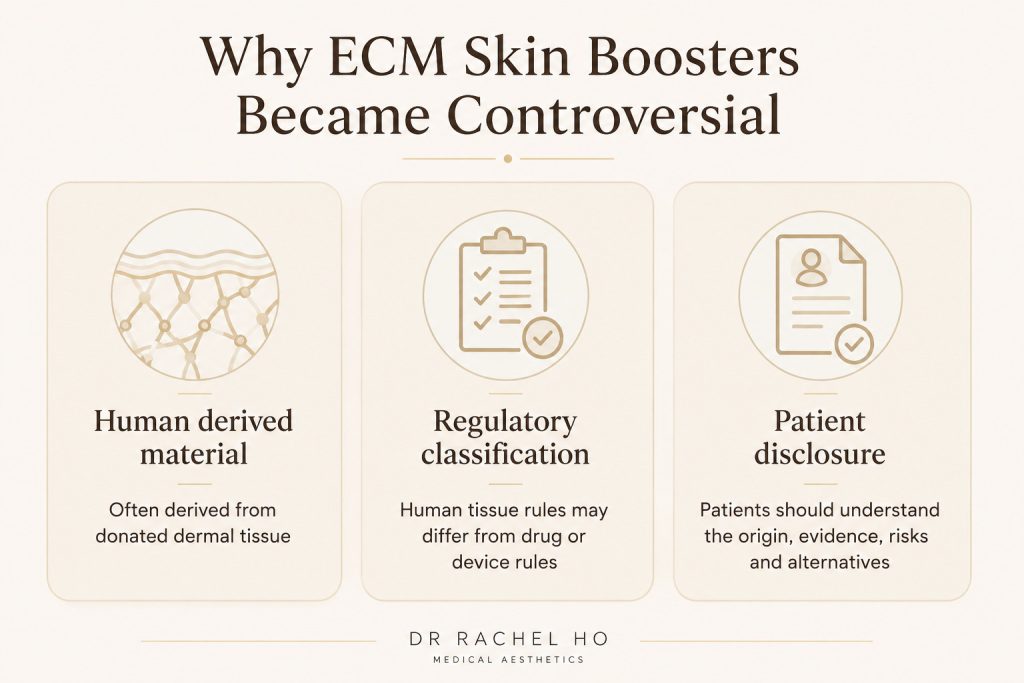
The controversy around ECM skinboosters is mainly about human tissue origin, regulatory classification and informed consent.
Why ECM skin boosters became controversial in Korea
Most of the ECM skin boosters from Korea are derived from donated human skin or cadaver derived dermal tissue that has been processed to remove the cells and leave behind the extracellular matrix material. Hence, ECM skin boosters are also referred to as human acellular dermal matrix. The acellular dermal matrix is processed into a powder; which can be dissolved in fluids like normal saline to be injected into the face.
The first controversy of ECM skin boosters is ethical. People who donate their bodies to science to further science and medical research and education usually do so with altruistic intentions. Donated human tissue also has historically been associated with reconstructive surgery, burn care, breast reconstruction and wound healing. Using donated human tissue based materials for elective cosmetic injections that profits the pharmaceutical or tissue companies and clinics involved undermines this altruistism and critics in Korea have asked whether tissue donated for medical or public interest purposes should be used in commercial aesthetic procedures1.
The second controversy of ECM skin boosters is the regulatory loophole it falls under. In Korea, ECM skin boosters do not fall under regulatory approvals for drugs or medical devices, even though ECM skin boosters are administered like medical devices like skinboosters. Instead, ECM skin boosters are regulated under the Safety and Management of Human Tissue Act rather than standard medical device law2. Because of this categorisation, ECM skin boosters have relatively lesser clinical proof requirements with regards to device safety, risk profiles, and clinical efficacy before entering the market2. This means that ECM skin booster brands can be distributed in the Korean market without clinical trials or product-level approval3.
FYI- as of May 2026, there are two ECM skin booster brands in Singapore that are classified in the Health Science Authority (HSA)’s Cell, Tissue and Gene Therapy Products (CTGTP) Database.
My third concern is about disclosure of use of human derived products, which I believe is part of allowing the patient to make an informed decision. Currently, based on marketing material from aesthetic clinics and content on social media, I do not find that the use of human derived products in ECM skin boosters is conveyed clearly by everyone.
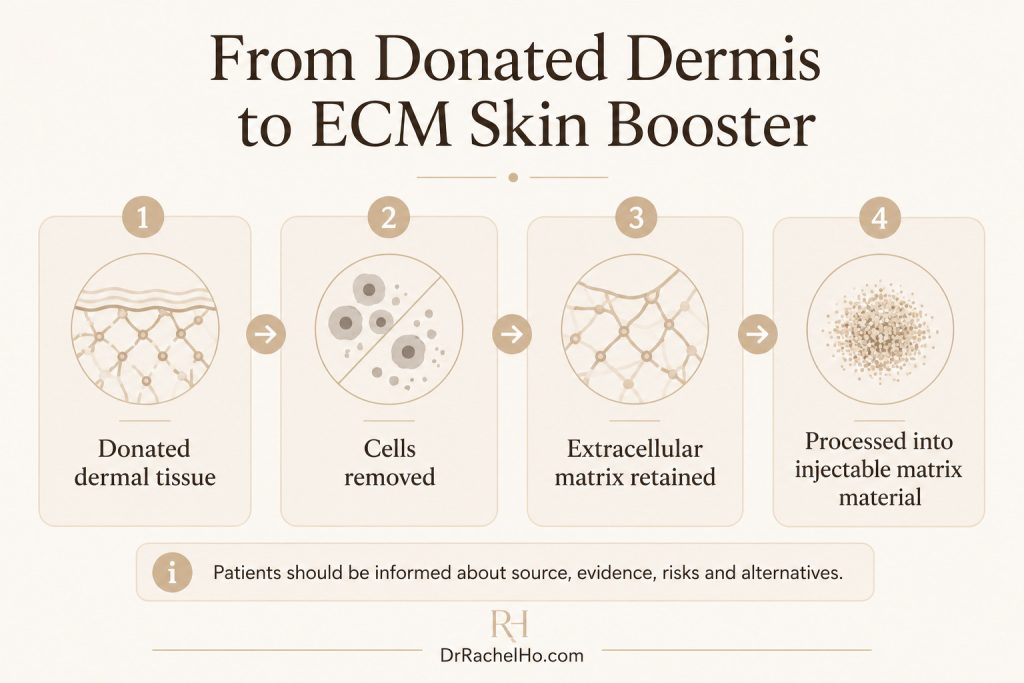
ECM skinboosters are often described as acellular dermal matrix based treatments, which makes clear disclosure important.
My take on the controversies around ECM skin boosters
From a safety standpoint, my greatest concern is whether ECM skin boosters as an injectable aesthetic treatment has sufficient evidence for its safety and efficacy. As explained in ECM skin boosters Explained: What the Extracellular Matrix Has to Do With Skin Ageing, acellular dermal matrices (ADMs) have been used in reconstructive surgeries. However, ECM skin boosters are completely different in form and function from ADMs in surgeries, and so we should not assume that the findings from ADMs can be extrapolated for ECM skin boosters.
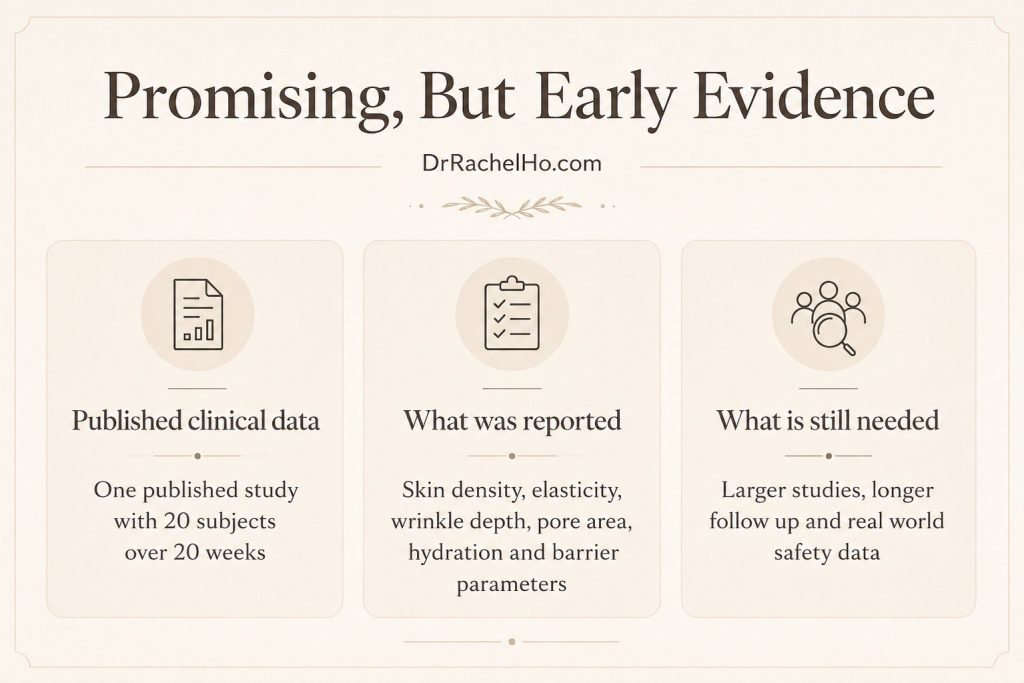
Early ECM skinbooster data is encouraging, but longer term and larger studies are still needed.
As I’ve emphasised before, data on ECM skinboosters is early. There is one published study on ECM skin boosters on 20 subjects over 20 weeks; which should show improvements in skin density, elasticity, wrinkle depth, pore area, hydration and barrier related parameters, with no serious adverse events reported during the trial4. The results of this study on ECM skin boosters are encouraging but it is insufficient for us to assess longer term safety data with a short study duration and number of subjects.
I also would like to see the gap in standards for safety and clinical efficacy for ECM skin boosters addressed. As ECM skin boosters are regulated under the Safety and Management of Human Tissue Act which focuses on biosafety and disease transmission. Because of this loophole, ECM skin boosters do not require the rigorous, multi-year clinical trials normally required for medical devices and drugs. As ECM skin boosters consist of human tissues administered as medical devices like skin boosters, my opinion is that ECM skin boosters should also adhere to the same safety and regulatory standards as medical devices AND human tissues. Both are not mutually exclusive categories, and ECM skin boosters are an overlap of both human tissue and medical devices.
Lastly, we need more transparency about advertising of ECM skinboosters. Soft, vague terminologies to hide the origin of ECM skin boosters and its relatively early history should be made clear. Patients should understand the nature and origin of treatments administered to them, and evidence, uncertainties and alternative treatment options.
ECM Skin Booster Controversies at a Glanc
| Controversy | What it means for patients |
|---|---|
| Human derived material | Patients should understand the origin of the treatment material |
| Donor intent | Cosmetic use of donated tissue raises ethical questions |
| Regulatory classification | Human tissue regulation may differ from drug or medical device approval |
| Evidence gap | Published aesthetic data is still limited |
| Disclosure | Consent should clearly explain source, evidence, uncertainties and alternatives |
How this affects my planning as an aesthetic doctor
I find ECM skin boosters to be promising in treating conditions such as dark eye circles, acne scars, enlarged pores and skin quality. I also recognise that ECM skin boosters are a relatively new treatment that’s lacking in long term and robust studies. In my practice, ECM skin boosters are not treated as routine skin boosters. I routinely counsel my patients about the limitations and their alternative treatment options for them to make an informed choice.
Alternatives to ECM Skin boosters
| Main concern | Alternative treatment options |
|---|---|
| Enlarged pores | Fractional CO2 laser, RF microneedling, PDRN skinboosters |
| Acne scars | Fractional CO2 laser, RF microneedling, PDRN, HA skinboosters, collagen biostimulators |
| Dark eye circles | Dermal fillers, collagen biostimulators |
| Skin quality, wrinkles, crepiness or hydration | HA skinboosters, collagen biostimulators, RF microneedling, PDRN skinboosters |
| Pigment or dullness | Pigment skincare, lasers, peels or pigment focused skinbooster protocols |
If you are uncomfortable with ECM skin boosters, what are your alternative options?
For patients that want to address their dark eye circles, acne scars, enlarged pores and improve their skin quality without ECM skin boosters, these are alternative treatment options: Some patients may prefer to avoid human derived injectable treatments. That is entirely reasonable. There are other treatment options, depending on the concern.
• Enlarged pores: fractional C02 laser, radiofrequency microneedling, PDRN skinboosters
• Acne scars: fractional C02 laser, radiofrequency microneedling, PDRN skinboosters, hyaluronic acid skin boosters, collagen biostimulators
• Dark eye circles: dermal fillers, collagen biostimulators
• Skin quality (wrinkles, sagging, crepiness, hydration): hyaluronic acid skin boosters, collagen biostimulators, radiofrequency microneedling, PDRN skinboosters
Doctor’s takeaway on ECM skin booster controversies
The controversies surrounding ECM skin booster are a reminder that we should exercise caution when adopting new treatments and trends. Just because a product or treatment is trending does not mean that it is necessarily safe or effective.
ECM skin boosters are an interesting category because they consist of human tissues administered like a medical device. Currently, ECM skin boosters are regulated by Safety and Management of Human Tissue Act in Korea, which focuses on biocompatibility and transmission of diseases; and so ECM skin boosters bypass the clinical trials required by medical devices. My take is that ECM skin boosters should be held to higher safety and regulatory standards as both human tissues and medical devices, given the nature of the product and methods of administration.
I would love to hear your take on this- let me know your thoughts!
References
1. Skin boosters made from cadavers raise ethical concerns in South Korea. The Straits Times. 17 April 2026.
2. As people turn to cadaver tissue to look younger, experts raise ethical concerns. Korea JoongAng Daily. 10 May 2026.
3. South Korea moves to close regulatory gap on cadaver-skin boosters. Chosun Biz. 16 April 2026.
4. Injectable Particulated Human Acellular Dermal Matrix Booster for Skin Restoration: An Integrated Randomized, Split Face, Double Blinded Clinical Trial and Preclinical Study. Lee YI, Chau NH, Nguyen NH, Ham S, Baek Y, Kim J, Lee JH. International Journal of Molecular Sciences. 2026. Volume 27, Issue 5.

No Comments