


02 Apr Brightening Skincare for Dull Skin: A Doctor’s Guide
Brightening Skincare for Asian Skin
By Dr Rachel Ho
MBBS (NUS), MMed (Otolaryngology)
Aesthetic doctor and founder of The Skin Longevity Clinic, Singapore
Treating dullness and the quest for brighter, glowy skin are common requests in my clinic. From a technical perspective, dull skin is due to the optics of your skin’s natural light reflection mechanisms and a reflection of the health of your skin barrier. Factors such as dehydration, roughness from comedones and uneven hyperpigmentation can impact skin texture and light reflection.
To restore brightness to dull, tired skin first requires a diagnosis of the underlying physiological causes behind the dullness in each patient. This doctor’s guide will take you through the foundation of brightening skincare routine including targeted active ingredients chosen specifically for your skin’s primary concerns.
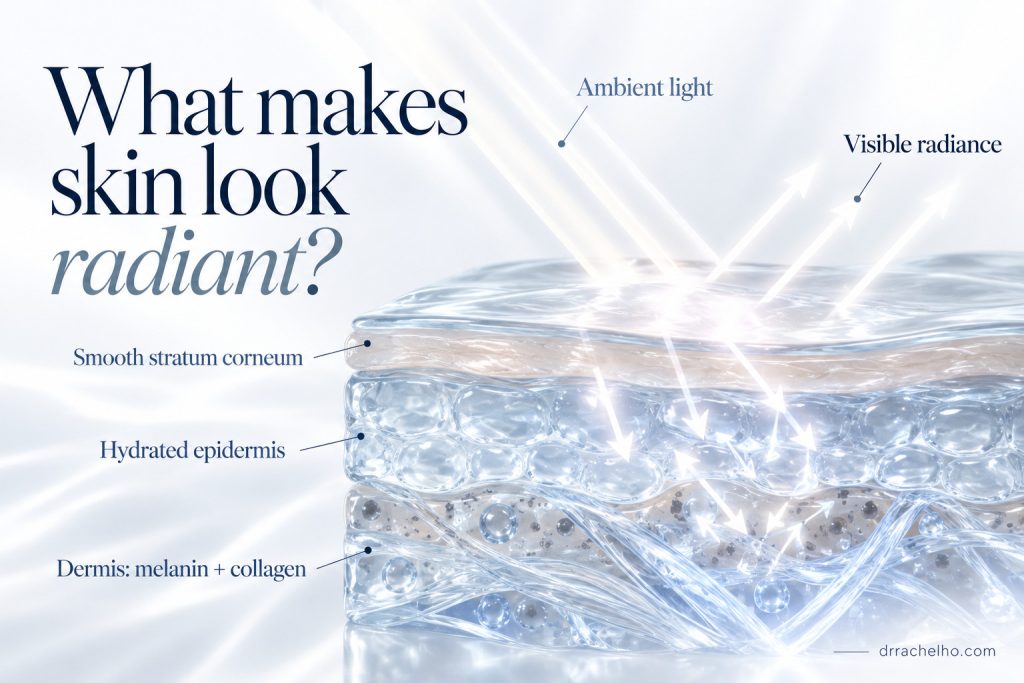
Skin looks radiant when a smooth, hydrated surface reflects light evenly and deeper skin structures scatter light back. Roughness, dehydration and uneven pigment distribution can interrupt this optical effect.
Defining Brighter Skin: The Physics of Reflection
In dermatological science, skin brightness and radiance depend on a dual-reflection mechanism: light bouncing off the smooth surface of the stratum corneum, combined with light scattering back from within the deeper dermal layers¹˒².
Several variables in skin physiology affect this optical brightening process:
- Hydration levels: Adequate water content within the outer epidermal layers reduces light scattering, enhancing skin translucency³.
- Surface texture: Microscopic roughness or irregular desquamation scatters light unevenly, leading to a matte or flat appearance.
- Melanin distribution: Localised clusters of pigment interrupt light transmission, creating perceived dullness and sallow skin tones.
Observational studies in East Asian women have shown that microscopic surface texture plays a significant role in light interaction and perceived glow⁴. Similarly, research in Chinese and Japanese cohorts highlights that uniform pigmentation is strongly correlated with facial radiance⁵. These findings from these studies show that hyperpigmentation and texture are major causes of dullness in Asian skin.
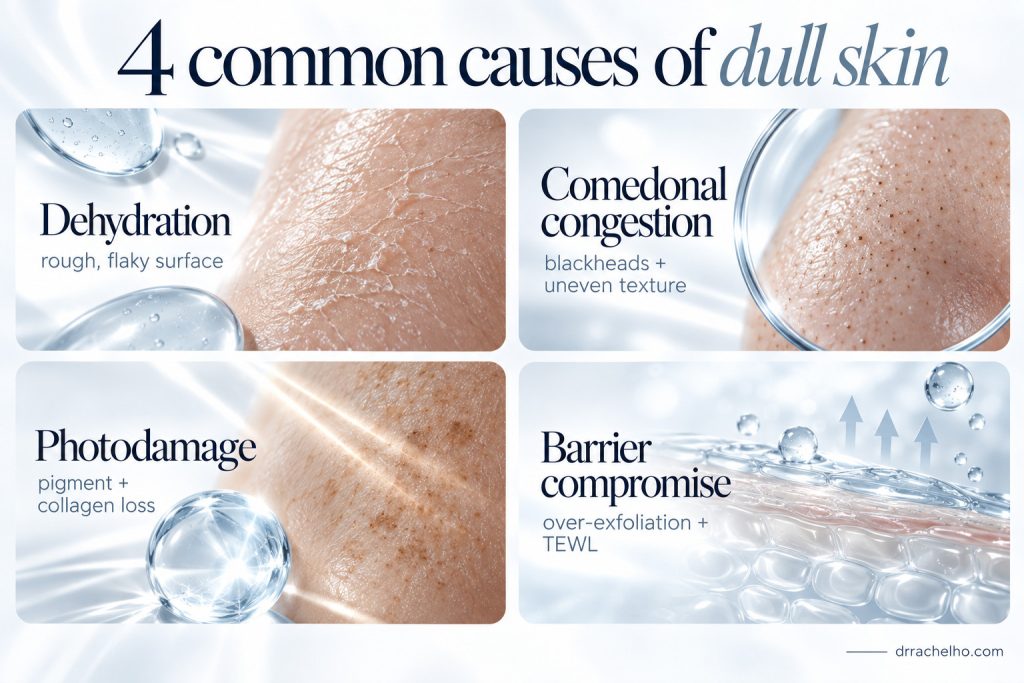
Dull skin is a description rather than a single diagnosis. Dehydration, clogged pores, cumulative photodamage and barrier damage can each reduce visible radiance through different mechanisms.
Common causes of dull skin
1. Dehydration & impaired desquamation
The outermost skin layer is called the stratum corneum, which continually sheds dead cells through enzymatic desquamation⁶. Desquamation is a natural process that relies heavily on water availability⁶. When skin is dehydrated, these enzymes function suboptimally, leading to an accumulation of corneocytes, surface roughness, and increased light scattering³˒⁶. Restoring hydration reduces surface friction and improves light reflection in the skin.
If your skin feels tight or displays fine superficial flaking, please read my clinic guide on Dry vs. Dehydrated Skin to identify whether your barrier requires water-binding humectants or barrier-repairing lipids in skincare.
2. Comedonal congestion & post-inflammatory hyperpigmentation
Comedones (i.e. blackheads and whiteheads) are formed when sebum and keratinized skin cells accumulate within hair follicles⁷. Comedones create micro-convexities or irregularities on the skin surface which disrupt the smooth reflection of light, resulting in dull looking skin.
Comedones are precursors to acne, which can lead to post-inflammatory hyperpigmentation (PIH), which are post acne dark marks. For a skincare guide to treating hyperpigmentation please refer to my guide on Skincare for Lightening Dark Spots.
3. Cumulative photodamage & dermal matrix degradation
Chronic, cumulative ultraviolet (UV) radiation accelerates collagen matrix degradation and disorganises dermal architecture⁸. Although the skin barrier health is crucial for optics of brighter skin, the underlying dermal support can lead to skin creases and loss of elasticity, which lead to loss of skin radiance. A clinical study involving Chinese women found a strong correlation between chronic solar exposure and premature facial aging markers, including uneven pigment distribution and loss of skin translucency.
4. Barrier compromise from over-exfoliation
Our skin barrier has important roles in protecting our skin’s integrity against transepidermal water loss (TEWL) and exposure to toxins and infections⁹. Skin barrier compromise from medical conditions such as eczema as well as excessive retinoids or over exfoliation can compromise epidermal barrier integrity, and increase TEWL, leading to dull skin³˒⁹˒¹⁰. Learn how to strengthen your skin barrier in my guide How to Repair Your Skin Barrier.
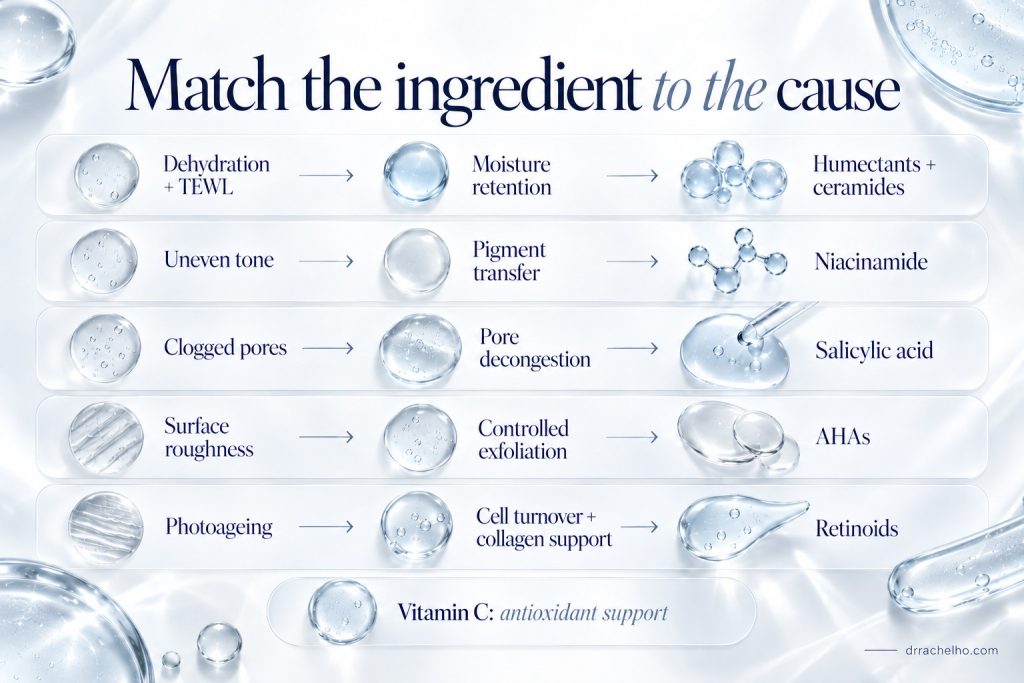
Match the active ingredient to the cause: humectants and ceramides for moisture loss, niacinamide for uneven tone, salicylic acid for congestion, AHAs for roughness and retinoids for photoageing. Vitamin C provides antioxidant support.
Skincare for brightening skin
My recommendation for choosing brightening skincare is to focus on active ingredients that target the causes of your dull skin. Examples of these ingredients include:
Related blogposts:
What are Active Ingredients in Skincare?
How to Layer Skincare Correctly?
1. Humectants & barrier lipids for hydration and moisture
Humectants such as glycerin, hyaluronic acid, and urea attract and hold water within the stratum corneum¹¹. To prevent transepidermal water loss, pair them with emollients like ceramides or occlusive agents like petrolatum, which reinforce the intercellular lipid matrix in the skin barrier. I’ve shared more about hyaluronic acid and ceramide skincare in separate guides Hyaluronic Acid Skincare: How to Use It and Ceramide Skincare for Dry Skin.
Most well formulated moisturisers already contain a mix of humectants, emollients and occlusives¹¹. If you find that your moisturiser still leaves your skin feeling dry and dull, you might want to consider layering a separate hydrating serum.
2. Niacinamide to lighten dark spots and for skin barrier support
Niacinamide (Vitamin B3) lightens dark spots by inhibiting melanosome transfer from melanocytes to keratinocytes¹². This ingredient also supports barrier lipid synthesis to fortify the skin barrier¹³. A 12-week clinical trial evaluating a 5% niacinamide formulation demonstrated measurable improvements in facial sallowness (yellowish discoloration), hyperpigmentation, and fine lines compared to vehicle control¹⁴. I also have a detailed guide on niacinamide skincare and how to incorporate this in your skincare routine in Niacinamide Skincare: A Doctor’s Guide to Using It.
3. Salicylic acid for decongestion of comedones
Salicylic acid is a lipophilic beta-hydroxy acid (BHA) capable of penetrating the lipid-rich pilosebaceous unit to dissolve follicular debris and reduce comedone formation. It is indicated for skin presenting with textural congestion or blackheads¹⁵˒¹⁶. For an in-depth read on salicylic acid and how to choose a product for your concerns, please refer to my guide Salicylic Acid for Acne and Clogged Pores.
4. Alpha hydroxy acids for to lighten hyperpigmentation and surface smoothness
Alpha hydroxy acids (AHAs) such as glycolic acid and lactic acid decrease corneocyte cohesion in the outer stratum corneum, promoting controlled desquamation¹⁷. In clinical practice hydroxy acids are often used in chemical peels to lighten dark spots, smoothen skin texture and brighten skin¹⁷. I’ve shared more about chemical peels in How do Chemical Peels Work and exfoliating acids in A Complete Guide to Acids in Skincare & Chemical Exfoliation.
5. Topical retinoids for cellular turnover & treating signs of ageing.
Retinoids are a class of topical ingredients that regulate epidermal differentiation and promote collagen synthesis¹⁰˒¹⁸. In the clinic, prescription retinoids i.e. retinoic acid is well evidenced in clinical literature supporting to improve skin texture, roughness, fine wrinkles, and hyperpigmentation in photodamaged skin¹⁹. You can purchase retinoids over the counter in skincare, in the form of milder options such as retinol and retinoid esters¹⁰. These milder options are generally well tolerated, and can offer a more gradual approach to addressing skin texture, especially if you have sensitive skin. For a more detailed guide to understanding retinoids, please refer to Retinol vs Retinal vs Tretinoin: Which Should You Use? If you’re new to retinoids, I highly recommend starting with retinol and titrating gradually towards stronger retinoids to reduce your risks of side effects such as retinoid dermatitis. For tips on how to get started on retinol, please refer to Retinol for Skin: A Beginner’s Guide.
Safety Warning: Prescription retinoids and high-strength retinol are contraindicated during pregnancy. For pregnancy safe skincare options, head to my updated blogpost Pregnancy Safe Skincare: A Singapore Doctor’s Guide.
6. Vitamin C for antioxidant defense
Vitamin C in our skin functions as a biological antioxidant against free radical damage and an essential cofactor in collagen biosynthesis²⁰. In skincare, vitamin C exists as two common forms: active L-ascorbic acid and inactive vitamin C derivatives. Active L-ascorbic acid has the most direct biological action on the skin, compared to vitamin C derivatives that have to undergo enzymic conversion in the skin to form L-ascorbic acid eventually to work on the skin. The catch? L-ascorbic acid is more unstable and oxidises more readily than stabilised, inactive vitamin C derivatives. For a deep dive into vitamin C skincare, please refer to my guide Vitamin C Skincare: What is the Best Form?
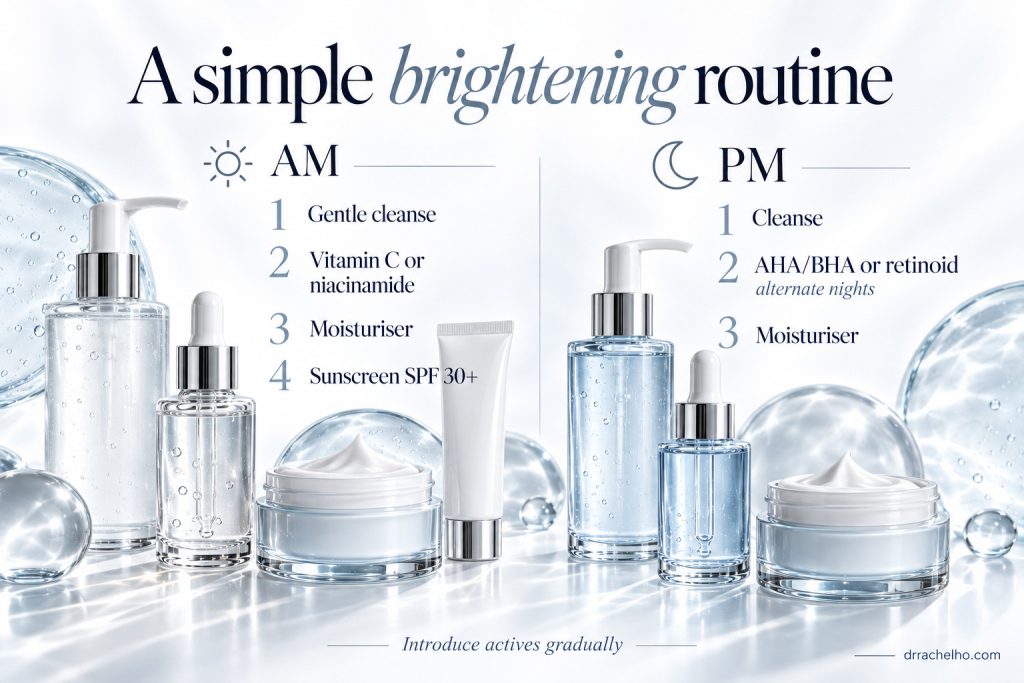
Morning and evening routine for dull skin with cleanser, vitamin C or niacinamide, moisturiser, sunscreen and an alternate-night exfoliant or retinoid.
Structuring a brightening skincare routine
If you’re wondering how to incorporate the gamut of brightening skincare ingredients into your skincare routine, here’s a simplified guide that I use. This guide aims to minimse irritation, while maintaining a consistent foundational core that supports your skin barrier
Brightening skincare schedule example
| Routine | Steps & application | Purpose |
|---|---|---|
| Morning | 1. Cleanse: Gentle, non-stripping cleanser. | Neutralise daytime environmental stressors, maintain hydration, and prevent UV-induced melanogenesis. |
| 2. Treatment: Antioxidant (e.g., Vitamin C) or Niacinamide. | ||
| 3. Moisturise: Barrier-supportive moisturiser | ||
| 4. Sunscreen: Broad-spectrum SPF 30+ (PA+++ or higher). | ||
| Evening | 1. Cleanse: Thorough double-cleanse if wearing water-resistant sunscreen or makeup. | Accelerate cellular turnover, address follicular congestion, and repair barrier function overnight. |
| 2. Targeted active: exfoliant (AHA/BHA) OR retinoid (on alternate evenings) | ||
| 3. Moisturise: Ceramide- or lipid-rich moisturiser |
Dr Rachel Ho’s takeaway is that brighter-looking skin comes from supporting hydration, surface texture and pigment stability over time, without creating chronic irritation or compromising the skin barrier.
Dr Rachel Ho’s takeaway on brighter skin and long term skin longevity
From a skin longevity perspective, achieving a radiant complexion should not come at the expense of chronic inflammation or barrier compromise. True skin health span relies on maintaining structural integrity and preventing avoidable photogenic degradation. I hope that you find these tips I’ve shared to be useful and please feel free to modify the brightening skincare schedule above according to your skin type and tolerance.
For a more comprehensive approach on brightening dull skin, please refer to my clinic guide to Treating Dull Skin.
References
- Matsubara A, Liang Z, Sato Y, Uchikawa K. Analysis of human perception of facial skin radiance by means of image histogram parameters of surface and subsurface reflections from the skin. Skin Res Technol. 2012;18(3):265–271. doi:10.1111/j.1600-0846.2011.00570.x.
- Anderson RR, Parrish JA. The optics of human skin. J Invest Dermatol. 1981;77(1):13–19. doi:10.1111/1523-1747.ep12479191.
- Jiang ZX, DeLaCruz J. Appearance benefits of skin moisturization. Skin Res Technol. 2011;17(1):51–55. doi:10.1111/j.1600-0846.2010.00462.x.
- Omotezako T, Rodrigues M, Eleanor N, et al. Subvisible microscale texture is present on the crista cutis of the skin and interacts with incident light to create a soft and radiant ‘shitsukan’ appearance. Int J Cosmet Sci. 2025;47(4):691–702. doi:10.1111/ics.13064.
- Flament F, Ye C, Mercurio DG, et al. Evaluating the respective weights of some facial signs on the perceived radiance/glow in differently aged women of six countries. Skin Res Technol. 2021;27(6):1116–1127. doi:10.1111/srt.13071.
- Watkinson A, Harding C, Moore A, Coan P. Water modulation of stratum corneum chymotryptic enzyme activity and desquamation. Arch Dermatol Res. 2001;293(9):470–476. doi:10.1007/s004030100257.
- Oon HH, Wong SN, Aw DCW, Cheong WK, Goh CL, Tan HH. Acne Management Guidelines by the Dermatological Society of Singapore. J Clin Aesthet Dermatol. 2019;12(7):34–50. PMID:31531161.
- Fisher GJ, Wang ZQ, Datta SC, Varani J, Kang S, Voorhees JJ. Pathophysiology of premature skin aging induced by ultraviolet light. N Engl J Med. 1997;337(20):1419–1428. doi:10.1056/NEJM199711133372003.
- Rajkumar J, Chandan N, Lio P, Shi V. The Skin Barrier and Moisturization: Function, Disruption, and Mechanisms of Repair. Skin Pharmacol Physiol. 2023;36(4):174–185. doi:10.1159/000534136.
- Mukherjee S, Date A, Patravale V, Korting HC, Roeder A, Weindl G. Retinoids in the treatment of skin aging: an overview of clinical efficacy and safety. Clin Interv Aging. 2006;1(4):327–348. PMID:18046911.
- Sethi A, Kaur T, Malhotra SK, Gambhir ML. Moisturizers: The Slippery Road. Indian J Dermatol. 2016;61(3):279–287. doi:10.4103/0019-5154.182427.
- Hakozaki T, Minwalla L, Zhuang J, et al. The effect of niacinamide on reducing cutaneous pigmentation and suppression of melanosome transfer. Br J Dermatol. 2002;147(1):20–31. doi:10.1046/j.1365-2133.2002.04834.x.
- Tanno O, Ota Y, Kitamura N, Katsube T, Inoue S. Nicotinamide increases biosynthesis of ceramides as well as other stratum corneum lipids to improve the epidermal permeability barrier. Br J Dermatol. 2000;143(3):524–531. doi:10.1111/j.1365-2133.2000.03705.x.
- Bissett DL, Oblong JE, Berge CA. Niacinamide: A B vitamin that improves aging facial skin appearance. Dermatol Surg. 2005;31(7 Pt 2):860–865; discussion 865. doi:10.1111/j.1524-4725.2005.31732.
- Arif T. Salicylic acid as a peeling agent: a comprehensive review. Clin Cosmet Investig Dermatol. 2015;8:455–461. doi:10.2147/CCID.S84765.
- Reynolds RV, Yeung H, Cheng CE, et al. Guidelines of care for the management of acne vulgaris. J Am Acad Dermatol. 2024;90(5):1006.e1–1006.e30. doi:10.1016/j.jaad.2023.12.017.
- Kornhauser A, Coelho SG, Hearing VJ. Applications of hydroxy acids: classification, mechanisms, and photoactivity. Clin Cosmet Investig Dermatol. 2010;3:135–142. doi:10.2147/CCID.S9042.
- Griffiths CE, Russman AN, Majmudar G, Singer RS, Hamilton TA, Voorhees JJ. Restoration of collagen formation in photodamaged human skin by tretinoin (retinoic acid). N Engl J Med. 1993;329(8):530–535. doi:10.1056/NEJM199308193290803.
- Weinstein GD, Nigra TP, Pochi PE, et al. Topical tretinoin for treatment of photodamaged skin: a multicenter study. Arch Dermatol. 1991;127(5):659–665. doi:10.1001/archderm.1991.01680040067005.
- Pullar JM, Carr AC, Vissers MCM. The Roles of Vitamin C in Skin Health. Nutrients. 2017;9(8):866. doi:10.3390/nu9080866.

No Comments