


16 Aug Medicube Sudan Red Scandal: Is the Pink PDRN Cream Safe?
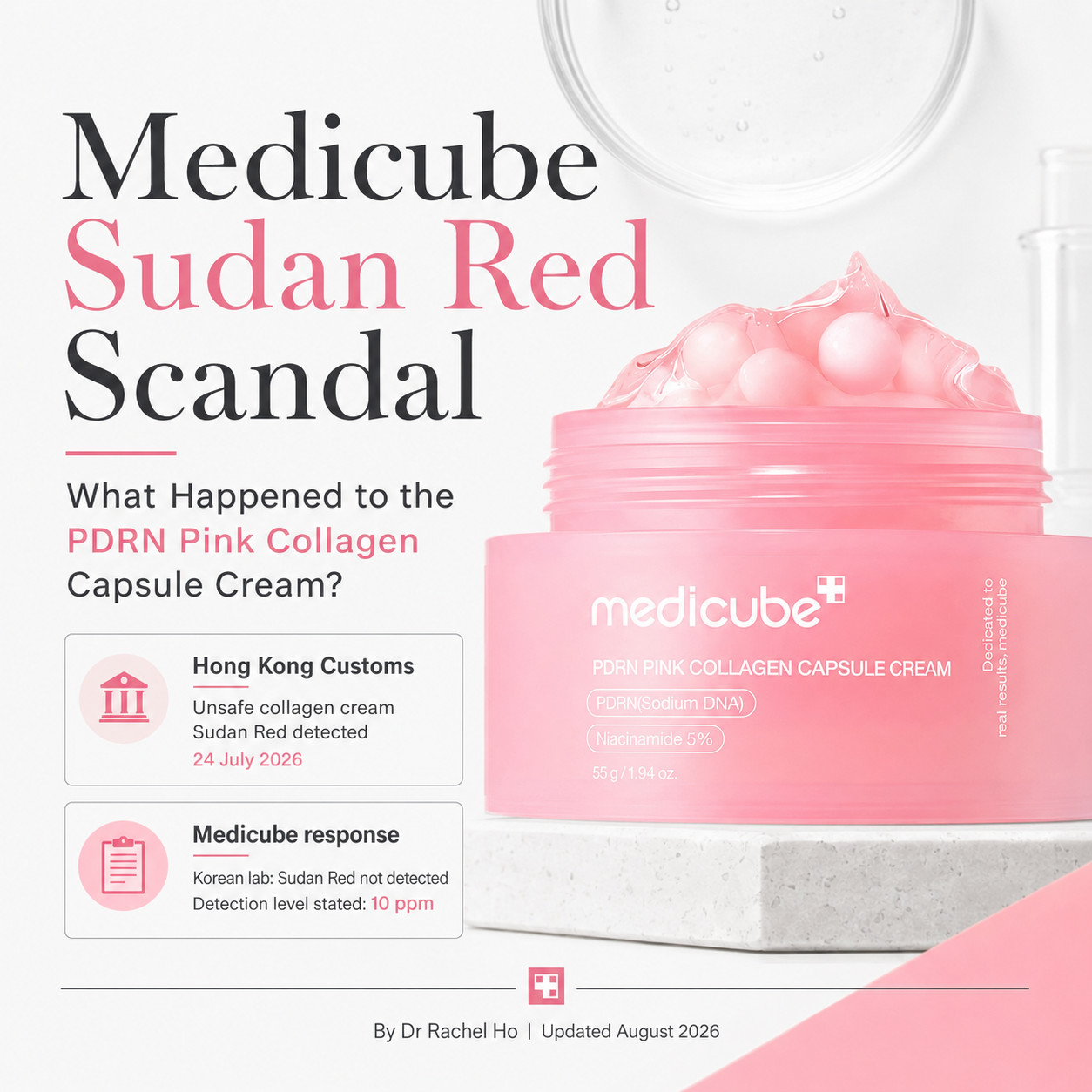
Medicube Sudan Red Scandal: What Happened to the PDRN Pink Collagen Capsule Cream?
By Dr Rachel Ho | Updated October 2026
Singapore update based on HSA findings published 28 August 2026
HSA found minute amounts of Sudan IV in two Medicube PDRN Pink Collagen Capsule Cream samples supplied by Venus Beauty: batches 2E122I.2E117I and 2E191G.2E193G. Recall instructions for those batches were issued on 26 August. Sudan Red dyes were not detected in the samples submitted by APR Singapore and Rirora, and unaffected batches could resume sale.
HSA advised consumers not to continue using affected products and to contact the seller about refunds. It also stated that the minute quantities detected were unlikely to pose serious health risks from previous use.
The Medicube Sudan Red controversy began in late July 2026 after Hong Kong Customs reported that its Government Laboratory detected a prohibited ingredient, Sudan Red, in a Medicube PDRN Pink Collagen Capsule Cream bought from the local market. Hong Kong Customs advised consumers to stop using that Medicube PDRN Pink Collagen Capsule Cream and advised retailers to remove the PDRN cream from shelves¹.
Related blogposts:
Salmon Sperm Facials & PDRN Skincare
Is Vegan or Plant PDRN as effective as Salmon PDRN?
View this post on Instagram
In response, Medicube has disputed the findings from the Hong Kong Government Laboratory. According to Medicube, testing of the Medicube PDRN Pink Collagen Capsule Cream was performed at a laboratory in Korea. These results were shared on Medicube’s social media with the laboratory reporting Sudan Red as not detected- based on its minimum detection level of 10 parts per million (ppm).
Let’s discuss this controversy.
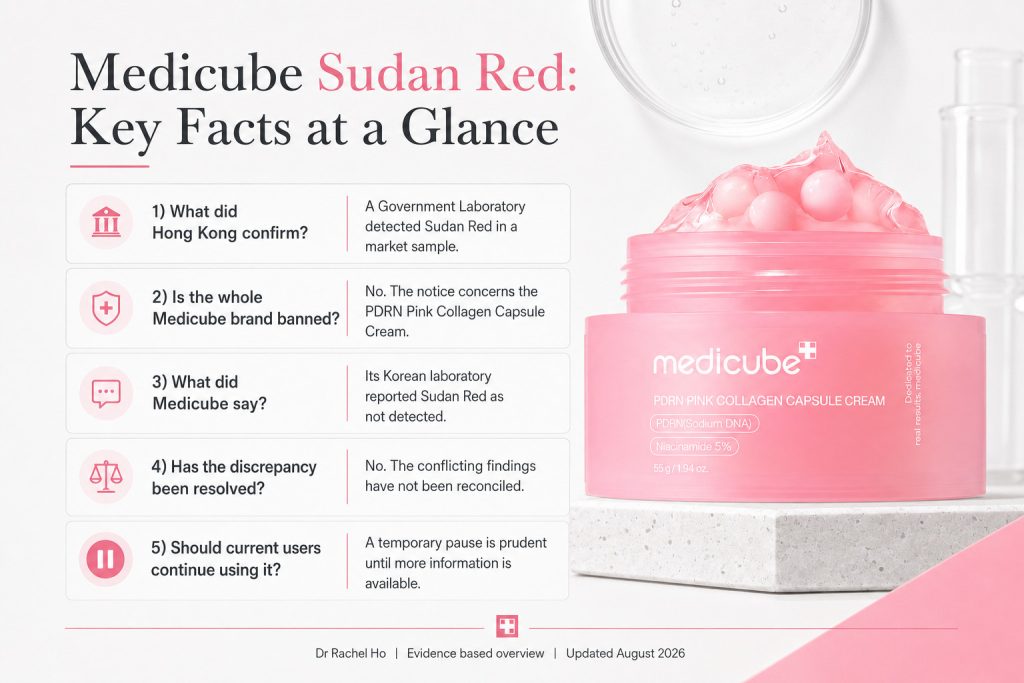
Why Sudan Red is taken seriously by regulators. This graphic explains what Sudan Red is, why it is restricted, and why its presence in a skincare product raises concern.
What exactly did Hong Kong Customs confirm about the Medicube PDRN Pink Collagen Cream?
According to an announcement from the Hong Kong Customs, the Medicube PDRN Pink Collagen Cream was bought from the local market and sent to the Government Laboratory. The laboratory detected Sudan Red in Medicube PDRN Pink Collagen Cream, which is prohibited for use in cosmetics in Hong Kong. In the same announcement, Hong Kong Customs also raised a separate labelling concern because the package did not carry warnings in Chinese, but in English and Korean¹.
Information about the type of Sundan Red, amount detected, batch number or laboratory method(s) used was not provided in the statement from the Hong Kong Customs.
Related blogposts:
5 Beauty Industry Scandals & Controversies
Australian Sunscreen Controversy 2025
Can Asian Sunscreens Be Trusted?
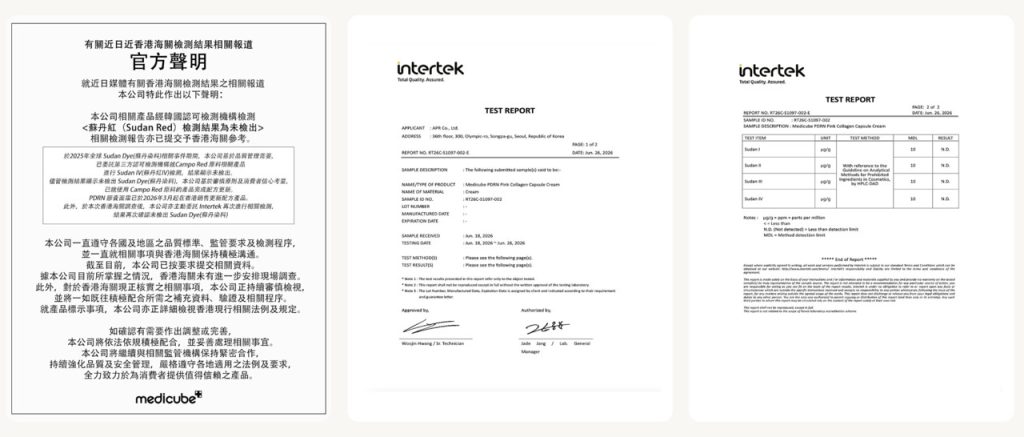
Medicube response to the Sudan Red investigation
Medicube’s response to Sudan Red detection in Medicube PDRN Pink Collagen Cream
Medicube issued a statement through its Hong Kong Instagram platform on 25 July 2026 to say that a third party Korean testing institution found no Sudan Red in the relevant product and that the company had supplied its report and requested documents to Hong Kong Customs².
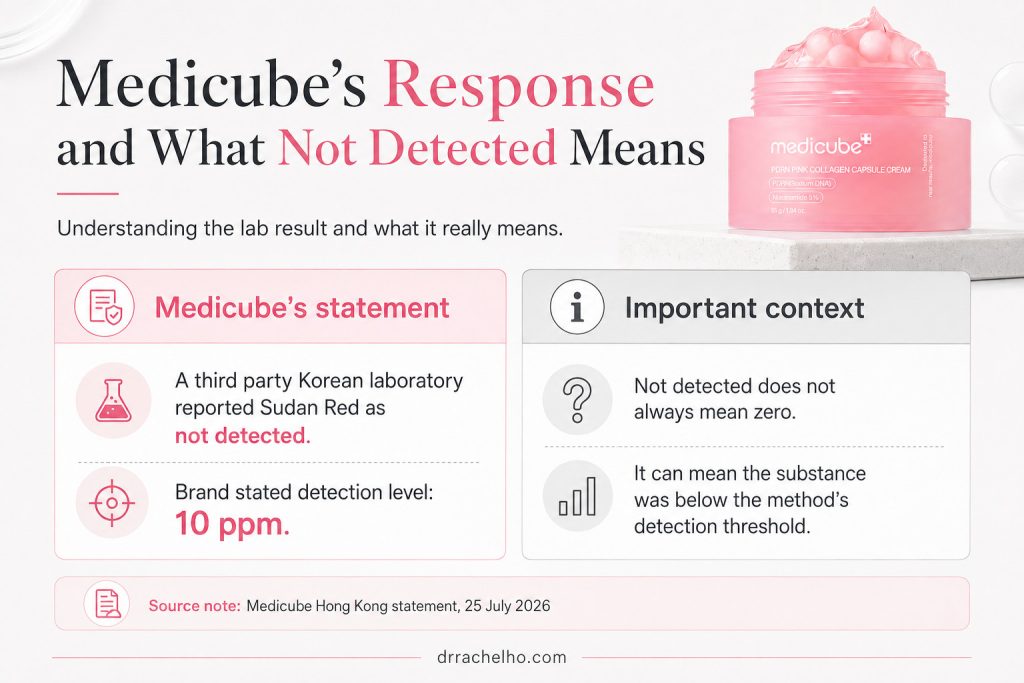
Medicube response at a glance. A summary of the brand’s public position, the reported testing dispute and the key questions still under review.
Note that a result of “not detected” does not necessarily mean zero presence of a substance. Depending on the laboratory and test used, it usually means that the substance was below the detection or reporting limit of the method used. According to the third party Korean laboratory used by Medicube, the detection level was 10 ppm. This means if Sudan Red was present at levels less than 10ppm, the result would still be read as “not detected”.
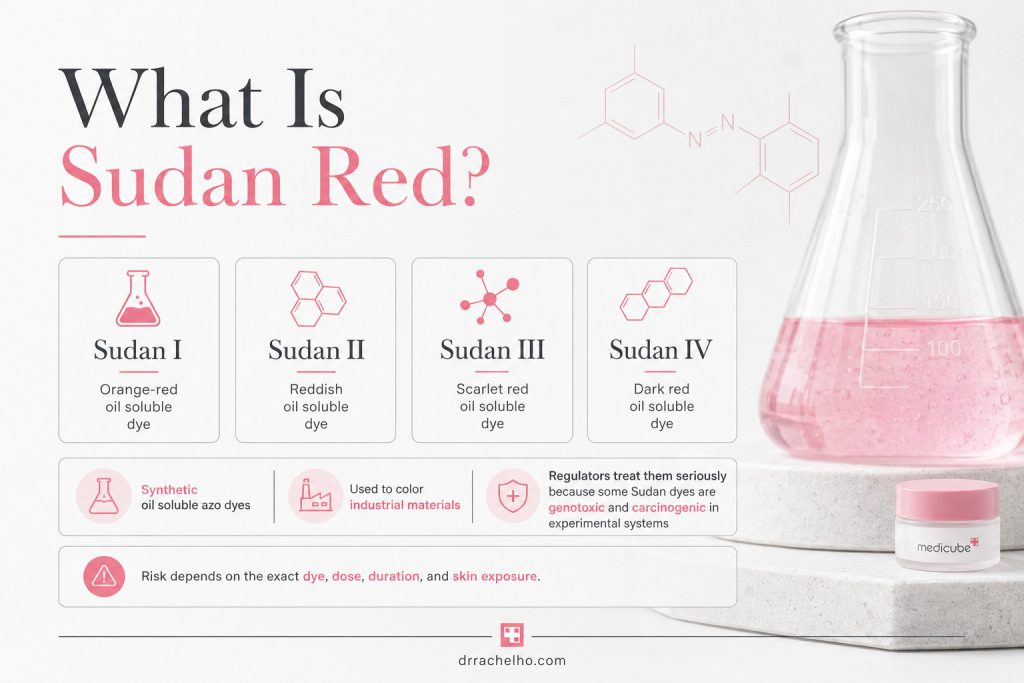
Why Sudan Red is taken seriously by regulators. This graphic explains what Sudan Red is, why it is restricted, and why its presence in a skincare product raises concern.
What is Sudan Red? Why is Sudan Red Toxic?
Sudan dyes are synthetic, oil soluble azo dyes used to colour industrial materials. Sudan Red is a family of four chemicals: Sudan I, II, III and IV. Each of these types of Sudan red have different structures and toxicological profiles. Nonetheless, all 4 types of Sudan Red are classified as genotoxic carcinogens i.e. they can damage DNA and increase the risk of cancer.
The actual risk of these side effects are also dependent on the exact dye, dose, skin exposure, duration and whether the skin was intact.
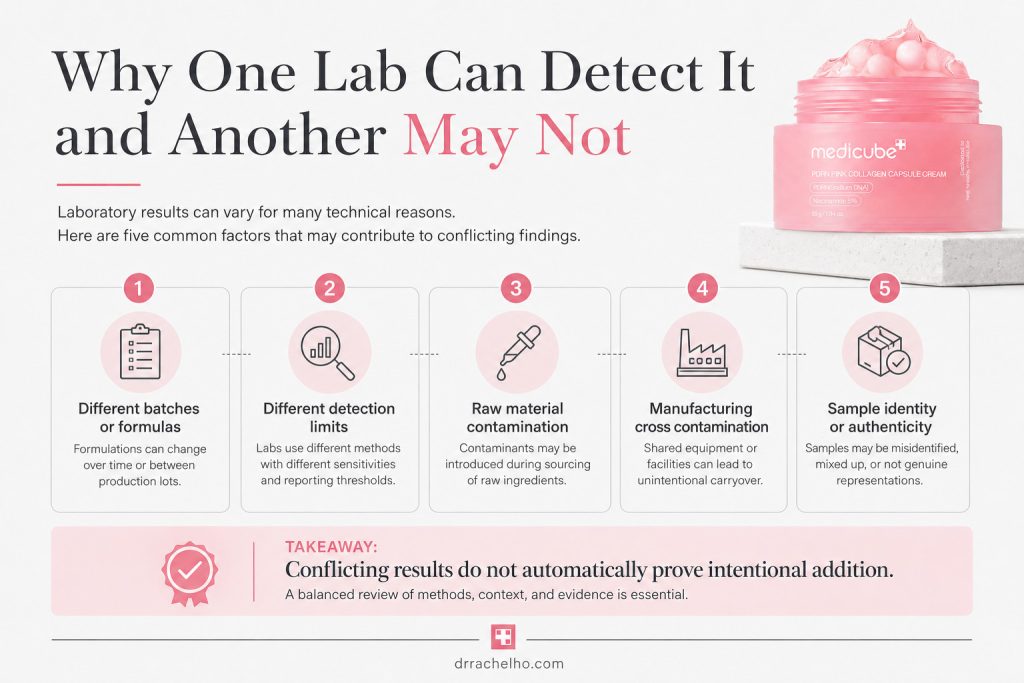
Explainer why sudan red can be detected in cosmetics in different labs
Is it possible for one laboratory to detect Sudan Red while another did not?
It is plausible for different laboratories to have differing results. This can be due to:
Different batches or formulas. If the manufacturing lots, formula versions or regional stock tested are different, brand and regulator samples can vary, leading to different results.
Different detection limits. Sensitivity and detection limits can differ for different methods and laboratories. A less sensitive method can report not detected while a more sensitive method finds a low level.
Raw material contamination or adulteration. Contamination of a product or a component can occur, and affect the results. In 2025, investigations in Taiwan found Sudan IV in the raw material used by several cosmetic companies, showing that a finished brand can inherit a problem from a supplier⁷.
Manufacturing cross contamination. Processes in the manufacturing or supply chain can introduce contamination into products.
Sample identity or authenticity. Grey market stock or counterfeit goods which lack the quality control mechanisms of the authentic stock may also contain toxic substances,
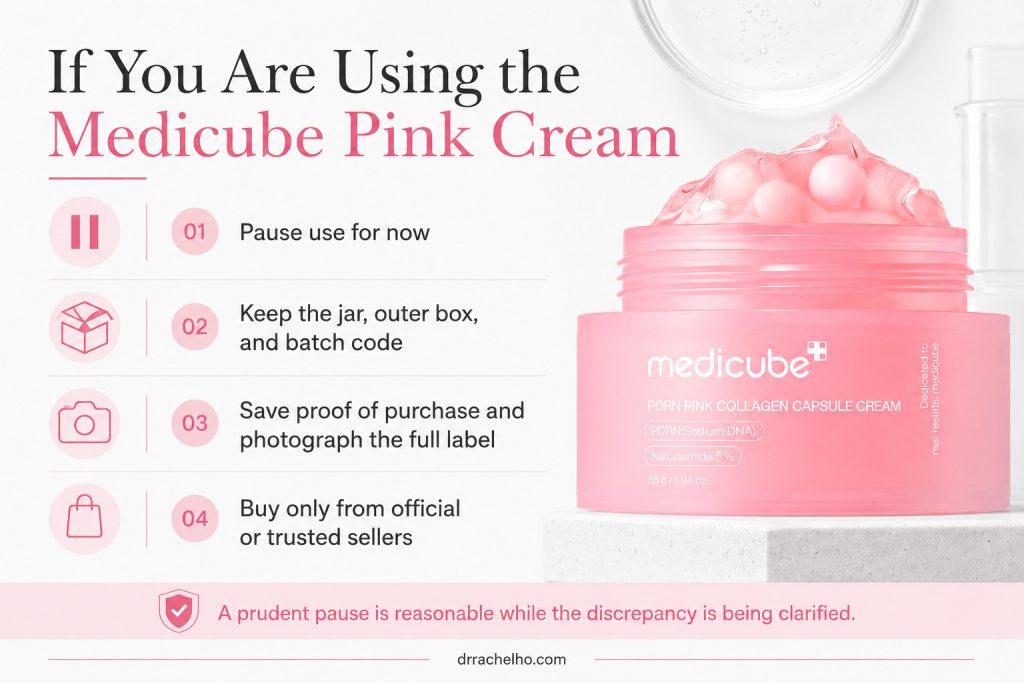
Safety tips for users of Medicube PDRN Pink Collagen Cream
My take as an aesthetic doctor and beauty industry advisor on this Medicube PDRN Pink Collagen Cream Controversy
At the core of this controversy is a dispute between the Hong Kong government and Medicube regarding the detection of a prohibited toxic substance, Sudan Red, in the Medicube PDRN Pink Collagen Cream.
There is currently no evidence that shows that Medicube intentionally added an industrial dye. The detection of a prohibited substance in Medicube products by a government laboratory is likely to be due to contamination and differences in analytical sensitivity in different laboratories. Nonetheless, this does not absolve Medicube of the responsibility of ensuring that its products are safe for consumers. For companies that profit from their products, the onus is on them to ensure that their products are safe and live up to their claims.
What should users in Singapore do if you have Medicube PDRN Pink Collagen Capsule Cream?
Update 8th October 2026:
Minute amounts of Sudan IV in two Medicube PDRN Pink Collagen Capsule Cream samples supplied to Singapore HSA by Venus Beauty: batches 2E122I.2E117I and 2E191G.2E193G. These batches of products were recalled. These findings of Sudan Red are batch specific, and should not be generalised to assume that all batches of Medicube PDRN Pink Collagen Capsule Cream contain Sudan REd.
Dr Rachel Ho’s takeaway on the Medicube PDRN Pink Collagen Cream
The detection of Sudan Red in the Medicube PDRN Pink Collagen Cream from a government laboratory is a serious concern for users, who may end up exposing themselves unnecessarily to a genotoxic and carcinogenic substance. Although Medicube has provided laboratory reports to show that Sudan Red was not detected in their cream, it could be due to their testing being less sensitive than the methods employed by Hong Kong government laboratories.
Ultimately, the onus is on brands to ensure the safety of their products, whether or not the production, sourcing of raw materials and evaluations were done in house or outsourced.
Frequently asked questions about the Medicube PDRN Pink Collagen Cream Sudan Red Controversy in Hong Kong
Is Medicube banned in Singapore or Hongkong?
The current Hong Kong and Singapore HSA recall concerns only the Medicube PDRN Pink Collagen Cream Cream, not all the Medicube skincare or devices.
Does Sudan Red cause cancer?
Some Sudan dyes are genotoxic and carcinogenic in experimental systems and animal studies. Human cancer risk from cosmetic exposure remains uncertain, which is why regulators take a precautionary approach.
Could the positive test come from contamination?
It is possible that contamination or adulteration of a raw material, cross contamination, a batch difference, sample authenticity or analytical method differences have contributed to the detection of Sudan red in Medicube PDRN Pink Collagen Cream.
References
- Hong Kong Customs and Excise Department. Hong Kong Customs Alerts Public to One Model of Unsafe Collagen Cream. 24 July 2026.
- Medicube Hong Kong statement, Medicube Hong Kong Instagram 25 July 2026.
- Medicube. PDRN Pink Collagen Capsule Cream, Official Product Page and Ingredient List. Accessed August 2026.
- Fonovich TM. Sudan Dyes: Are They Dangerous for Human Health? Drug and Chemical Toxicology. 2013. PMID 22947042.
- European Food Safety Authority. Opinion on Illegal Dyes in Food. 2005.
- Centre for Food Safety, Hong Kong. Sudan Dyes in Food. Updated 2017.
- Taiwan Food and Drug Administration. Investigation of Imported Cosmetic Raw Material Containing Sudan IV. 2025.
- Taiwan Food and Drug Administration. Method of Test for Sudan Dyes in Cosmetics. 2025.
- Mothership. HSA working with companies to halt sales & recall Medicube cream suspected to contain prohibited ingredient. 21 August 2026. https://mothership.sg/2026/08/hsa-recall-medicube-pdrn-pink-collagen-capsule-cream/

VERONICA FRANCO
Posted at 16:30h, 29 AugustQué lotes están contaminados?