


08 Nov Volufiline Skincare Review: The Science Behind the ‘Topical Filler’ Trend
Volufiline skincare is in the spotlight thanks to TikTok buzz and a new wave of beauty launches. Notably, The Ordinary has announced Volufiline 92% + Pal-Isoleucine 1%, a targeted “plumping” serum positioned for areas of perceived volume loss, Medicube PDRN Pink Collagen Volume Multi Balm Stick and Sungboon Editor highlights “patented Volufiline™” in its Deep Collagen Power Boosting Cream-in-Serum line.
Related blogposts:
What is Skin Cycling? The Derm Approved TikTok Trend
5 Worst TikTok Skincare & Beauty Trends to Avoid
Is Your Visual Weight High or Low? TikTok’s Glow Up Theory Explained
With the “topical filler” narrative making the rounds, let’s unpack the science behind Volufiline, whether Volufiline skincare truly is as impressive as it’s been marketed to be.

What is Volufiline™ ?
Volufiline™ is the patented trade name for an ingredient originally created by Sederma, a French cosmetics brand. Sederma has now been acquired by Croda International Group.
Volufiline contains a mixture of extracts from Anemarrhena asphodeloides and hydrogenated polyisobutene (the oil-based carrier/emollient)1. The exact composition or percentage of sarsasapogenin in Volufiline™ is not disclosed by Sederma and Croda.
Anemarrhena asphodeloides is a plant native to China and Mongolia; and used in traditional Chinese medicine for treating fevers and lung infections2. The active within Volufiline™ as highlighted by the manufacturer is sarsasapogenin3. In skincare ingredient lists, you’ll find Volufiline™ listed as hydrogenated polyisobutene and Anemarrhena Asphodeloides (Root) Extract.
Volufiline™ in skincare: Benefits and evidence
According to Sederma/Croda, Volufiline™increased the appearance of volume in treated areas over weeks. The Ordinary claims that their Volufiline™ serum targets “volume loss” and “works to plump the appearance of areas prone to showing loss of volume, such as under the eyes and around the cheeks and smile lines”. There are numerous videos of users also claiming that The Ordinary Volufiline 92% + Pal-Isoleucine 1% improved their facial volumes and hollowness of users, akin to dermal fillers without injections.
Related blogposts:
The Ordinary Skincare Review & Ingredients Decoded

Volufiline™: How does it work?
According to Sederma, Volufiline™ works by “encouraging lipid storage and adipocyte differentiation to promote a fuller, more sculpted look”1. The brand points towards its internal studies to support this claim. According to Sederma’s cell studies, Volufiline™increased pre-adipocytes (precursor fat cells) maturity when exposed to the active ingredient in Volufiline™ (sarsasapogenin) by modulation of PPAR-γ–linked pathways3.
The more frequently cited study for Volufiline™ comes from another study conducted by Sederma in human volunteers. In this study, Volufiline 5% was applied to one breast twice daily for 56 days. The treated breast showed an average increase of 2.2% in volume after 56 days after Volufiline 5% application, based on imaging studies3. However, this internal study has been criticised for its wide response variability- afterall, breast size can fluctuate for many reasons including menstrual cycles. The average volume increase was 2.2% which may not translate to a noticeable, visible difference for the average person.
What is the evidence for Volufiline™ in skincare?
Despite the hype around Volufiline™ skincare, published evidence for its benefits in skincare is truly lacking. There is no published data for Volufiline™ skincare in mainstream journals at this point. It seems that Sederma and The Ordinary determined the benefits of Volufiline™ to come from the small internal study on breast tissue (mentioned above), not facial tissue.
The problems with Sederma’s studies on Volufiline™
I am skeptical of Sederma and Medicube, Sungboon Editor and The Ordinary that Volufiline™ skincare can treat areas of volume loss for these reasons:
View this post on Instagram
1. Breast tissue is anatomically different from facial tissue. Facial fat pads are compartmentalised and thinner; periorbital and temple areas are delicate with different vasculature and skin barrier. Extrapolating breast results (i.e. Sederma’s internal study) to under-eyes or cheeks is not evidence-based.
2. Breast size is known to fluctuate, and the study did not account for factors such as hormones or period cycle that could change the breast size.
3. For Volufiline™ to reach its target fat cells, Volufiline™ skincare would have to bypass the skin barrier and dermis to reach the subcutaneous layers in the face. This would be a real challenge for Volufiline™; and if it could truly change the function of fat cells, Volufiline™ would qualify as a drug and cosmetic… and I would be concerned about unwanted fat growth in the face.
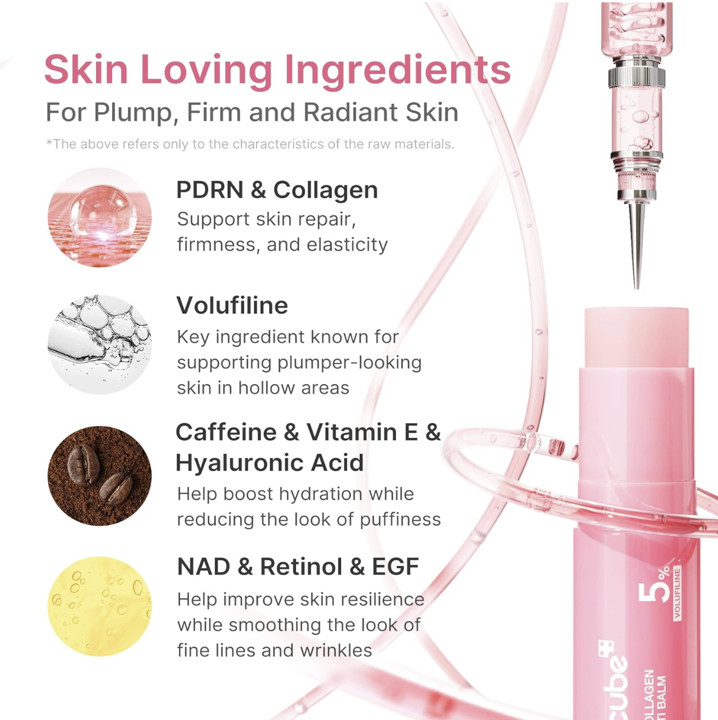
Medicube PDRN Pink Collagen Volume Multi Balm Stick
Can Volufiline™ skincare increase fat growth and improve like dermal fillers?
I am highly doubtful of Volufiline™ skincare’s ability to act like a facial filler. Dermal fillers are medical devices injected into specific planes to restore structure and volume with predictable, measurable outcomes. In contrast, Volufiline™ is a topical cosmetic with limited evidence in non-facial regions.

Why do we lose facial fats and become more hollow?
As part of the physiological ageing processes, our faces tend to lose their structural support and facial volume. Plump faces with even distribution of facial fats are associated with a youthful look. As we age, the many layers of our faces change- the bones resorb, fat pads shrink and redistribute, and overlying skin thins out- causing hollowness, lines and sagging.
Related blogposts:
Are You a Sagger, Sinker or Wrinkler?

How can facial hollowness be treated or delayed?
To restore volume loss and support in the face, in-clinic treatments such as facial fillers in the temples, cheeks and tear trough can reduce the gaunt, hollow look, especially when injected sparingly and tastefully. There are valid concerns about dermal fillers creating an overfilled look, which can make a patient look even older. Hence, it’s important to choose a doctor that shares your sense of aesthetics. I personally prefer a less is more approach with my patients- look lifted, naturally you and not overdone.
Related blogposts:
Fillers Gone Wrong: Telltale Signs of Too Much Fillers
5 Aesthetic Treatments to Avoid
Too Much BTX: Botulinum toxin Gone Wrong

Collagen biostimulators or bioremodelling treatments are another category of regenerative aesthetic treatments that can lift and restore contours when used in isolation or in combination with dermal fillers. Collagen biostimulators induce collagen and elastin production in the skin to improve the structure and lift saggy parts of the face.
Related blogposts:
How to Treat Sagging Skin Without Surgery
Hybrid Cooperative Complex for Structure
Skincare also plays a supportive role to delay collagen loss. Sunscreens and retinoids are evidence based for protecting collagen levels in the skin and reducing signs of ageing. I share my sunscreen and retinoid recommendations in Sunscreen Reviews 2024 and Retinol Serums Review.
Related blogpost:
The Beginner’s Guide to Starting Retinoids
Is Collagen Skincare a Scam?
References
1. https://www.crodabeauty.com/en-gb/products/product/3043-volufiline
2. Pharmacological Activity, Pharmacokinetics, and Toxicity of Timosaponin AIII, a Natural Product Isolated From Anemarrhena asphodeloides Bunge: A Review. Lin et al. Front Pharmacol. 2020 Jun 3;11:764.
Volufiline, Sederma. https://www.totalcurve.com/wp-content/uploads/2018/06/volufiline.pdf

No Comments