



11 Jun TrapTox: Slimmer Shoulders with Trapezius BTX Injections
TrapTox Explained: Results, Risks and Shoulder Function
If you have been keeping an eye on recent aesthetic trends, you have likely come across TrapTox. Often dubbed “Barbie BTX” on social media, this treatment involves strategically injecting botulinum toxin into the upper trapezius muscles. The goal of TrapTox is to relax hyperactive upper back muscle to ease chronic tension and, over time, visibly slim the bulky silhouette between your neck and shoulders.
However, achieving that sculpted look requires more than simply following trends. Your upper trapezius has vital functions of controlling your shoulder blades and stabilising your upper body. When we use neuromodulators like botulinum toxin to reduce muscle bulk, we are fundamentally altering its daily mechanics. A successful TrapTox treatment is therefore an exercise in precision: carefully balancing the aesthetic slimming and tension while preserving your functional anatomy.

TrapTox may reduce prominent trapezius muscle bulk in selected patients. It changes muscle contour rather than bone structure, which is why careful assessment matters.
What can trapezius botulinum toxin change?
The trapezius is a broad muscle extending across the back of the neck and upper back. Its upper, middle and lower portions work with other muscles to support and coordinate shoulder blade movement².
Botulinum toxin, sometimes abbreviated to BTX in Singapore, reduces the release of acetylcholine, the chemical messenger that allows nerves to activate muscles. Reduced contraction can lead to a gradual decrease in muscle bulk, potentially making a prominent shoulder slope less noticeable¹,⁵.
The intended outcome from botulinum toxin injections into the trapezius muscle is a reduction in muscle tension and bulk, rather than a modification of bone width or neck length. Broad shoulders in some individuals may also reflect normal skeletal proportions, surrounding tissues and shoulder position, which is why assessment should establish whether the trapezius is actually the feature someone wants to change²,⁶.

A typical TrapTox consultation includes assessment, marking of the upper trapezius, BTX injections at selected points and review of both contour and shoulder function.
How is TrapTox performed?
Assessment and planning for TrapTox
At my clinic, The Skin Longevity Clinic, the doctor’s consultation begins with a discussion of the desired change, any neck or shoulder symptoms, previous injuries and usual activities. Examination also includes assessment of the muscle prominence, strength symmetry and shoulder movement²,⁶. For a full guide trapezium muscle BTX and shoulder slimming, please refer to Enlarged Shoulders & Trapezius Hypertrophy in Singapore.
Your lifestyle, exercise routine and work requirements are also considered in the assessment. For example, someone who regularly lifts, climbs or works with their arms overhead may have different priorities from someone whose main concern is their appearance.
The BTX injections for TrapTox
After the skin is cleansed, treatment sites are marked over the upper trapezius. A fine needle delivers the prescribed medicine into the muscle at several points, with the distribution and amount determined by your doctor³,⁵.
Published studies have used different injection patterns and treatment amounts. These variations are one reason that an injection count found online should not be treated as a standard prescription for every patient³,⁴.
Aftercare and review for TrapTox
Shortly after BTX injections into the trapezius muscles, there might be mild swelling, tenderness or bruising can occur around the injection sites. In my clinic, patients are given aftercare advice and a follow update for their review.
What does the research on trapezius muscle BTX show?
Research on trapezius BTX treatments
| Study | Study findings | Limitations of study |
|---|---|---|
| 2025 retrospective study involving 22 women | Trapezius measurements decreased during follow up at one, three and six months³. | The study lacked an untreated comparison group. |
| 2026 randomised trial involving 20 women | Two active treatment regimens reduced contour measurements at 12 weeks, without a statistically significant difference between them⁴. | Small sample sizes. |
The evidence for cosmetic benefits such as slimmer trapezius muscles is encouraging, but remains limited by small studies and selected patient groups. Some of the studies also measured from broader claims about comfort, strength or sporting performance³,⁴.
These studies on botulinum injections to the trapezius muscles showed size reduction of trapezius muscle bulk in patients³,⁴.
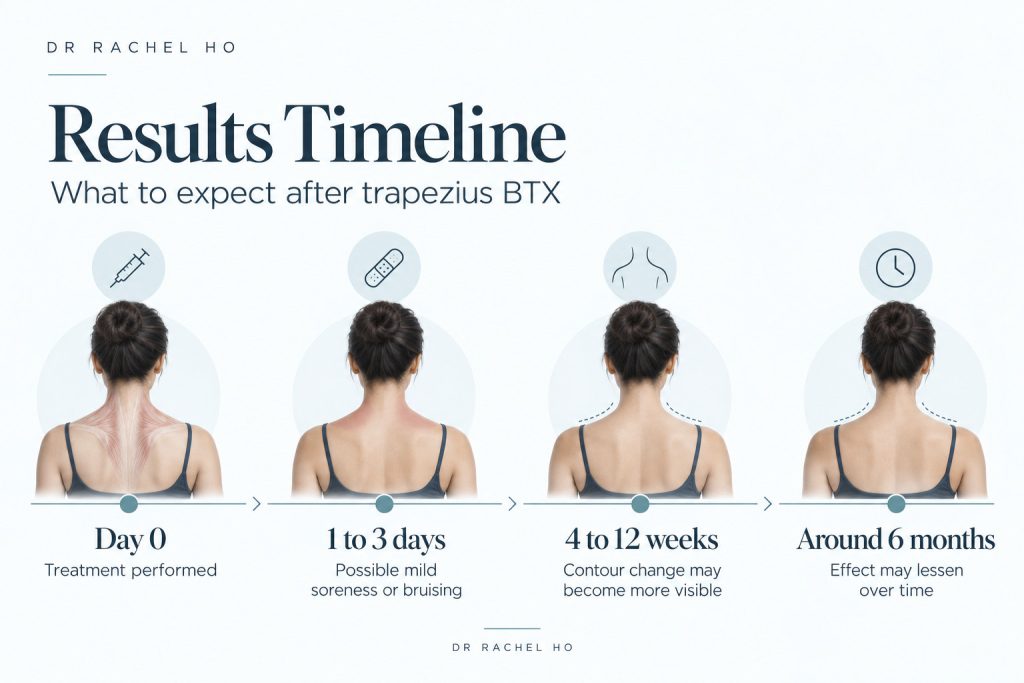
Visible contour change after trapezius BTX is gradual. Early soreness or bruising may occur first, with shape changes developing over the following weeks.
When do results appear on TrapTox, and how long do they last?
Changes in trapezius muscle hyperactivity can precede reduction of the muscle size. Published trapezius studies have assessed changes from around four weeks, with further assessments at approximately three months³,⁵.
In the 2025 study, average muscle thickness was lowest at three months and had partly recovered by six months³.
For more about the effects of BTX, please read how long botulinum toxin lasts. The time expected for results to show for botulinum toxin injections differs for larger muscle groups like the trapezius and gastrocnemius muscles, compared to smaller facial muscle groups timing¹,⁵.

The upper trapezius contributes to shoulder movement and support. Before treatment, it is worth discussing possible weakness, bruising, contour dissatisfaction and how treatment may affect training or overhead work.
Can TrapTox cause shoulder weakness?
Relaxing and reducing trapezius muscle activity is the mechanism of treatment. Weakness of the upper back is a possible side effect. Because the trapezius contributes to shoulder blade control, preserving comfortable function deserves attention alongside the desired appearance¹,².In a 2021 study involving 20 women, one participant reported temporary muscle weakness during the first month⁵.

A trapezius BTX consultation should take your medical history, exercise routine and treatment goals into account. This is especially relevant for athletes, people with overhead work and those with previous shoulder or neck issues.
Who should avoid botulinum toxin injections to the trapezius muscles?
Patients with existing shoulder weakness, previous injuries and demanding physical activities should share their medical and social history with their doctors before proceeding with TrapTox. For individuals who rely on shoulder strength at work or in sport, the possibility of reduced performance may outweigh the cosmetic appearance of a slimmer shoulder muscle².
Tell the doctor about neuromuscular conditions, medicines, previous reactions and other recent botulinum toxin treatments. Read my guide to botulinum toxin safety for broader background. The assessment still needs to address the particular muscles being treated and your own medical history.
How many units of botulinum toxin are needed for the trapezius muscle?
It’s hard to give a universal unit count due to individual differences in trapezius strengths and muscle sizes as well as differences in preparations for different brands of botulinum toxin available in Singapore. The number of units and distribution of botulinum toxin for TrapTox should always be individualised to the patient’s muscle size, desired change and functional requirements.
Considering Traptox/ BTX to the trapezius muscles in Singapore?
If you’re considering getting TrapTox or botulinum toxin to your trapezius muscles, it’s important to recognise that the relaxation of the trapezius muscle could weaken the muscle. The right balance of BTX should allow you to preserve your function while reducing tension and the cosmetic appearance of the muscle bulk.
References
- Choudhury S, Baker MR, Chatterjee S, Kumar H. Botulinum Toxin: An Update on Pharmacology and Newer Products in Development. Toxins. 2021;13:58.
- Camargo PR, Neumann DA. Kinesiologic considerations for targeting activation of scapulothoracic muscles, part 2: trapezius. Brazilian Journal of Physical Therapy. 2019;23:467 to 475.
- Park JY, et al. Efficacy and Safety of Incobotulinumtoxin A for Trapezius Muscle Reduction: Quantitative Evaluation With Imaging Studies. Plastic and Reconstructive Surgery Global Open. 2025;13:e6782.
- Kim TH, Kang HI, Lee SJ, Jeong WS. Efficacy and Safety of LetibotulinumtoxinA Injection for Trapezius Hypertrophy: A Prospective, Randomized, Double Blind Trial. Aesthetic Plastic Surgery. 2026;50:5260 to 5268.
- Chen W, et al. Ultrasound guided five point injection of botulinum toxin for patients with trapezius hypertrophy. Journal of Orthopaedic Surgery and Research. 2021;16:634.
- Wang L, et al. Ultrasonographic Analysis of Trapezius Muscle for Efficient Botulinum Toxin Type A Injection. Aesthetic Plastic Surgery. 2023;47:2029 to 2036.
- Brin MF, James C, Maltman J. Botulinum toxin type A products are not interchangeable: a review of the evidence. Biologics: Targets and Therapy. 2014;8:227 to 241.
- Witmanowski H, Błochowiak K. The whole truth about botulinum toxin: a review. Advances in Dermatology and Allergology. 2020;37:853 to 861.
- Crowner BE, et al. Systemic weakness after therapeutic injections of botulinum toxin A: a case series and review of the literature. Clinical Neuropharmacology. 2010;33:243 to 247.
- Gross AR, et al. Botulinum toxin type A for subacute/chronic neck pain. Cochrane Database of Systematic Reviews. 2026;5:CD008626.

Pingback:TrapTox is the latest cosmetic surgery craze on TikTok - Breaking News
Posted at 17:42h, 09 June[…] the procedure comes with some minor risks. […]
Pingback:TrapTox Has Changed My Life — My Shoulders Never Looked Better - India Best Entertainment News Portal | Latest Bollywood & Hollywood News
Posted at 01:49h, 03 June[…] the process comes with some minor risks. […]
Pingback:TrapTox is the latest cosmetic surgery craze on TikTok - BOHIXO
Posted at 23:41h, 02 June[…] But, the method has some minor risks. […]
Pingback:TrapTox is the latest cosmetic surgery craze on TikTok
Posted at 23:26h, 02 June[…] But, the procedure comes with some small risks. […]
Pingback:TrapTox Has Changed My Life — My Shoulders Never Looked Better - Starleto News
Posted at 23:25h, 02 June[…] the procedure comes with some minor risks. […]
Pingback:TrapTox has changed my life — my shoulders never looked better - Indianapolis News Source
Posted at 23:23h, 02 June[…] the procedure comes with some minor risks. […]