


24 Aug Jaw Botox: Jawline Slimming BTX and Masseter Hypertrophy Treatment, Results and Risks
Jaw Slimming BTX: Masseter Treatment, Results and Risks
By Dr Rachel Ho
A slimmer jawline and smaller jaw have become the beauty standards in Singapore and Asia. This pursuit of slimmer jaws has lead to growing interest in non-surgical jaw slimming procedures such as jaw BTX. Botulinum toxin injections into the masseter muscles serve as a targeted, non-invasive intervention to address both masseter hypertrophy and a medical treatment of jaw clenching and bruxism. This updated review provides evidence-based answers to FAQ about jaw BTX injections in Singapore.
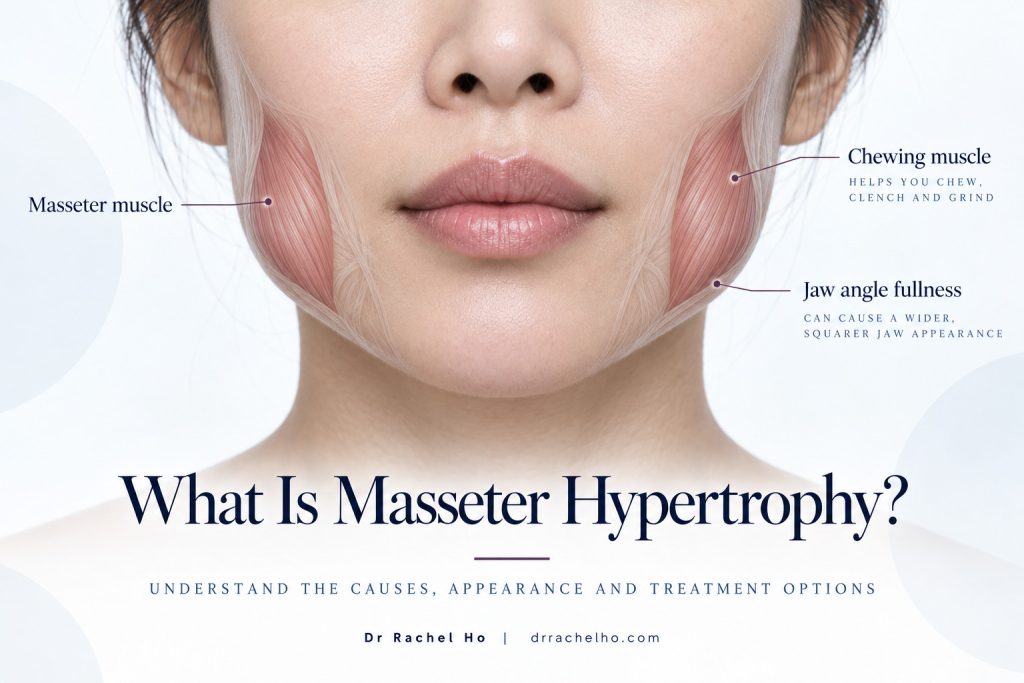
Masseter hypertrophy means enlargement of a chewing muscle at the side of the jaw. It can increase fullness near the jaw angle, but muscle prominence should be assessed alongside the surrounding facial structures.
What is masseter hypertrophy?
The masseter is a chewing muscle situated at the side of the jaw¹. Enlargement of this muscle, called masseter hypertrophy, can create fullness near the jaw angle and make the lower face appear broader¹.
Clenching, teeth grinding and chewing habits have been associated with this enlarged masseter muscles¹. Enlarged jaw muscles can occur on one or both sides of the face, with or without patients noticing discomfort¹.
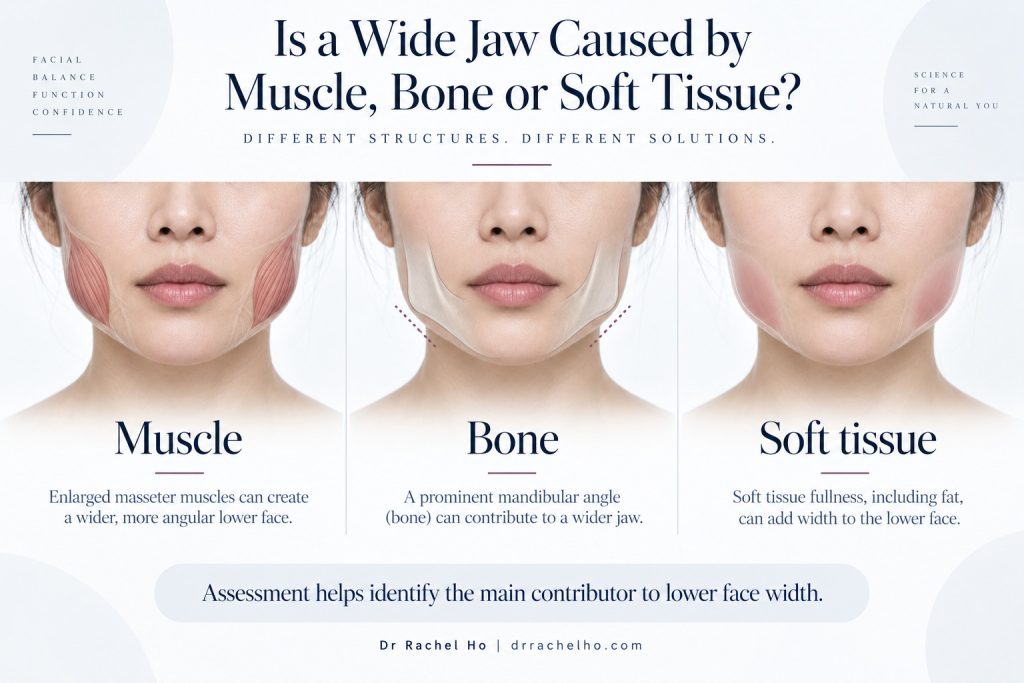
Muscle, mandibular shape and surrounding soft tissue can each contribute to a broad lower face. Assessment helps identify which features a treatment directed at the masseter can realistically change.
Is a wide or enlarged jaw caused by muscle, bone or soft tissue?
The width of the lower face depends on several factors: bones (the shape of the mandible), muscle (size of the masseter muscles) and the surrounding soft tissues². Patients with wide jaw or square looking jaw can have one or several of these factors contributing to their enlarged jaw size.
As part of the consultation at my clinic, patients who are seeking treatments for jawline slimming or jaw reduction are assessed for the contribution of the masseter muscles, soft tissue bulk and skeletal contribution. One easy way to assess the contribution of masseter muscles towards an enlarged jaw is to get the patient to clench to assess the muscle to help with patient counselling and treatment planning. My clinic’s page on masseter hypertrophy and jaw slimming guide explains how assessments and treatments are planned for jawline slimming.
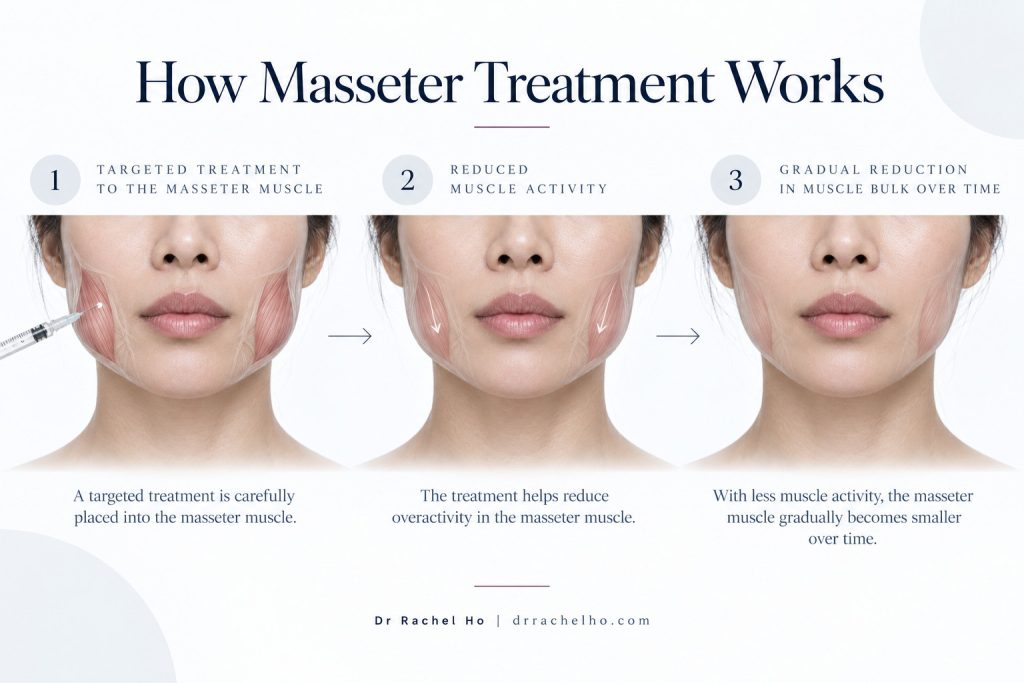
Botulinum toxin reduces masseter activity, followed by a gradual reduction in muscle bulk in suitable patients. The diagram illustrates this sequence rather than an actual patient result or an injection guide.
How does masseter/ jaw BTX work?
Botulinum toxin, abbreviated as BTX, is a neurotoxin that is often used as a treatment for jawline slimming or shrinking enlarged jaw muscles in Singapore. Jaw BTX reduces the release of acetylcholine, a chemical messenger involved in muscle contraction¹. Injecting botulinum toxin into a selected masseter temporarily reduces the muscle activity, followed by a gradual reduction in muscle bulk in suitable patients¹,⁴. This phenomenon of using BTX to relax and shrink the size of enlarged masseter muscles is known as controlled atrophy.
Note that jaw BTX is a treatment that targets the masseter muscle rather than facial fat, mandible bone shape or chin projection². Consequently, a slimmer contour depends on how much the masseter contributes to the original width².
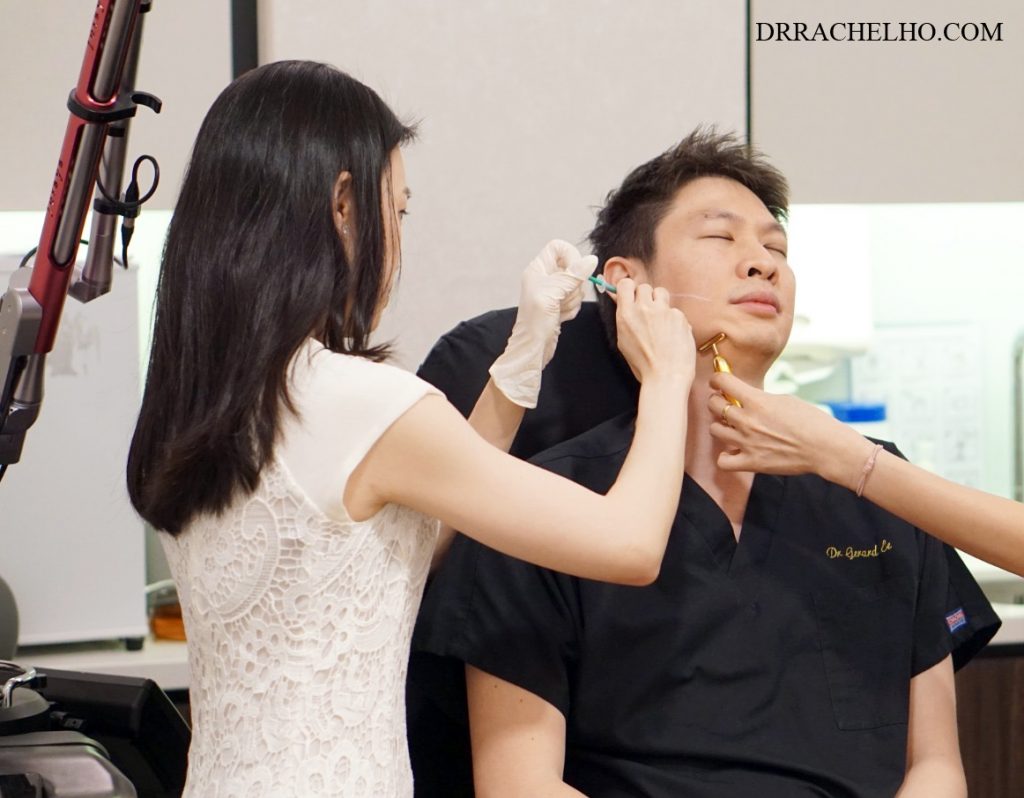
What does jaw BTX for jawline slimming involve?
As part of the facial assessment during the consultation, the contribution of the masseter muscle towards the enlarged jawline is considered. For some of my patients, anatomical factors such as mandible width and projection, jowling, and soft tissue volumes also contribute significantly to the width of their jawline and they may also benefit from additional treatments that address these factors such as XERF to lift sagging and jawline and chin fillers to improve the mandible projection and proportions. These procedures are staged appropriately for safety and results.
During the procedure for jaw BTX, the masseter muscle anatomy is evaluated and botulinum toxin is injected using fine needles into the jaw muscles. The exact dosing of BTX and distribution of botulinum toxin into the masseter muscles is personalised according to my patient’s muscle prominence, facial proportions and the desired degree of change.
How many units of botulinum toxin are needed for jaw BTX?
Jaw BTX dose is highly individualised, and published studies on jawline contouring have evaluated different treatment protocols¹. In Singapore, the different botulinum toxin brands cannot be compared directly as their formulation and conversions differ³.
When do jawline slimming results from jaw BTX become visible?
Visible jaw slimming develops over 4-6 weeks rather than immediately after injection⁴. In a controlled trial involving jaw BTX, improvement was evident at the first assessment around one month, with the greatest measured reduction in prominence around three months⁴.
Jaw BTX: what does the clinical evidence show?
A phase 3 trial involving mostly Asians and females, treated 376 adults with marked or very marked masseter prominence using one botulinum toxin preparation or placebo⁵. At three months, 51.2%of treated participants achieved an improvement of at least two grades on the investigator’s prominence scale, compared with 2.2%receiving placebo⁵.
This study on jaw BTX also found a reduction in measured lower facial width, with improvements continuing through six months⁵.
How long do the results of jaw BTX last?
The results of botulinum toxin for jaw slimming and clenching last typically 3-5 months, depending on the dose of BTX, brand of botulinum toxin and patient’s underlying muscle prominence. My article on how long botulinum toxin lasts explains in depth why duration differs between treatment areas and individuals.
Can jaw BTX affect chewing?
Botulinum toxin can temporary reduce masseter function and chewing force⁶. A published series covering 2,036 treatment sessions recorded this after 30 per cent of sessions⁶.
That said, there are 3 other muscles of mastication- the temporalis, medial and lateral pterygoid muscles- that also contribute to chewing function. Nonetheless, doctors should not be complacent with overdosing botulinum toxin into the jaw muscles. Just like dermal fillers, it isn’t the more the merrier with BTX.
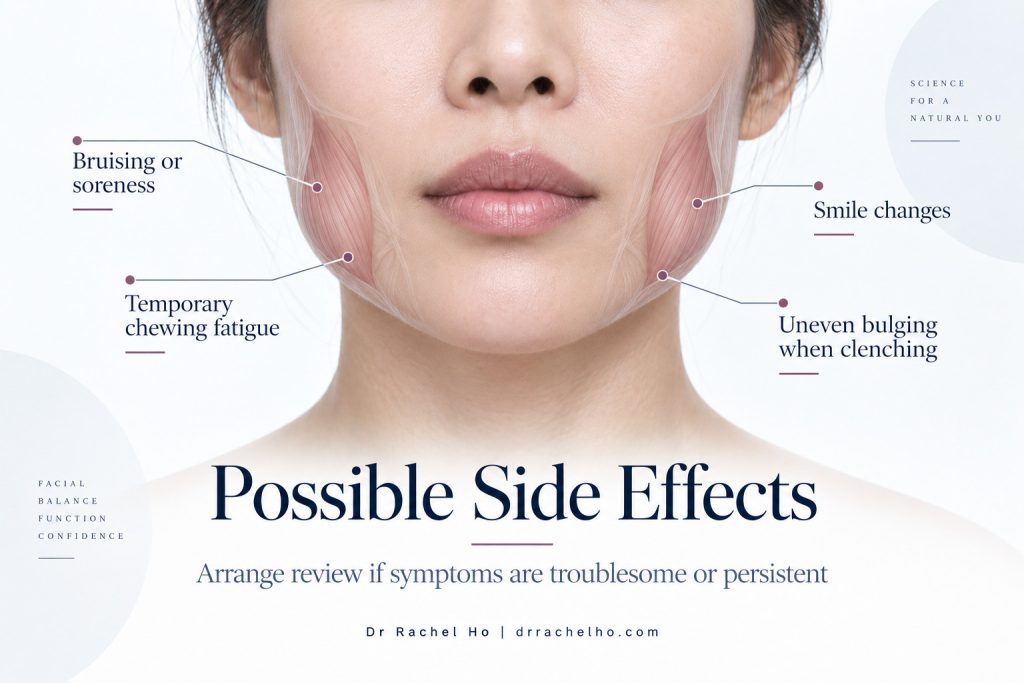
Possible effects include bruising, soreness, temporary chewing fatigue, smile changes and uneven bulging when clenching. Arrange clinical review for troublesome or persistent changes.
What are the side effects of BTX?
Bruising, soreness and smile changes
Injection site pain, discomfort and local muscle weakness have been reported in clinical trials for jaw BTX⁵. Smile asymmetry can also occur if botulinum toxin diffuses to nearby facial muscles like the risorious muscle²,⁶.My article on botulinum toxin side effects and unwanted results covers several these concerns related to BTX injections.
Uneven bulge due to paradoxical muscle bulge
Paradoxical masseter bulge is an uncommon bulge during clenching can develop after treatment, sometimes called paradoxical masseter bulging⁶. Paradoxical masseter pulse is due to the deeper portion of the muscle bulging superficially. Treatment requires relaxation of this deeper portion of the masseter muscle.
Arrange examination when a new bulge or asymmetry appears. The cause should be established before further injections are considered.
Jowls and sagging after jaw BTX
Sunken cheeks and sagging have also been reported after masseter treatment⁶. Patients who already have jowls or sagging are predisposed to this after jaw BTX. As a result of jaw slimming, the excess skin that was previously stretched by the enlarged jaw muscle droops forward to cause jawline sagging and jowls. Patients who are prone to jowls should also consider lifting and skin tightening treatments such as XERF and collagen biostimulators.
Does jaw BTX cure teeth grinding?
Botulinim toxin injections into the masseter treatment can reduce the intensity of muscle activity during sleep bruxism⁷. The Skin Longevity Clinic’s bruxism assessment guide discusses the wider assessment of clenching, grinding and associated symptoms.
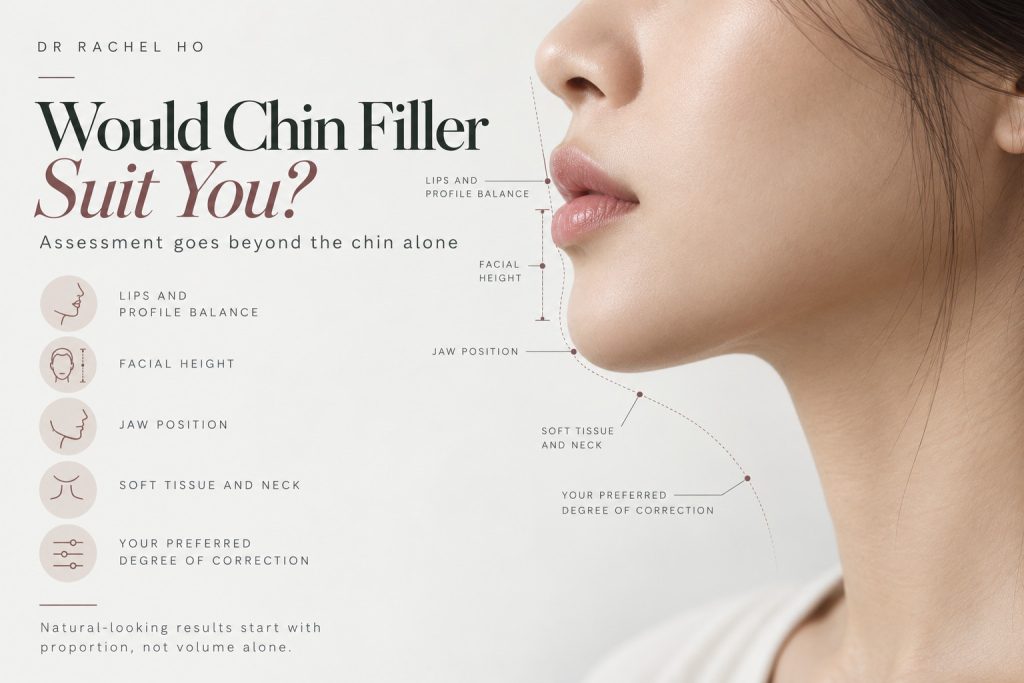
Assessment for chin filler considers the lips, facial height, jaw position, surrounding soft tissues and the patient’s preferences³. A recessed appearance may involve more than chin contour, so concerns about chewing or bite alignment require separate assessment.
How does jaw BTX differ from chin filler?
Jaw BTX reduces size of masseter muscles at the sides fo the face that contribute to lower face width⁴. Chin fillers, on the other hand, add volume to change chin length, projection or contour, with research supporting chin fillers for correction of selected chin retrusion¹¹.
Treatments for slimmer jaw
| Treatment for wide jaw | Main intended change | What it should not be confused with |
|---|---|---|
| Masseter treatment | Reduce prominence caused by an enlarged jaw muscle⁴ | Adding chin projection or correcting every cause of lower face width |
| Chin filler | Add volume and improve selected chin contour concerns¹¹ | Reducing the jaw muscle |
| Assessment of fat and skin | Identify other contributors to lower face fullness² | Assuming that a muscle treatments will address them |
My blogpost on chin fillers explains more about chin fillers and how they are performed in detail.
Why does my jaw still look wide after my jaw BTX?
Besides enlarged masseters, mandible and soft tissue can continue to contribute to enlarged or square jaws². Patients with soft tissue and skeletal contribution to a square and wide jaw can benefit from non-surgical treatments that target these conditions such as chin fillers, jawline fillers, XERF and collagen biostimulators.
Conclusion on Jaw BTX for jawline slimming in Singapore
Jaw BTX injections can reduce masseter prominence, and as a result, lower face width in with controlled studies documenting improvements over several months⁴,⁵. For patients with soft tissue and mandible contributions to their jawline, additional procedures that address skin support and bone projection should be considered.
References
- Ferrillo M, Sommadossi E, Raciti L, et al. The role of botulinum toxin for masseter muscle hypertrophy: A comprehensive review. Toxins. 2025;17(2):91. doi:10.3390/toxins17020091.
- Li Z, Chi Y, Chen C, et al. A comprehensive ultrasound evaluation approach of lower facial structure before masseter muscle botulinum toxin injection. Aesthetic Surgery Journal. 2023;43(4):NP283 to NP292. doi:10.1093/asj/sjac336.
- AbbVie. OnabotulinumtoxinA prescribing information. Sections covering contraindications, potency units, drug interactions and warnings about swallowing, breathing and distant toxin effects.
- Liew S, Jones D, Dayan S, et al. A controlled phase 2b trial to assess the efficacy and safety of a single intervention of onabotulinumtoxinA for treating masseter muscle prominence. Aesthetic Surgery Journal. 2025;45(10):1043 to 1050. doi:10.1093/asj/sjaf042.
- Sun J, Wang L, Wu Y, et al. OnabotulinumtoxinA treatment for masseter muscle prominence: 6 month safety and efficacy results, including patient reported outcomes, from a phase 3, randomized, placebo controlled, multiregional trial. Aesthetic Surgery Journal. 2026;46(5):486 to 494. doi:10.1093/asj/sjaf204.
- Peng HLP, Peng JH. Complications of botulinum toxin injection for masseter hypertrophy: Incidence rate from 2036 treatments and summary of causes and preventions. Journal of Cosmetic Dermatology. 2018;17(1):33 to 38. doi:10.1111/jocd.12473.
- Shim YJ, Lee HJ, Park KJ, Kim HT, Hong IH, Kim ST. Botulinum toxin therapy for managing sleep bruxism: A randomized and placebo controlled trial. Toxins. 2020;12(3):168. doi:10.3390/toxins12030168.
- Busse JW, Casassus R, Carrasco Labra A, et al. Management of chronic pain associated with temporomandibular disorders: A clinical practice guideline. BMJ. 2023;383:e076227.
- Hong SW, Kang JH. Decreased mandibular cortical bone quality after botulinum toxin injections in masticatory muscles in female adults. Scientific Reports. 2020;10:3623.
- Kostenuik P, Mallya SM, Hopfinger R, et al. Longitudinal computed tomography indicates no negative impact of onabotulinumtoxinA on mandibular bone density in a 12 month, double blind, randomized, repeat treatment, placebo controlled study in healthy adults with masseter muscle prominence. Aesthetic Surgery Journal. 2026;46(1):76 to 85. doi:10.1093/asj/sjaf167.
- Xie Y, Zhao H, Wu W, et al. Chin augmentation and treatment of chin retrusion with a flexible hyaluronic acid filler in Asian subjects: A randomized, controlled, evaluator blinded study. Aesthetic Plastic Surgery. 2024;48(5):1030 to 1036.

Pingback:slim muscle masseter - 783hz
Posted at 04:13h, 27 March[…] Dr Rachel Ho | A Guide to a Slimmer V Face: Jaw Reduction. – First of all, it is (1) a sharp, crisp and defined jawline that is slim in shape and; (2) a sharp, (Botox) into the masseter muscles. The masseter muscles lie at the sides of our jaw and are responsible for chewing and clenching the jaw. When the jaw muscles (masseter muscles) are enlarged in a condition called masseter muscle hypertrophy. […]
Pingback:A Slimmer V Face without Surgery: Jaw Botox and Chin Fillers with Dr. Rachel H – Priscilla
Posted at 07:29h, 13 September[…] could probably do your own research or check out Dr. Rachel’s Ho blog for a detailed overview http://drrachelho.com/blog/a-guide-to-a-slimmer-v-face-jaw-reduction-botox-and-chin-filler-review/ After having your chin fillers done, avoid facials, wash your face gently, and avoid pressure on […]