



25 Jun Chin Filler in Singapore: Results, Risks and Recovery
By Dr Rachel Ho, MBBS, MMed
Aesthetic doctor and founder of The Skin Longevity Clinic, Singapore
Last clinically reviewed: 4th October 2026
Chin filler adds volume to change the contour of the chin, including its forward projection¹. This doctor’s review focuses on temporary hyaluronic acid, or HA, fillers, which have been studied for improving the appearance of an underdeveloped or recessed chin¹.
For anyone considering chin filler in Singapore, a useful starting point is to describe the change you want. A more defined profile, a longer chin and a wider chin are different goals, so the discussion should establish which change would suit your preferences.
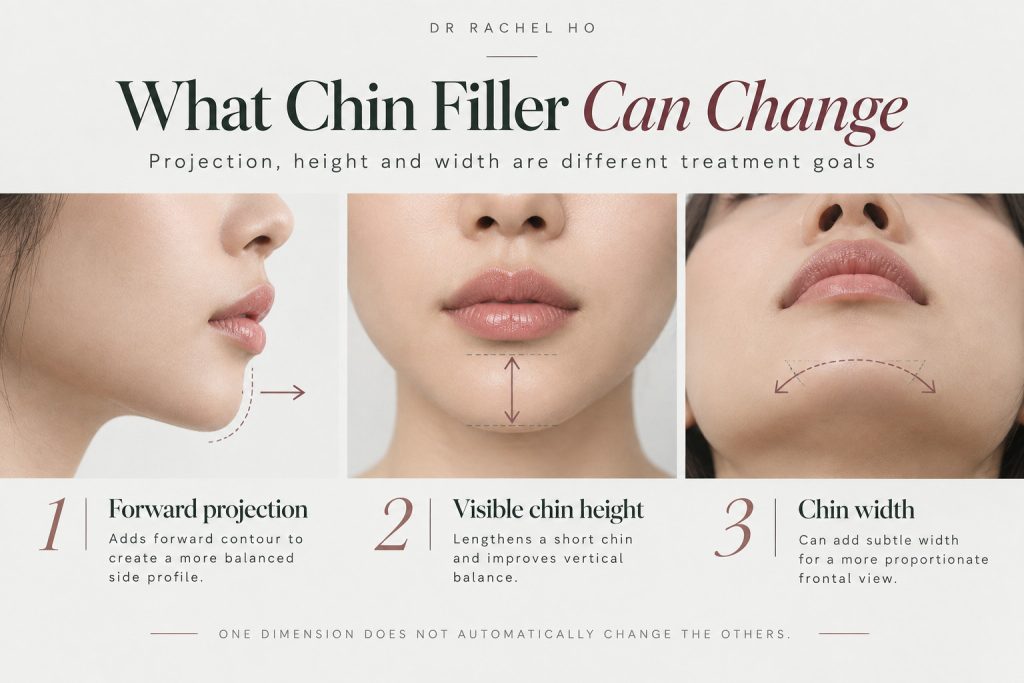
Chin filler can alter forward projection, visible chin height and width, depending on placement². Increasing projection does not necessarily create a longer chin, so each dimension should be considered separately when planning treatment.
What can chin filler change?
Chin filler can increase forward projection, adjust visible chin height and add width, depending on its placement². These dimensions need to be considered separately because increasing one does not necessarily produce the desired change in another².
A more projected chin does not necessarily result in a longer chin. Ask the doctor to explain the intended results from different angles, and let your doctor know if there are any of your existing features you would like to preserve.
The surrounding lower face also deserves attention during assessment as the jawline and neck also affect the appearance of the lower face³. For a deep dive on dermal fillers, please read The Skin Longevity Clinic’s overview of dermal fillers for background on injectable materials and their different treatment objectives.
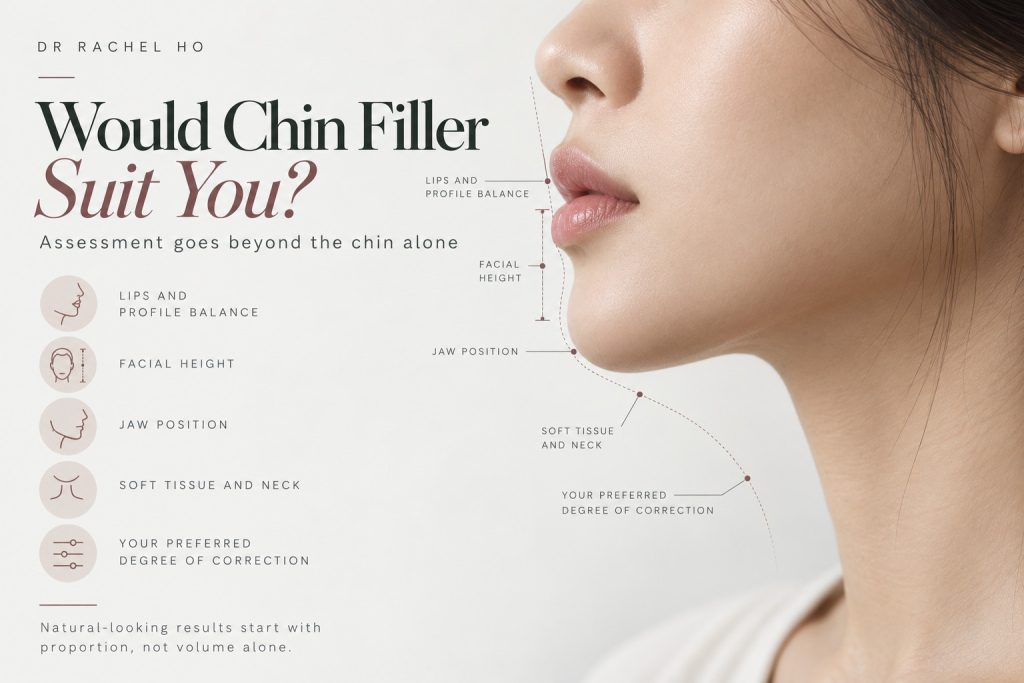
Assessment for chin filler considers the lips, facial height, jaw position, surrounding soft tissues and the patient’s preferences³. A recessed appearance may involve more than chin contour, so concerns about chewing or bite alignment require separate assessment.
How do you know whether chin filler would suit you?
Assessment for chin filler suitability considers the chin alongside the lips, facial height, jaw position and soft tissues³. Profile measurements and angles can determine ideal ratios, angles and projections for patients³. My personal preference for patients undergoing dermal filler injections, including chin fillers, is to intentionally undercorrect any perceived deficits to create a natural looking result that retains my patient’s recognisable features. The art of dermal fillers and facial fillers is to create an noticeable, but undetectable result.
Can chin filler correct a recessed chin?
A chin that appears set back can occur with a normal bite, or involve bite or jaw abnormalities³. Chin fillers can augment soft tissue contours contributing to a recessed or short chin, but chin fillers do not correct a jaw malalignment or bite problem³. Hence, chin fillers can improve chin projection in selected patients with chin retrusion. However, a medical assessment is needed to determine whether your rconcern can reasonably be addressed with filler or requires a different approach¹.
If you notice an overbite, difficulty chewing, previous orthodontic treatment or concerns about jaw alignment, please bring these concerns up with your doctor during the consultation. Some patients with these issues can benefit from a dental or surgical assessment when the concern extends beyond the chin’s appearance³.
What changes can chin filler achieve?
Chin filler adds volume to alter the contour and projection of the chin¹.
What does the research show about chin filler results?
A 2023 systematic review included eight studies involving 917 patients who received HA chin augmentation¹. The studies reported generally favourable satisfaction, alongside injection reactions such as swelling, bruising, redness and pain¹.
A subsequent randomised study of 148 Chinese adults compared one HA filler with an initially untreated control group⁴. At six months, 81% of treated participants achieved at least one grade of improvement on a chin retrusion scale, compared with 5% of controls, according to a blinded evaluator⁴.
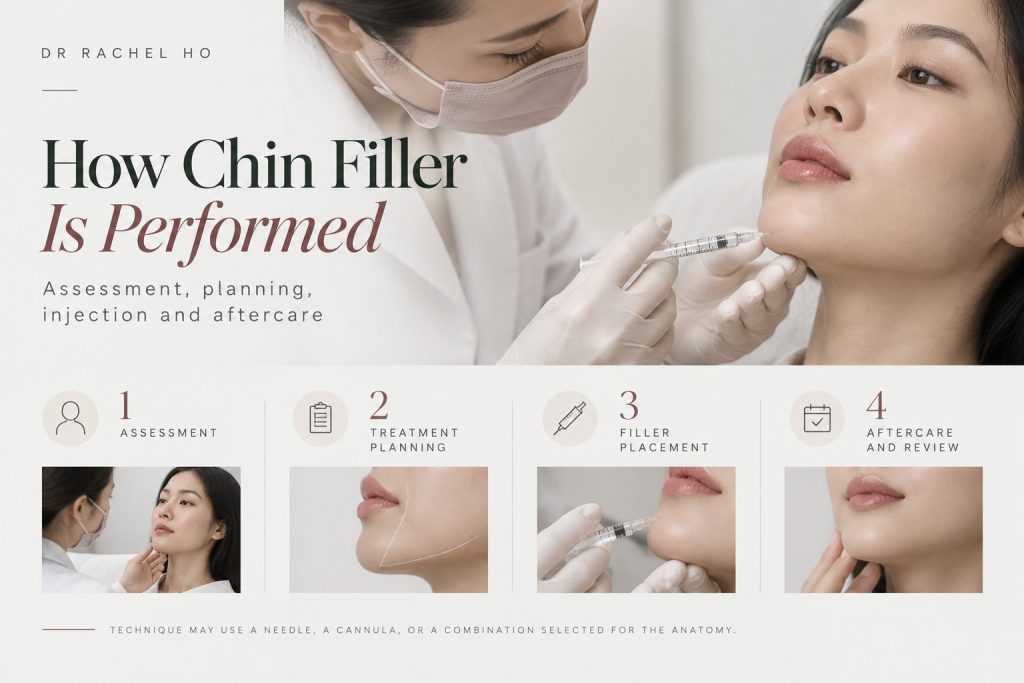
Chin filler treatment begins with assessment, discussion of alternatives and risks, and informed consent⁵. A needle, cannula or combination may be selected according to anatomy and the intended change, followed by aftercare and review arrangements²,⁵.
How are chin filler injections performed?
In The Skin Longevity Clinic, treatment always begins with assessment, a discussion of alternatives and risks, and informed consent⁵. As part of the consultation, I discuss with my patients the ideal facial proportions and projections for their ethnicity; and their personal preferences, such as under or ideal correction.
The skin is cleansed, treatment sites are planned, and local anaesthesia may be used to improve comfort⁵. Chin fillers can be introduced with a needle, a cannula or a combination selected for the anatomy and intended change². The procedure finishes with aftercare instructions and clear arrangements for obtaining advice or review⁵.

Is 1 ml of chin filler enough for non-surgical chin augmentation?
The same volume of dermal fillers can produce different results depending on your structural anatomy and technique of placement². A published anatomical approach to chin augmentation advises placement strategies tailored to chin shape rather than one identical injection pattern².
Knowing the amount of chin fillers required for your chin augmentation is important for your knowledge. However, the amount of dermal fillers is only part of the equation in determining the results of your chin filler injections. Your underlying anatomy and injector’s technique also influence your results of chin fillers.

Swelling, tenderness and bruising can temporarily affect the appearance after chin filler¹. In this review, Dr Rachel Ho describes reviewing patients within one week, alongside published consensus recommending review at approximately two to four weeks for a new treatment area⁵. Worsening symptoms require earlier assessment.
What should you expect during recovery after chin filler injections?
Swelling, tenderness and bruising can temporarily affect the appearance of the chin¹. Published expert consensus recommends review after two to four weeks for new patients or a newly treated area⁵. However, I find that early swelling can also make it harder to judge the contour immediately after treatment, hence I always review my patients within a week of their chin filler injections as part of their follow up in my clinic. For more information about recovery aftger chin filler treatments and follow up care, please refer to my clinic’s chin filler recovery, swelling and aftercare guide.
How long does chin filler last?
The duration of results of chin fillers depends on several factors including type of dermal fillers, volume of chin fillers injected and patient’s individual metabolism of dermal fillers. In the randomised study described above, 61% of treated participants still met the chin retrusion improvement threshold at 12 months after their last treatment. The protocol allowed an optional additional treatment at one month⁴. Note that this study was sponsored by the manufacturer and evaluated one HA formulation, so the results may not apply to all other types of chin filler.

What are the risks of chin filler?
Possible complications include an uneven result, unwanted fullness, infection and delayed inflammatory nodules⁷. Persistent or worsening lumps need assessment because their causes and treatment can differ⁷.
Rarer, but serious complications occur when filler obstructs blood flow, potentially causing skin injury or tissue loss⁶. Facial filler injections have also been associated with visual complications, which require emergency care⁶.
Increasing pain or skin that becomes unusually pale, dusky or mottled requires immediate medical assessment⁶. Sudden blurred vision or loss of vision after a filler injection is an emergency, rather than something to observe until a routine review⁶.
Does using a cannula for chin fillers eliminate vascular risk of dermal fillers?
Vascular occlusion has been reported with both needles and cannulas for dermal fillers, although a large observational study found fewer reported events with cannulas⁸. That said, this finding does not make cannula introduction of dermal fillers risk free⁸.
What happens if too much chin filler is used?
An unwanted result may involve excessive length, projection, width or asymmetry². Frankly overfilled chins can distort facial anatomy and leave a patient looking more than unnaturall. My article on recognising excessive filler and unwanted changes in facial proportions discusses this more broadly.
Can chin filler be dissolved?
Hyaluronic acid filler can be broken down with hyaluronidase, an enzyme used by clinicians to manage selected filler problems⁷. The response of hyaluronic acid dermal fillers varies to hyaluronidase, and some situations require more than one treatment⁷. That said, hyaluronidase can itself cause adverse reactions, including allergy⁷. Read my guide to dissolving fillers with hyaluronidase for the wider discussion. An assessment should establish the material involved and the reason for the problem before a correction is proposed.
How does chin filler compare with surgery?
Dermal filler changes soft tissue volume, while surgical options include a chin implant or genioplasty, which can reposition the chin bone³. The underlying anatomy, desired degree of change and relationship between the jaws influence which treatment gives better results³. For patients who wish to correct an underlying jaw misalignment or underbite or overbite, chin surgery may be a better option. However, for patients who wish to improve the soft tissue projections of their chin and lower face, chin fillers, with or without jawline enhancement is an effective consideration.

Does chin filler need to be combined with other treatments?
The chin is part of the lower face, and an assessment may identify concerns involving other structures such as the lips, jawline, marionette lines and upper neck³. My review of jaw reduction and chin contouring discusses these different treatment objectives.
What should you ask before chin filler treatment in Singapore?
If you’re considering chin fillers in Singapore, speak to your doctor about how chin fillers can improve your facial anatomy without distorting your appearance. The chin is one part of your lower face, and some patients may also benefit from augmentation of their lips, jawlines, marionette lines and neck when chin augmentation is considered.
My clinic’s guide to your first aesthetic consultation can help you prepare these questions. Take time to consider the recommendation, including the option to leave your chin unchanged. If you’d like to understand more about chin fillers at my clinic, The Skin Longevity Clinic, please refer to my clinic’s guide to chin fillers.
Conclusion on chin filler treatments in Singapore
Chin filler can improve lower face projection and contour for selected patients¹. My pro-tip for patients is to always ask your doctor, what is the expected outcome of chin filler injections as the amount of dermal fillers and technique of introduction can influence the results. It’s important that chin augmentation or enhancement truly optimises your appearance and does not distort your facial anatomy, so if in doubt, I prefer to choose a more conservative, less aesthetic result for my patients. Afterall, the best results of aesthetic treatments are always noticeable, but undetectable.
References
- Ou Y, Wu M, Liu D, et al. Nonsurgical Chin Augmentation Using Hyaluronic Acid: A Systematic Review of Technique, Satisfaction, and Complications. Aesthetic Plastic Surgery. 2023;47:1560 to 1567.
- Chen B, Ma L, Wang J. Chin Augmentation With Hyaluronic Acid: An Injection Technique Based on Anatomical Morphology. Dermatologic Surgery. 2022;48:747 to 751.
- Arroyo HH, Olivetti IP, Lima LFR, Jurado JRP. Clinical evaluation for chin augmentation: literature review and algorithm proposal. Brazilian Journal of Otorhinolaryngology. 2016;82:596 to 601.
- Xie Y, Zhao H, Wu W, et al. Chin augmentation and treatment of chin retrusion with a flexible hyaluronic acid filler in Asian subjects. Randomised controlled study. Aesthetic Plastic Surgery. 2024;48:1030 to 1036.
- Goodman GJ, Liew S, Callan P, Hart S. Facial aesthetic injections in clinical practice: Pretreatment and posttreatment consensus recommendations to minimise adverse outcomes. Australasian Journal of Dermatology. 2020;61:217 to 225.
- Murray G, Convery C, Walker L, Davies E. Guideline for the Management of Hyaluronic Acid Filler Induced Vascular Occlusion. Journal of Clinical and Aesthetic Dermatology. 2021;14:E61 to E69.
- Kroumpouzos G, Treacy P. Hyaluronidase for Dermal Filler Complications: Review of Applications and Dosage Recommendations. JMIR Dermatology. 2024;7:e50403.
- Alam M, et al. Rates of Vascular Occlusion Associated With Using Needles vs Cannulas for Filler Injection. JAMA Dermatology. 2021;157:174 to 180.
- Goodman GJ, et al. Aspiration Before Tissue Filler: An Exercise in Futility and Unsafe Practice. Aesthetic Surgery Journal. 2022;42:89 to 101.

No Comments