


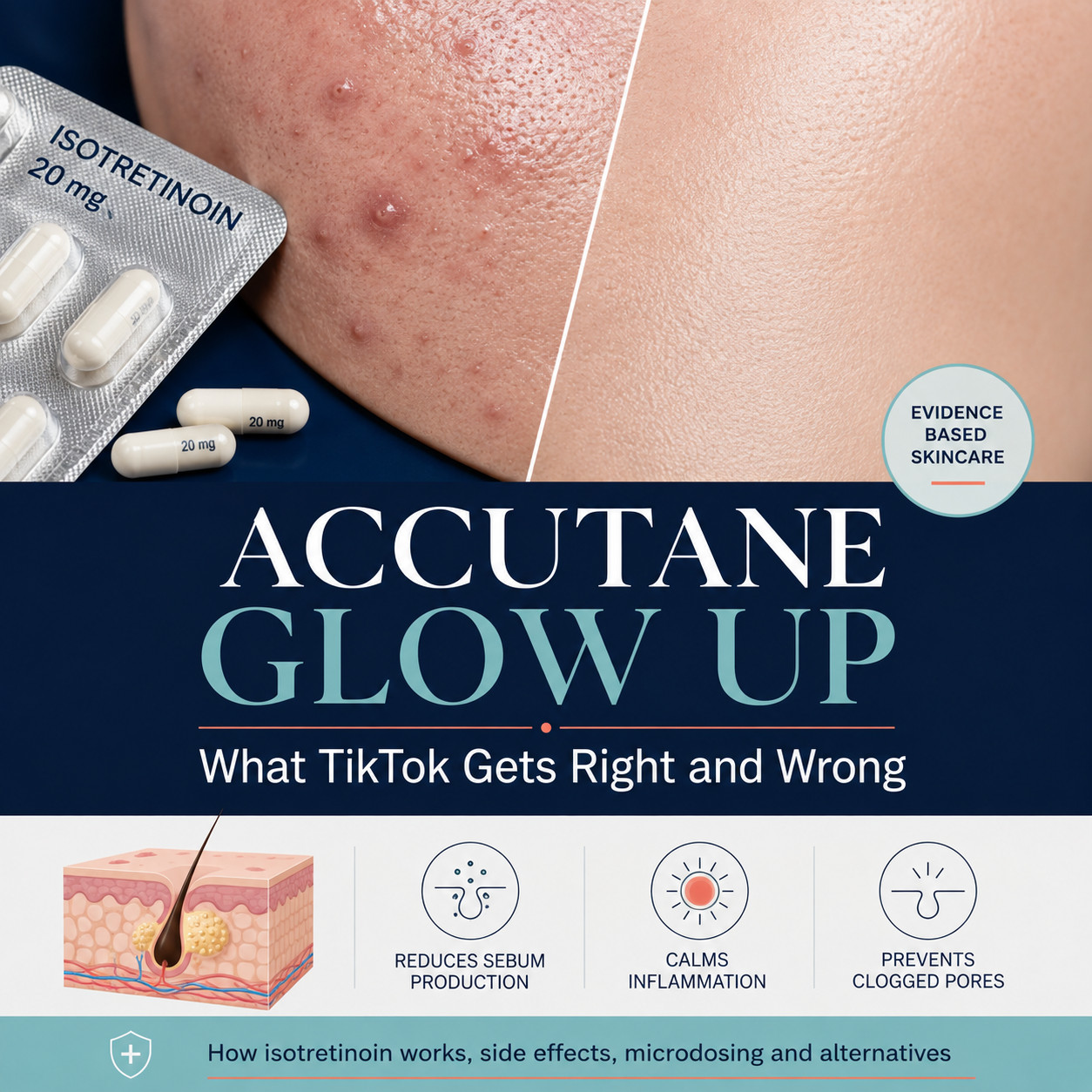
28 Aug Accutane Glow Up: What TikTok Gets Right and Wrong about Acne Medications
Accutane Glow Up: What TikTok Gets Right and Wrong about Acne Medications
By Dr Rachel Ho | Updated August 2026
‘Accutane glow up’ aka accutane microdosing has been hailed as the secret behind the glass skin of many Hollywood celebrities. Now this trend is flooding social media as many TikTok content creators are crediting this acne medication for their flawless skin transformation. Accutane is an oral medication that can fundamentally reset severe acne. However, this medical treatment is not without its side effects like the purge. As an aesthetic doctor, I’ve seen the complex biological reality behind acne in my patients. So before you embark on this trend of dosing yourself with oral acne medications, allow me to bring you through the science behind acne treatments, isotretinoin and your options for acne treatments, beyond oral medications.
Related blogposts:
Is Isotretinoin Dangerous?
5 Worst TikTok Skincare & Beauty Trends to Avoid
Adult Female Acne: A Doctor Explains (Singapore)
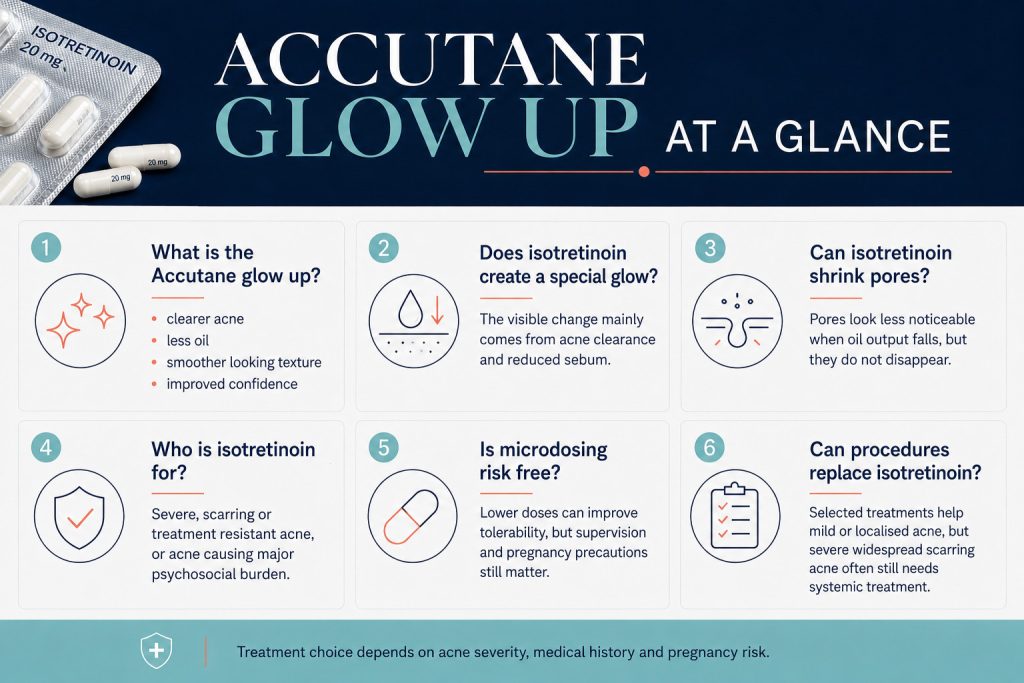
What does TikTok get right and wrong about the Accutane glow up? Isotretinoin can clear severe acne and reduce facial oil, but it does not create a special glow, permanently close pores or become risk-free at a lower dose.
Accutane (Isotretinoin) glow up at a glance
FAQ about Accutane (Isotretinoin)
| Question about Isotretinoin | Evidence based answer |
|---|---|
| What is the Accutane glow up? | A social media term for clearer acne, less oil, smoother looking texture and improved confidence during isotretinoin treatment |
| Does isotretinoin create a special glow? | The visible change mainly comes from acne clearance and reduced sebum rather than a distinct glow mechanism |
| Can isotretinoin shrink pores? | Lower oil output can make pores look less noticeable, but pores do not disappear |
| Who is isotretinoin for? | Severe, scarring, treatment resistant acne or acne causing substantial psychosocial burden |
| Is microdosing risk free? | Lower doses often improve tolerability, but pregnancy risk and medical supervision remain essential |
| Can procedures replace isotretinoin? | Selected treatments can control mild or localised acne, but none reliably replaces isotretinoin for severe, widespread scarring disease |
This summary reflects current acne guidelines, Singapore medication advice and recent research on different isotretinoin dosing strategies³,⁵,⁸,⁹. Treatment still needs to be individualised according to the patient’s acne severity, medical history and pregnancy risk.
What is the Accutane glow up?
“Accutane glow up” describes the improvement in skin appearance following isotretinoin treatment. With isotretinoin or accutane therapy, acne disappears, enlarged pores look smaller, facial oiliness is reduced and the complexion looks smoother and more even.
Several non medical factors also contribute to this glass skin effect, including makeup and filters.
Related blogposts:
5 Skincare Ingredients for Acne & Acne Prone Skin
Cycle Sync Your Skincare for Menstrual Acne
Aklief (Trifarotene): 4th Generation Retinoid for Acne
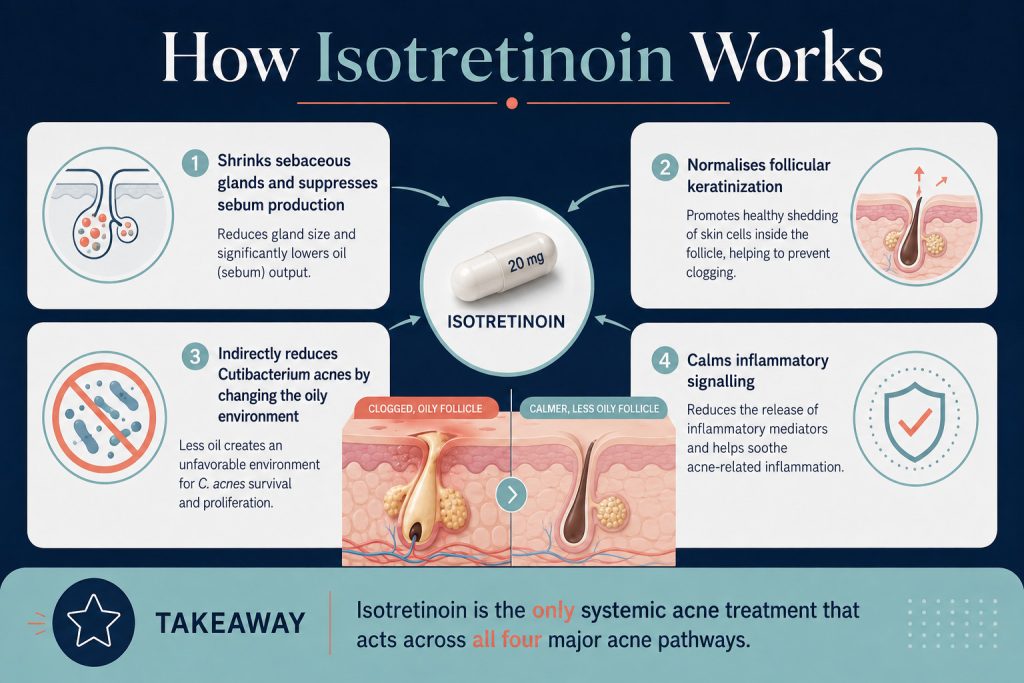
How does isotretinoin treat acne? It acts across the four major acne pathways by suppressing sebum, normalising follicular keratinisation, altering the environment needed by Cutibacterium acnes and reducing inflammation.
How does isotretinoin work to give a “glow up”?
Isotretinoin is the only systemic acne treatment that acts across all four major acne pathways at the same time. Isotretinoin shrinks sebaceous glands and suppresses sebum production, normalises the way cells shed inside follicles, indirectly reduces Cutibacterium acnes by changing the oily environment it depends on, and reduces inflammatory signalling²,³.
At a cellular level, isotretinoin promotes sebocyte apoptosis and alters FoxO1 and FoxO3 signalling within sebaceous glands². This helps explain why oil production can fall so dramatically and why isotretinoin can produce a relatively longer remission.
Current acne guidelines strongly recommend oral isotretinoin for severe acne, acne causing scarring or psychosocial burden, and disease that has failed appropriate topical or oral treatment³. A 2025 cohort involving 19,907 patients found that 22.5 percent experienced relapse, while a higher total dose over the treatment course was associated with a lower relapse risk⁴.
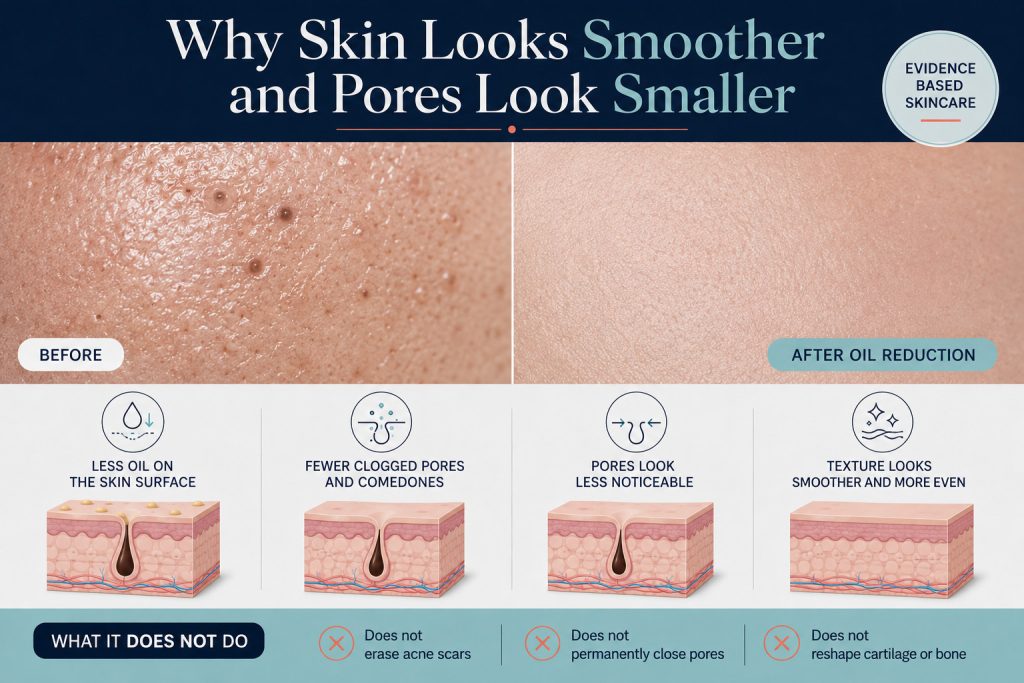
Why can pores look smaller during isotretinoin treatment? Lower oil output and fewer comedones reduce surface congestion, making pores less noticeable. Pores remain normal anatomical openings, and isotretinoin does not resurface established acne scars.
Why does skin look smoother and pores look smaller?
Sebum fills the follicular opening and makes the skin oily and congested. When isotretinoin suppresses oil production, pore openings can appear smaller and comedones can reduce.
However, isotretinoin or accutane does not permanently close pores or resurface acne scars. Similarly, regarding viral claims of “Accutane nose” aka shrinking of nose from isotretinoin treatment. Research has found reductions in nasal skin and soft tissue thickness in selected patients, but isotretinoin does not reshape nasal cartilage or bone¹⁵.
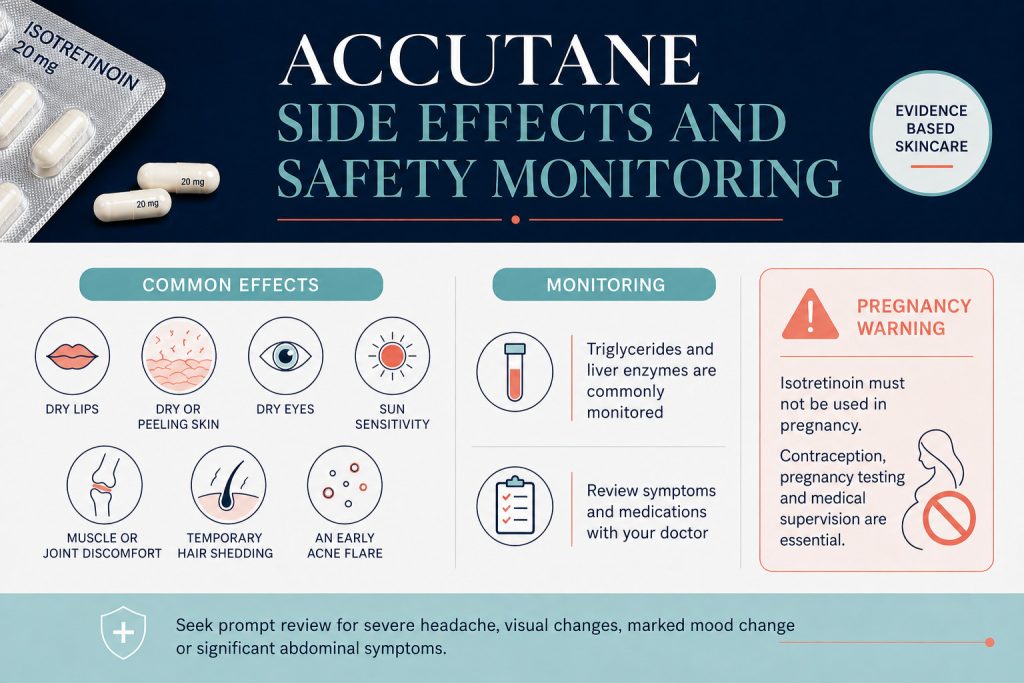
What should patients know before starting isotretinoin? Dry lips, peeling skin, dry eyes and sun sensitivity are common. Selected blood tests and strict pregnancy precautions remain important throughout treatment, including with lower-dose regimens.
Side effects of Accutane or Isotretinoin for acne
Common side effects of isotretinoin include dry lips, dry or peeling skin, dry eyes, nasal dryness, nosebleeds and greater sun sensitivity are common. Muscle or joint discomfort, temporary hair shedding and an early acne flare can also occur. Severe headache, visual changes, marked mood changes or significant abdominal symptoms are rarer, and if they should happen, require prompt medical review⁵.
Isotretinoin can also raise triglycerides and liver enzymes, so baseline and follow up blood tests are used according to individual patient risk. Expert consensus supports checking liver enzymes and triglycerides levels before treatment and around the highest dose⁶.
Isotretinoin is contraindicated in pregnancy and breastfeeding. Exposure to isotretinoin during pregnancy exposure can cause teratogenicity. Guidelines in Singapore for prescribing isotretinoin requires strict contraception for at least one month before treatment, throughout the course and for one month after stopping, with pregnancy testing and counselling directed by the prescribing doctor⁵.
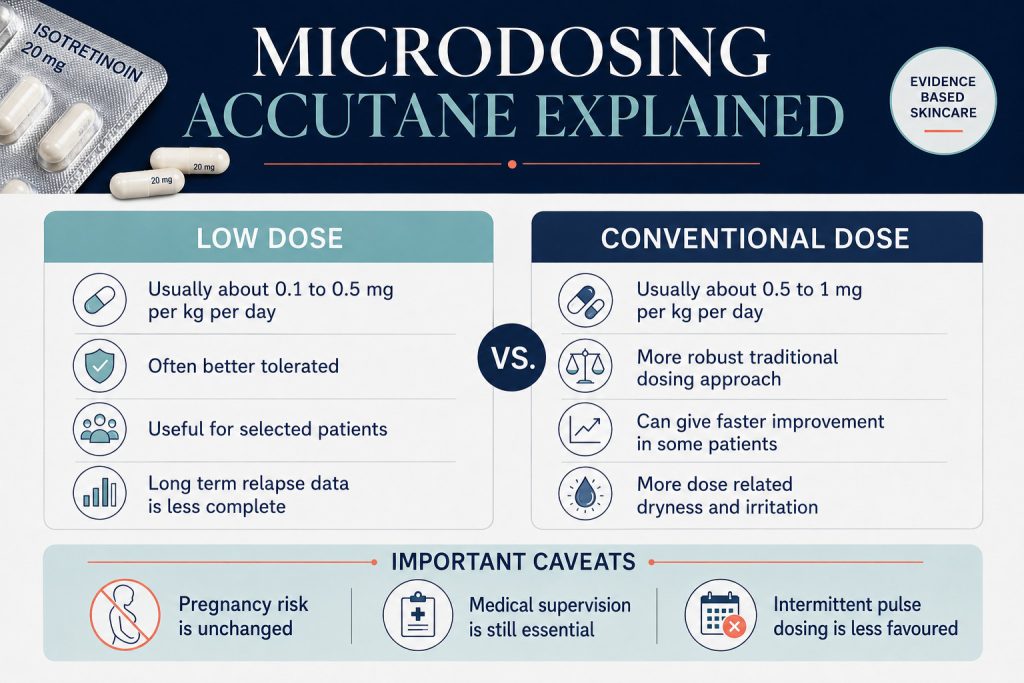
What does “microdosing Accutane” mean? The term usually refers to continuous low-dose isotretinoin. Lower daily doses can improve tolerability for selected patients, but pregnancy risk remains unchanged and long-term relapse evidence is less complete.
What is microdosing Accutane?
Microdosing is a term for continuous low dose of isotretinoin, usually within the range of about 0.1 to 0.5 mg per kg each day. It is sometimes promoted as a long term route to lower oil and clearer skin.
A 2025 systematic review of 15 randomised trials found that low dose regimens could provide similar short term acne improvement with fewer dose related mucocutaneous side effects. The authors of this study also highlighted limited long term evidence on relapse and extended safety, so the findings do not prove that every low dose plan is equivalent or superior to a conventional course of isotretinoin⁸.
Continuous low dose treatment performed better than intermittent pulse treatment in a randomised comparison, and the intermittent group experienced substantially more relapse at one year⁹. Lower daily doses may improve tolerability of isotretinoin, but they do not reduce the side effects or the need for therapy to be under medical supervision.
View this post on Instagram
Is isotretinoin available in Singapore?
Isotretinoin is a prescription medication in Singapore. Before starting isotretinoin, your doctor should diagnose the type of acne, severity, pregnancy risk, medical history, medication interactions and previous treatment response. Buying isotretinoin online or sharing capsules bypasses the safeguards that make treatment safer.
What are the alternatives to isotretinoin in Singapore?
Alternatives to Isotretinoin for acne in Singapore
| Medical treatment | Indication | Limitations and side effects |
|---|---|---|
| Topical medication | Retinoids, benzoyl peroxide, azelaic acid, salicylic acid and suitable combinations for mild to moderate acne | Irritation and adherence affect results |
| Oral medication | Oral tetracyclines with topical treatment, or hormonal treatment such as selected contraceptives and spironolactone for suitable women | Relapse can occur and oral antibiotics should be time limited |
| Selective sebaceous gland ablation | A single microneedle delivers radiofrequency into selected glands to ablate these sebaceous glands | Evidence is smaller than for standard medication and technique is operator dependent |
| Chemical peels | Salicylic, glycolic or mandelic acid can support mild acne, congestion and post acne marks | Results vary |
| Q switched 1064 nm Nd:YAG laser | Selected dual mode can reduce oil and inflammatory lesions | Protocols differ in studies |
| Blue and red LED light | A low downtime adjunct for selected inflammatory acne | Trials are generally short, small and at risk of bias |
Alternatives to acne are dependent on the type of and severity of acne. For more about these medical alternatives to isotretinoin for acne, please refer to my clinic guides on:
A randomised study of 63 patients found significant improvement in inflammatory acne after three sessions of selective sebaceous gland electrothermolysis at four week intervals¹¹. This technique differs from standard fractional radiofrequency microneedling for acne scars because it targets individual sebaceous glands rather than treating a broad dermal field.
A network meta analysis of 179 randomised trials found that topical combinations, chemical peels and light based approaches can help selected types of acne, while oral isotretinoin remained among the most effective options for moderate to severe disease¹². Evidence for chemical peels, light therapy and photodynamic treatment was more uncertain because studies were heterogeneous and often small.
Dr Rachel Ho’s clinical perspective on the Accutane Glow Up trend on TikTok
The Accutane glow up is real, but this medication is not without its risks and side effects and isotretinoin should not be considered as a supplement or beauty trend. Acne can also relapse after isotretinoin therapy, and patients may require alternative treatments for their acne.
Isotretinoin is typically considered for patients with recurrent acne or cystic acne. For milder, localised or hormonally driven acne, a structured combination of topical medication, selected oral treatment and carefully chosen procedures can be more proportionate.
Frequently asked questions
Is the Accutane glow permanent?
Acne remission can last for years, but relapse occurs in some patients. Oil production and pore size can also increase again after treatment ends, so maintenance skincare or further acne treatment with collagen biostimulators, radiofrequency microneedling or resurfacing lasers are sometimes needed.
Is microdosing isotretinoin safer?
Lower daily doses usually cause fewer dose related side effects. Pregnancy risk remains unchanged, and long term relapse and safety data are less complete than social media often suggests.
Can isotretinoin be taken for oily skin alone?
A doctor can consider low dose treatment in selected persistent acne cases, but oiliness alone rarely justifies exposing a healthy person to systemic isotretinoin. Skincare, topical retinoids and sebaceous gland ablative procedures can be considered first.
Can laser or RF treatment replace Isotretinoin?
In-clinic procedures can treat mild, moderate or focal acne. Severe nodulocystic, widespread or rapidly scarring acne often needs selective sebaceous gland ablation and systemic medical treatment. Delaying effective care can result in post inflammatory hyperpigmentation and scars for patients.
Related reading on DrRachelHo.com
For a deeper guide to safety and monitoring of isotretinoin, please read Is Isotretinoin Dangerous?. Related articles on acne include Adult Female Acne, Retinol vs Retinal vs Tretinoin and Retinol for Skin.
References
- Asare AO, Sefa AN, Haddad L, et al. Isotretinoin on TikTok: A Qualitative Analysis of Attitudes, Perspectives and Knowledge Dissemination of User Generated Content. Cureus. 2025.
- Agamia NF, et al. Effect of Oral Isotretinoin on FoxO1 and FoxO3 Proteins in Sebaceous Glands. Experimental Dermatology. 2018. PMID 30240097.
- Reynolds RV, et al. Guidelines of Care for the Management of Acne Vulgaris. Journal of the American Academy of Dermatology. 2024. PMID 38300170.
- Lai J, Barbieri JS. Acne Relapse and Isotretinoin Retrial in Patients With Acne. JAMA Dermatology. 2025. PMID 39813053.
- HealthHub Singapore. Isotretinoin. Updated 2026.
- Xia E, et al. Isotretinoin Laboratory Monitoring in Acne Treatment: A Delphi Consensus Study. JAMA Dermatology. 2022. PMID 35704293.
- Tan NKW, et al. Risk of Suicide and Psychiatric Disorders Among Isotretinoin Users. JAMA Dermatology. 2024. PMID 38019562.
- Lin L, et al. Effectiveness and Safety of Different Dosing Regimens of Isotretinoin for Acne Vulgaris. Postepy Dermatologii i Alergologii. 2025. PMID 41001139.
- Lee JW, et al. Effectiveness of Conventional, Low Dose and Intermittent Oral Isotretinoin. British Journal of Dermatology. 2011. PMID 21114478.
- Health Sciences Authority Singapore. Isotretinoin and Risk of Psychiatric Disorders and Sexual Dysfunction. 2023.
- Ahn GR, et al. Selective Sebaceous Gland Electrothermolysis Using a Single Microneedle Radiofrequency Device. Lasers in Surgery and Medicine. 2020. PMID 31502662.
- Mavranezouli I, et al. A Systematic Review and Network Meta Analysis of Acne Treatments. British Journal of Dermatology. 2022. PMID 35789996.
- Jung JY, et al. Dual Mode 1064 nm Nd:YAG Laser With Carbon Suspension for Acne Vulgaris. Journal of the American Academy of Dermatology. 2012. PMID 22033354.
- Scott AM, et al. Blue Light Therapy for Acne Vulgaris: A Systematic Review and Meta Analysis. Annals of Family Medicine. 2019. PMID 31712293.
- Fanning JE, et al. Clarifying the Role of Isotretinoin in Rhinoplasty: A Systematic Review and Analysis of an Emerging Social Media Trend. Aesthetic Plastic Surgery. 2026. PMID 41184659.

No Comments