


06 Jan Adult Female Acne: Hormones, Causes and Treatment
Adult Female Acne: Why It Happens and How It Is Treated
By Dr Rachel Ho
Acne in your 30s or 40s can be frustrating, especially when you expect breakouts to end with adolescence. Adult female acne is a chronic inflammatory skin condition involving the hair follicles and oil glands, with hormonal influences, skin sensitivity and recurring breakouts shaping its management¹,².
Persistent acne can affect confidence, social interactions and quality of life¹. A useful treatment plan considers that experience alongside the visible lesions, previous treatment response and the possibility of lasting marks or scars⁴.

Types of acne: comedones (blackheads and whiteheads), papules, pustules, nodules and cysts.
What is adult female acne?
Adult female acne usually refers to acne in women aged 25 and older². It may continue from adolescence, return after a period of clearer skin or begin for the first time in adulthood². The term describes the age and population affected, rather than a diagnosis of an underlying hormonal disorder².
Acne can include comedones, which are blackheads and whiteheads, as well as inflamed papules, pustules and deeper nodules³. The combination of lesions helps guide treatment, rather than age or facial location alone³.
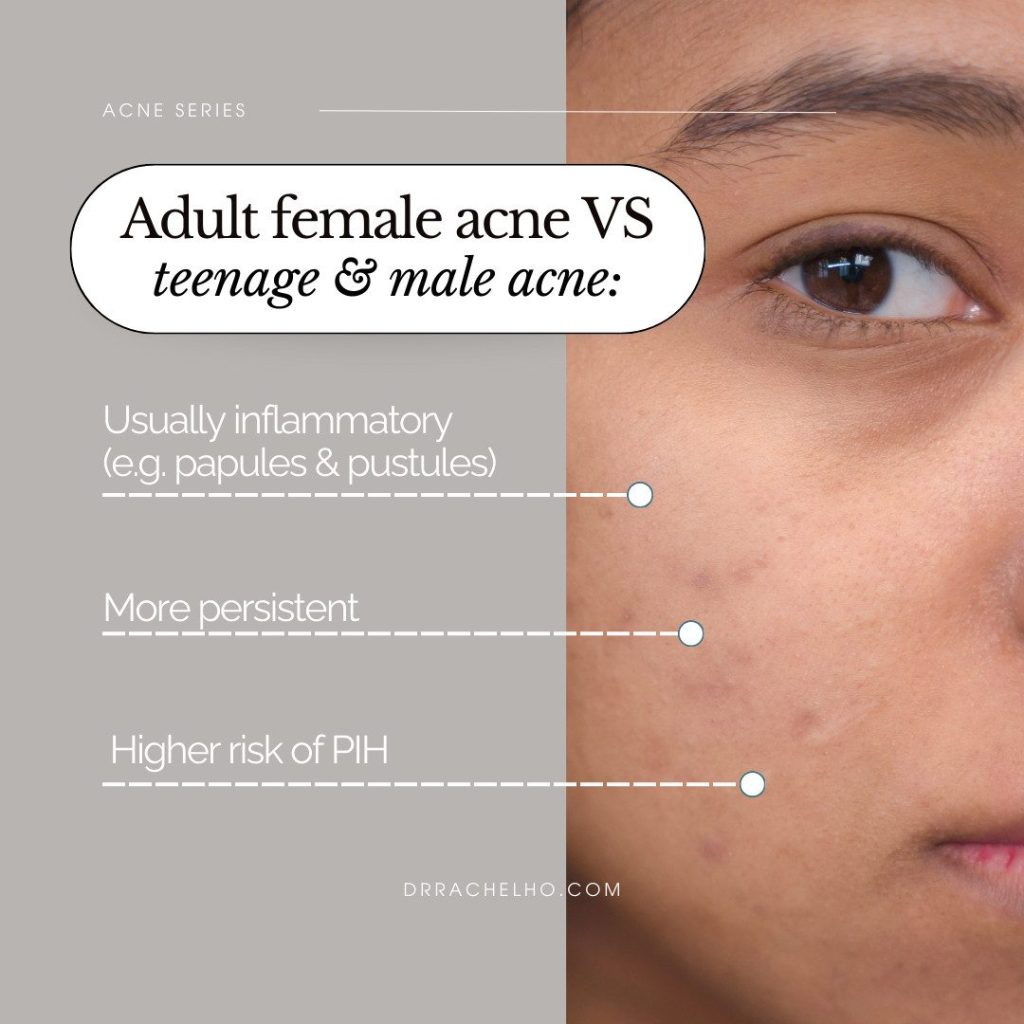
Adult female acne vs acne in teenagers and males
How does adult female acne differ from teenage acne?
Adult female acne often follows a persistent or recurring course, sometimes with flares around menstruation². Skin sensitivity, pregnancy plans and the psychological impact of ongoing breakouts can influence treatment choices¹,².
Chin and jawline acne are familiar patterns, but adult female acne frequently involves several facial areas³. In an international study of 374 women, almost 90% had acne across multiple facial zones, and most had comedones alongside other lesions³. The study challenges the assumption that adult women mainly develop isolated inflammatory spots along the jawline³.

The pathogenesis of acne involves follicular hyperkeratinisation, increased sebum or oil production, colonisation by C. acne bacteria and inflammation.
Why does acne occur?
Acne develops through several interacting processes within the pilosebaceous unit, which comprises the hair follicle and its associated oil gland⁴. Understanding these processes helps explain why treatment may combine ingredients with different actions⁴.
Pathogenesis of acne
| Process | What happens in the skin |
|---|---|
| Follicular blockage | Skin cells accumulate within the follicle, forming the small blockages from which comedones develop⁴. |
| Sebum production | Oil gland activity and changes in sebum contribute to the follicular environment associated with acne⁴. |
| Microbial activity | Cutibacterium acnes is part of the normal skin microbiome, but its interaction with the follicle and immune system can contribute to inflammation⁷. |
| Inflammation | Inflammatory activity contributes to the development of acne lesions, including red, tender spots⁴. |
This biology explains why washing more often cannot address every part of acne². Excessive cleansing can also irritate the skin, making an otherwise useful treatment routine harder to tolerate².
Why does adult acne occur in women?
In adult female acne, hormones play a crucial role. Androgens are a category of hormones that drive acne by stimulating sebaceous glands to produce excess oil which clogs pores and causes inflammation, leading to pimples2. Adult women with acne have an increased sensitivity of their sebaceous gland to androgen; with a higher conversion of androgens in the skin due to hyperactivity and abnormal activity of enzymes related to the metabolism of androgenic hormones2. A 2026 international consensus adopted polyendocrine metabolic ovarian syndrome, or PMOS, as the new name for polycystic ovary syndrome⁶. My guide to the change from PCOS to PMOS explains the terminology and its relevance to skin concerns.
In menopausal women, the decline of estrogen hormones and the relative increase in androgen hormones can also trigger acne11. For a deeper dive on this topic, please check out my guide to perimenopause and menopause.
A compromised skin barrier function has also been incriminated in the development of acne7. The increased transepidermal water loss as a result of a damaged skin barrier may be responsible for the onset of the inflammatory cascade in acne7.
View this post on Instagram
Can hormonal acne occur with normal blood tests?
Hormones can influence acne even when blood androgen levels are within the laboratory reference range¹. Androgens stimulate sebaceous gland activity, while local hormone metabolism and the sensitivity of the skin to these hormones also contribute¹.
Some women notice flares before their period, while others experience persistent acne without a clear monthly pattern². Changes in the balance between oestrogen and androgen effects may also contribute around menopause¹. These patterns are useful clinical information, but they do not establish a hormonal disorder by themselves⁵.
My article on menstrual acne and cycle sync skincare explores the relationship between the menstrual cycle and breakouts. Bring a record of recurring flares to your consultation, particularly when you have noticed a consistent pattern.
When should hormone tests be considered for adult female acne?
An assessment for androgen excess is relevant when acne accompanies irregular periods, increased facial or body hair, or scalp hair thinning⁵. Severe acne developing after menopause warrants assessment rather than being attributed to ordinary skin ageing⁵.
What role does the skin barrier play in acne?
The skin barrier helps regulate water loss and protects against external irritants⁷. Research has identified barrier abnormalities in acne, alongside changes in the skin microbiome⁷. Some acne treatments can add dryness or irritation, which makes supporting the barrier an important part of care⁹.
Females with oily skin can still need moisturiser⁹. The aim is to maintain a tolerable routine that treats acne while limiting unnecessary irritation, rather than repeatedly stripping oil from the surface⁹.
Does Singapore’s climate affect adult female acne?
Heat and humidity are often discussed as possible aggravating factors, although their effects vary between individuals⁸. In a study of 171 patients in a tropical setting, some reported worsening acne during summer, with temperature and humidity differing across periods of reported aggravation⁸.
For my patients in Singapore, lifestyle sweating, prolonged contact with clothing or masks, and cosmetic use are reviewed to assess their contribution to acne. For breakouts beyond the face, my clinic’s back and body acne guide provides further reading.

Treating adult female acne: a holistic approach
What skincare supports treatment for adult female acne?
Gentle cleansing, moisturising and sun protection can support acne medications and treatments⁹. The 2025 Nordic NECASA II expert consensus recommends integrating skincare according to acne severity, skin characteristics and the prescribed regimen⁹. It is a skincare consensus, rather than evidence that cosmetic products can replace medical treatment in every case⁹. My guide to skincare ingredients for acne explains commonly discussed ingredients and can help you prepare questions about products you already use.
Does diet affect adult female acne?
A systematic review found associations between diets with a higher glycaemic load and acne, while findings concerning dairy varied between studies¹⁰. Differences in study design and the reliance on observational data limit conclusions about whether a particular food causes an individual’s breakouts¹⁰.
I would avoid removing several food groups without a clear reason. My review of diet and acne examines the evidence and provides context for discussing dietary changes alongside treatment.
Which medical treatments help adult female acne?
Treatment plans for adult female acne depend onthe pattern of acne, severity, previous response, tolerability and the impact on daily life¹¹. Pregnancy plans, medical conditions and other medicines also influence the available options¹²,¹⁴.
Topical treatments for adult female acne
Topical retinoids help address follicular blockage and inflammation, while benzoyl peroxide has antimicrobial activity against acne associated bacteria⁴. Azelaic acid is another option supported by acne guidelines¹¹. These treatments may be combined or adjusted according to the acne pattern and skin tolerance¹¹.
For a broader explanation of how these approaches differ, read my guide to acne causes and treatment options. Ask which part of your acne each prescribed product is intended to address.
Spironolactone
Spironolactone reduces androgen effects and is an option for acne in suitable women¹². Before prescribing, I have to review with my patients their pregnancy plans, kidney function, other medicines and factors that could increase potassium levels¹². Possible adverse effects of spironolactone include menstrual changes, breast tenderness, headaches and dizziness¹².
The SAFA randomised trial enrolled 410 women with persistent facial acne and found benefit from spironolactone compared with placebo¹³. Participants could continue topical treatment, so the findings support the appropriate prescription of spironolactone in combination with acne treatments¹³.
Combined oral contraceptives
Selected combined oral contraceptives can improve acne and are a consideration for female patients when contraception is also wanted¹². Suitability for oral contraceptives for treating acne depends on medical history, including blood pressure, smoking, migraine with aura and a history of blood clots¹². The decision should reflect the patient’s contraceptive preferences as well as the acne treatment goal¹².
Oral antibiotics
Oral antibiotics may be used for inflammatory acne, alongside topical treatment¹¹. Guidelines recommend limiting their duration and using benzoyl peroxide with antibiotic treatment to reduce the development of resistance¹¹.
Isotretinoin
Isotretinoin may be considered for severe acne, acne causing scarring or substantial distress, and acne that has responded inadequately to other treatments⁴. Starting female patients on iostretinoin requires discussion of adverse effects, monitoring and pregnancy prevention, because it is contraindicated during pregnancy¹⁴. For my in-depth look at the evidence of isotretinoin, check out my updated blogpost Isotretinoin Singapore: Benefits, Side Effects and Safety.
Chemical peels, lasers and light treatments
Some of the in-clinic treatments that are evidence based for treating acne include:
-
- Chemical peels for exfoliation
- Q-switched laser to reduce inflammation and post acne dark marks
- LED light to reduce bacterial load
- Selective sebaceous gland ablation for recurrent acne
What changes when planning pregnancy or breastfeeding?
Pregnancy plans should be discussed before starting or continuing acne medicines¹⁴. Isotretinoin is contraindicated during pregnancy, while spironolactone and topical retinoids should also be avoided during pregnancy¹⁴. Azelaic acid and benzoyl peroxide are among the topical options that may be considered after medical review¹⁴.
Breastfeeding requires a separate assessment because recommendations differ from those for pregnancy¹⁴. For female patients, please share with your doctor about your current pregnancy, breastfeeding or plans to conceive so that your acne treatmentcan be reviewed appropriately¹⁴.
How long does treatment for adult female acne take, and why can acne return?
Acne treatment is assessed over weeks to month⁴. Adult female acne can follow a recurring course, and maintenance treatment may be needed after the initial improvement². A flare after stopping treatment does not necessarily mean the earlier treatment was ineffective but due to the natural history of adult female acne².
What about acne marks and scars?
Acne can leave flat areas of redness (post inflammatory erythema) or pigmentation (post inflammatory hyperpigmentation) as well as scars that change skin texture¹⁵. These residual changes can add to the psychological burden of acne, particularly when new breakouts continue to develop¹⁵.
My clinic’s guide to acne marks and acne scars explains the distinction between PIE, PIH and acne scars in more detail.

-
Conclusion on and my approach to adult female acne
Adult acne in women is not a problem with hygiene but a common, and treatable condition that requires strategic treatments of the pathogenesis of acne. Acne is driven by oil gland activity, clogged follicles, microbiome shifts, and inflammation, often with a hormonal component. Singapore’s climate also adds to acne’s severity and complexities in treatment. Adult acne, if left untreated, can lead to persistent hyperpigmentation, scarring, and significant psychological impact.
In my practice, the most effective and reliable results in my patients come from a combination of evidence based active ingredients and escalation to medications and treatments when needed and tailored to the individual. Acne is treatable and early, informed care makes a meaningful difference. As part of ongoing acne assessment and treatment in my clinic, patients are reviewed regularly with clear treatment priorities before deescalation or escalation of acne treatment is decided upon with the patient.
References
- Rocha MA, et al. Unveiling the Nuances of Adult Female Acne: A Comprehensive Exploration of Epidemiology, Treatment Modalities, Dermocosmetics, and the Menopausal Influence. International Journal of Women’s Health. 2024;16:663 to 678. doi:10.2147/IJWH.S431523.
- Bagatin E, et al. Adult female acne: a guide to clinical practice. Anais Brasileiros de Dermatologia. 2019;94(1):62 to 75. doi:10.1590/abd1806-4841.20198203.
- Dréno B, Thiboutot D, Layton AM, et al. Large scale international study enhances understanding of an emerging acne population: adult females. Journal of the European Academy of Dermatology and Venereology. 2015;29(6):1096 to 1106. doi:10.1111/jdv.12757.
- Eichenfield DZ, Sprague J, Eichenfield LF. Management of Acne Vulgaris: A Review. JAMA. 2021;326(20):2055 to 2067. doi:10.1001/jama.2021.17633.
- Elhassan YS, Hawley JM, Cussen L, et al. Society for Endocrinology Clinical Practice Guideline for the Evaluation of Androgen Excess in Women. Clinical Endocrinology. 2025;103(4):540 to 566. doi:10.1111/cen.15265.
- Teede HJ, Bahri Khomami M, Morman R, et al. Polyendocrine metabolic ovarian syndrome, the new name for polycystic ovary syndrome: a multistep global consensus process. The Lancet. 2026;407(10545):2329 to 2339. doi:10.1016/S0140-6736(26)00717-8.
- Rocha MA, Bagatin E. Skin barrier and microbiome in acne. Archives of Dermatological Research. 2018;310(3):181 to 185. doi:10.1007/s00403-017-1795-3.
- Narang I, Sardana K, Bajpai R, Garg VK. Seasonal aggravation of acne in summers and the effect of temperature and humidity in a study in a tropical setting. Journal of Cosmetic Dermatology. 2019;18(4):1098 to 1104. doi:10.1111/jocd.12777.
- Bjerring P, Anckar O, Andriessen A, et al. NECASA II: A Practical Algorithm Integrating Skincare in the Management of Adult Female Acne in the Nordic European Countries. Journal of Drugs in Dermatology. 2025;24(11):1094 to 1101. doi:10.36849/JDD.9196.
- Meixiong J, Ricco C, Vasavda C, Ho BK. Diet and acne: A systematic review. JAAD International. 2022;7:95 to 112. doi:10.1016/j.jdin.2022.02.012.
- Reynolds RV, Yeung H, Cheng CE, et al. Guidelines of care for the management of acne vulgaris. Journal of the American Academy of Dermatology. 2024;90(5):1006.e1 to 1006.e30. doi:10.1016/j.jaad.2023.12.017.
- Smith CA, Gosnell E, Karatas TB, et al. Hormonal Therapies for Acne: A Comprehensive Update for Dermatologists. Dermatology and Therapy. 2025;15(1):45 to 59. doi:10.1007/s13555-024-01324-8.
- Santer M, Lawrence M, Renz S, et al. Effectiveness of spironolactone for women with acne vulgaris (SAFA) in England and Wales: pragmatic, multicentre, phase 3, double blind, randomised controlled trial. BMJ. 2023;381:e074349. doi:10.1136/bmj-2022-074349.
- Ly S, Kamal K, Manjaly P, Barbieri JS, Mostaghimi A. Treatment of Acne Vulgaris During Pregnancy and Lactation: A Narrative Review. Dermatology and Therapy. 2023;13(1):115 to 130. doi:10.1007/s13555-022-00854-3.
- See JA, Chavda R, Kon KM, et al. A review of the topical management of acne and its associated sequelae in the Asia Pacific region with a spotlight on trifarotene. International Journal of Dermatology. 2024;63(6):704 to 713. doi:10.1111/ijd.17141.

No Comments