


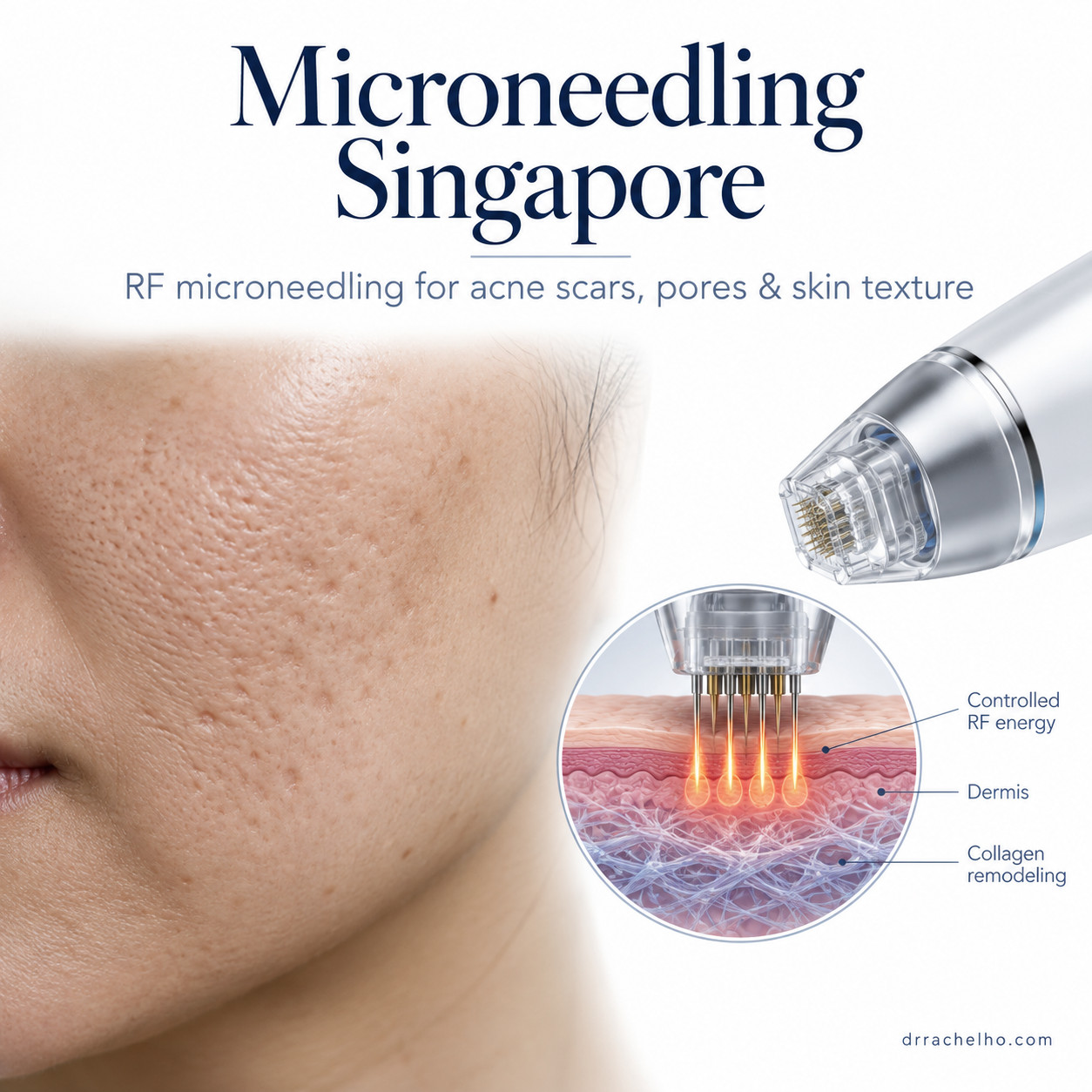
06 Oct Microneedling vs RF Microneedling: A Doctor’s Guide
Microneedling vs RF Microneedling: A Doctor’s Guide to Results, Recovery and Who Each Suits
By Dr Rachel Ho
Microneedling and radiofrequency microneedling are used in Singapore primarily to improve selected atrophic acne scars, enlarged pores and uneven skin texture. Conventional microneedling creates controlled mechanical injury, while RF microneedling combines traditional microneedling with radiofrequency energy at selected depths to produce additional thermal stimulation within the dermis¹˒².
Both microneedling and radiofrequency microneedling are supported by clinical evidence for treatment of atrophic acne scars¹˒²˒³. This doctor’s guide will explain the differences of these treatments and which modality matches the type of scar or skin concern being treated.
Microneedling Singapore: the short answer
Microneedling uses fine needles to create controlled microscopic injuries that stimulate dermal remodelling. RF microneedling adds radiofrequency energy through the needles, combining mechanical injury with controlled thermal stimulation¹˒².
For acne scars, both conventional microneedling and RF microneedling have clinical evidence¹˒²˒³. Treatment choice depends on scar morphology, skin type, pigment risk, recovery tolerance and whether another procedure such as subcision, TCA CROSS or fractional resurfacing better matches the structural problem⁹.
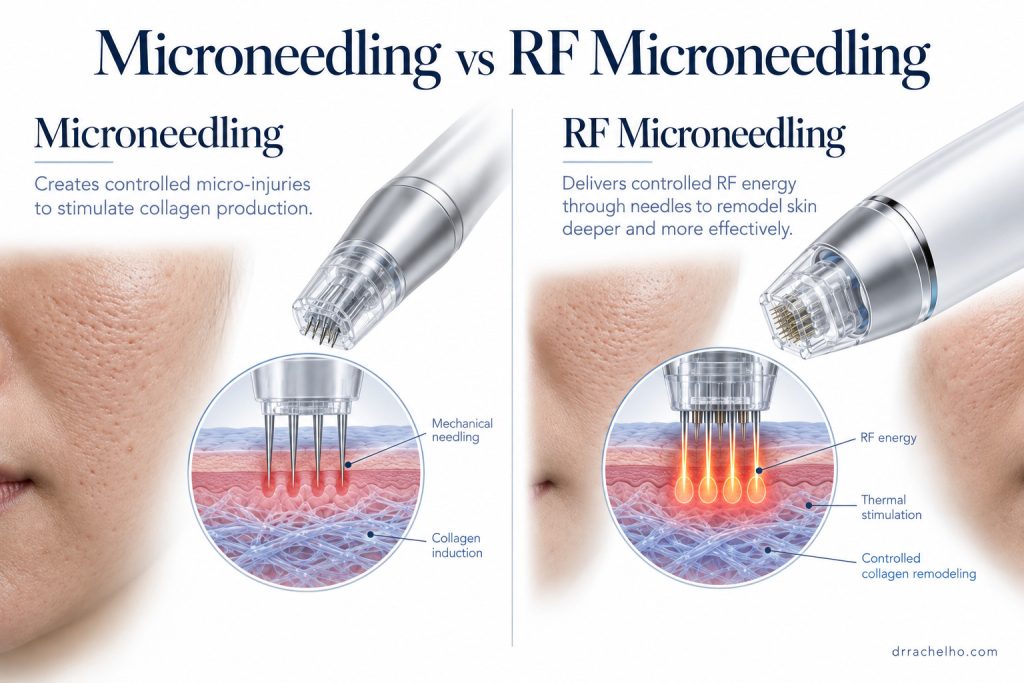
Conventional microneedling creates controlled mechanical injury, while RF microneedling adds controlled thermal energy within the skin. Both have evidence for acne scars; RF microneedling should not automatically be considered the better treatment for every patient
Microneedling and RF microneedling at a glance
FAQ about microneedling and RF microneedling
| Question | Evidence based answer |
|---|---|
| What is microneedling? | Fine needles create controlled microscopic injuries that stimulate wound healing and dermal remodelling¹. |
| What is RF microneedling? | Microneedles deliver radiofrequency energy within the skin, combining mechanical injury with controlled thermal stimulation². |
| What treatment has the strongest evidence? | Atrophic acne scars have the strongest clinical evidence for both conventional and RF microneedling¹˒²˒³. |
| Can RF microneedling improve pores? | RF microneedling has shown improvement in visible enlarged pores in clinical studies⁴˒⁷. |
| How many sessions of microneedling or RF microneedling are required? | Many acne scar studies use approximately three to four treatments, although protocols differ²˒⁴˒⁵. |
| What is the downtime for RF microneedling or microneedling alone? | Redness, swelling and temporary roughness commonly last several days, with recovery varying according to treatment intensity¹˒²˒⁵. |
| Does Asian skin need any special consideration? | Post inflammatory hyperpigmentation remains an important consideration, although RF microneedling has performed favourably against fractional lasers in some Asian studies⁵˒⁶. |
For more procedural information about, my clinic, The Skin Longevity Clinic has a separate guide to radiofrequency microneedling treatments in Singapore.
Are microneedling and RF microneedling the same treatment?
No, microneedling and RF microneedling are not the seame treatmetn. Conventional microneedling and RF microneedling both use needles, but RF microneedling additionally delivers radiofrequency energy within the skin². This creates controlled thermal injury alongside the mechanical injury from the needles, whereas conventional microneedling relies primarily on mechanical stimulation¹˒².
The distinction is important when interpreting clinical studies because evidence for one modality should not be extrapolated to the other².
What is microneedling?
Microneedling, also called percutaneous collagen induction, uses fine sterile needles to create controlled microscopic channels in the skin. These injuries activate wound healing pathways associated with collagen production and extracellular matrix remodelling¹.
Clinical trials and systematic reviews support microneedling for atrophic acne scars¹˒³. Treatment protocols differ in needle depth, treatment frequency and outcome measures, which means results from one study should not be extrapolated to every microneedling device³.
What is RF microneedling?
RF microneedling combines needle penetration into the skin with controlled radiofrequency energy delivery. Depending on the device and settings, RF energy at specific depths can create controlled thermal zones within the dermis, to cause biological responses such as neocollagenesis and remodelling².
The addition of thermal energy is what distinguishes RF microneedling from conventional microneedling. Histological and clinical studies have demonstrated changes in collagen and elastin alongside improvements in selected acne scars, skin texture and enlarged pores⁴.
Microneedling vs RF microneedling
Microneedling VS RF microneedling: What are the differences
| Conventional microneedling | RF microneedling | |
|---|---|---|
| Mechanical needling | Yes | Yes |
| Radiofrequency energy | No | Yes |
| Thermal injury | No deliberate thermal energy | Controlled thermal energy |
| Atrophic acne scar evidence | Yes¹˒³ | Yes²˒⁵ |
| Enlarged pore evidence | More limited | Clinical studies available⁴˒⁷ |
| Treatment depth | Needle penetration | Needle depth plus RF delivery |
| Recovery | Depends on treatment intensity | Depends on needle depth, RF energy and density |
RF microneedling is therefore a different treatment rather than simply a “stronger” version of microneedling.
Which microneedling treatment may best suit which skin concern?
Microneedling for skin concerns
| Concern | Where microneedling may fit |
|---|---|
| Broad atrophic acne scars | Conventional or RF microneedling may be considered¹˒²˒³ |
| Rolling scars with tethering | Subcision may be required before or alongside resurfacing⁹ |
| Deep ice pick scars | Focal treatments such as TCA CROSS may be more appropriate⁹ |
| Shallow boxcar scars | Microneedling, RF microneedling or fractional resurfacing may be considered⁹ |
| Enlarged pores | RF microneedling has clinical evidence for improving visible pore appearance⁴˒⁷ |
| Active inflammatory acne | Control of ongoing acne generally takes priority before scar correction⁹ |
| Patients prone to PIH | Skin type, inflammation and treatment intensity need particular consideration⁵˒⁶ |
Different types of acne scars frequently coexist, so several treatment mechanisms may be needed on the same face.
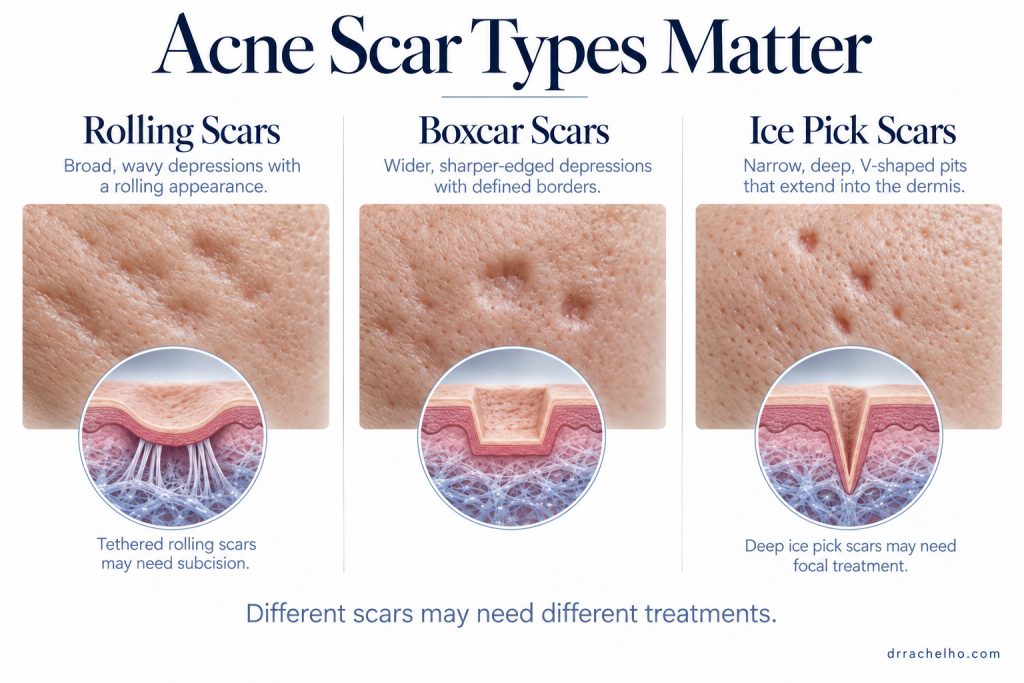
Choosing microneedling for acne scars starts with identifying the scar type. Microneedling and RF microneedling may help broader areas of atrophic scarring, while tethered rolling scars may need subcision and deep ice pick scars may need focal treatment such as TCA CROSS
Does microneedling work for acne scars?
Yes, microneedling is an evidence based treatment for improving atrophic acne scars, which are depressed scars caused by loss or remodelling of dermal tissue¹˒³.
A systematic review and meta analysis of randomised controlled trials found significant improvement in acne scars following microneedling treatment³. However, differences in treatment protocols and comparison groups limited the ability to identify one universally superior microneedling protocol³.
RF microneedling also has a growing evidence base. A 2025 systematic review evaluated 16 studies involving 481 patients and concluded that fractional RF microneedling appeared effective as a standalone treatment for acne scars, while noting substantial differences between devices and treatment parameters².
These findings support microneedling as one treatment option for acne scars.
Which acne scars respond to microneedling?
Rolling scars, boxcar scars and ice pick scars have different shapes and underlying structural abnormalities⁹. This distinction matters more clinically than simply describing all depressed marks as acne scars.
Microneedling and RF microneedling are generally more useful for broader areas of atrophic scarring and textural irregularity¹˒⁹. Deep ice pick scars may respond better to focal treatments such as TCA CROSS, while tethered rolling scars may require subcision to release fibrous attachments beneath the skin⁹.
For a visual explanation of these scar types, read my clinic’s guide to acne scar treatment in Singapore. The clinic also has separate guides to subcision for acne scars and TCA CROSS for ice pick scars.
What acne scars are less likely to respond to RF microneedling alone?
Deep ice pick scars are narrow defects that extend further into the dermis, so broad collagen remodelling treatments may produce limited correction when used alone⁹. Tethered rolling scars can also remain depressed if fibrous attachments underneath the scar have not been released⁹.
Patients frequently have several scar types on the same face. Combination treatment is therefore common because different procedures can address different structural components of the scars⁹.
Dr Rachel Ho’s clinical approach
For acne scars, I start with the structure of the scar rather than the name of the device. Tethered rolling scars, deep ice pick scars and shallow boxcar scars represent different anatomical problems, so expecting one technology to treat all of them equally is unrealistic.
This distinction is also why I prefer to assess acne scars individually during the consultation before recommending repeated sessions of any one resurfacing procedure.
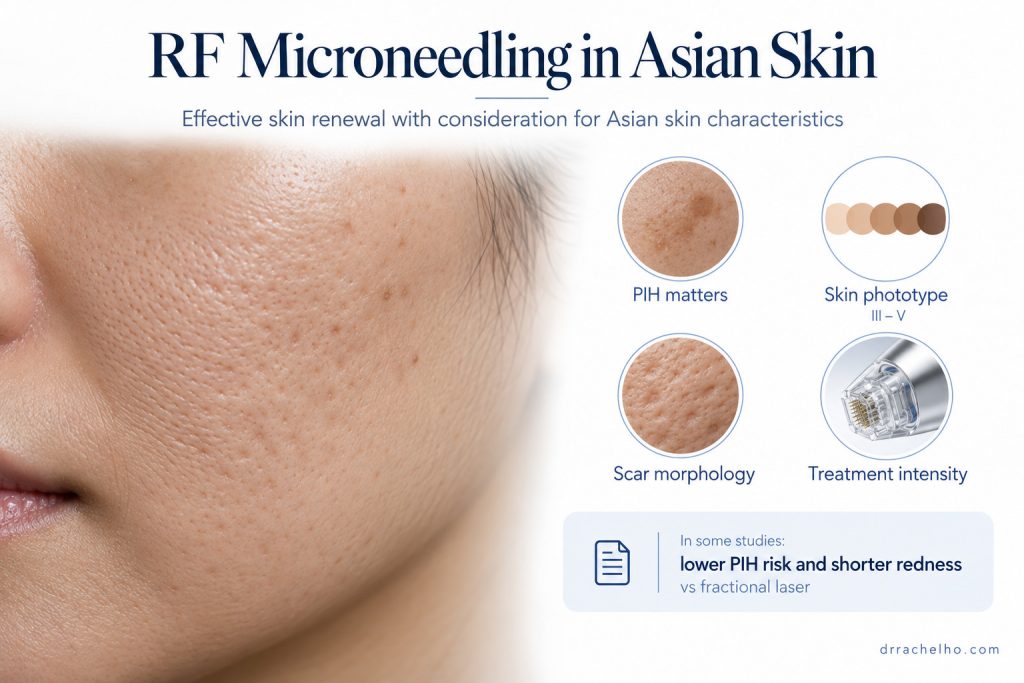
For patients considering RF microneedling in Singapore, skin phototype, previous pigmentation, scar structure and treatment intensity are important considerations. Asian skin includes a wide range of skin tones and responses, and post inflammatory hyperpigmentation remains possible after treatment.
Does RF microneedling work for acne scars in Asian skin?
Clinical studies involving Asian patients have shown improvement in atrophic acne scars after fractional RF microneedling⁵. This evidence is particularly relevant when post inflammatory pigmentation is part of treatment planning.
A prospective study involving Asian patients with Fitzpatrick skin phototypes III to V reported improvement after three fractional RF microneedling sessions⁵. Temporary redness, swelling and pigment changes were among the adverse effects reported in the study⁵.
A meta analysis focused on Asian patients found comparable acne scar improvement between fractional RF and fractional laser treatments, while RF was associated with a lower pooled incidence of post inflammatory hyperpigmentation and a shorter duration of redness⁶.
Asian skin includes a wide spectrum of skin tones and biological responses. Previous post inflammatory pigmentation, skin phototype, scar morphology and treatment intensity are therefore more useful considerations than ethnicity alone in the evaluation of suitability of RF microneedling for acne scars.
My guide to skin longevity for Asian skin discusses these considerations in greater detail.
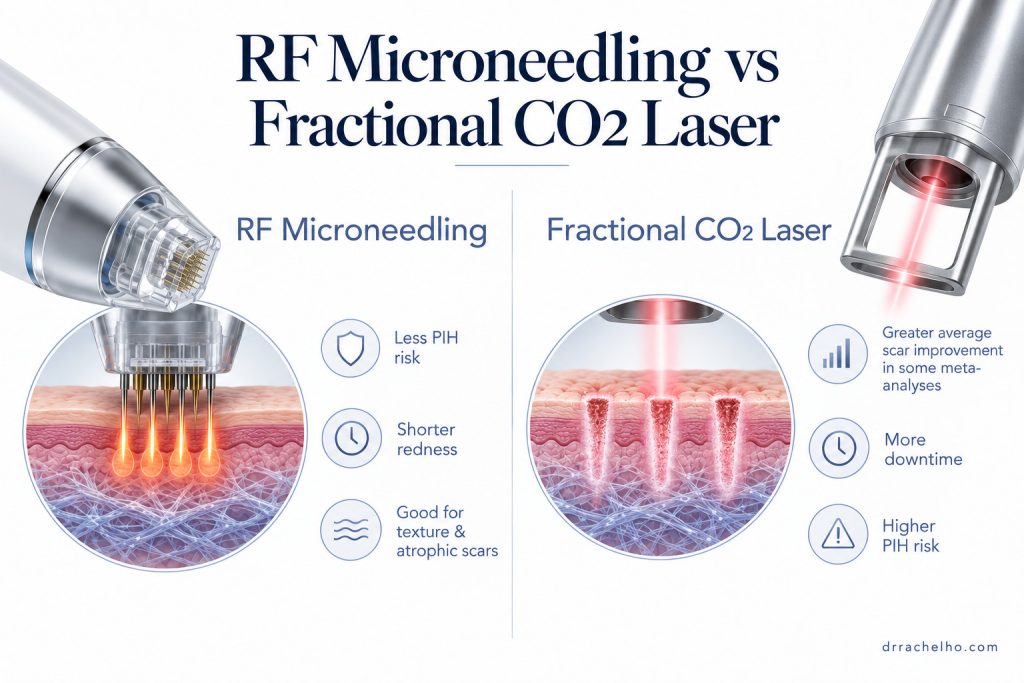
RF microneedling and fractional CO2 laser can both improve atrophic acne scars. Some comparative analyses favour fractional CO2 laser for scar improvement, while RF microneedling has shown lower post inflammatory hyperpigmentation risk and shorter lasting redness. Treatment selection depends on scar structure, pigment risk and acceptable recovery.
RF microneedling vs fractional CO2 laser for acne scars
Both RF microneedling and fractional CO2 laser stimulate dermal remodelling, but they create tissue injury differently. Fractional CO2 laser creates microscopic columns of ablative and thermal injury through the skin, while RF microneedling delivers thermal energy at selected depths through needles⁸˒¹⁰.
Recent comparative evidence provides a useful perspective on RF microneedling vs fractional CO2 laser. A 2026 meta analysis of eight randomised trials involving 249 patients found greater average acne scar improvement and patient satisfaction with fractional CO2 laser, while RF microneedling was associated with less post inflammatory hyperpigmentation and shorter lasting redness among subjects⁸.
What did the 2026 meta analyses comparing microneedling radiofrequency VS fractional CO2 laser find?
The 2026 meta analysis of eight randomised controlled trials found greater scar improvement with fractional CO2 laser than microneedling radiofrequency, with a mean difference of 0.31. Fractional CO2 laser was also associated with a substantially higher risk of post inflammatory hyperpigmentation, with a relative risk of 4.44, and erythema lasted an average of 1.72 days longer⁸.
A second 2026 meta analysis involving 17 comparative studies found no statistically significant difference in mean scar score reduction or quantitative scar reduction overall. Categorical treatment success modestly favoured fractional CO2 laser, while its pooled risk of post inflammatory hyperpigmentation was approximately three times that of needling based treatments¹⁰.
Taken together, the evidence suggests that both treatments can improve atrophic acne scars. Ultimately, the choice to proceed with RF microneedling or fractional CO2 laser involves consideration of the scar morphology, pigment risk and acceptable recovery or downtime.
My clinic’s guide to fractional CO2 laser in Singapore explains this treatment in more detail.
RF microneedling vs pico laser for acne scars
Fractional pico laser and RF microneedling stimulate remodelling through different physical mechanisms. Fractional pico treatments create microscopic optical injury, while RF microneedling combines needle injury with controlled radiofrequency heating.
Direct comparative evidence between the two approaches remains less developed than the evidence comparing RF microneedling with fractional CO2 laser, so it’s hard to tell if one modality is better than the other for the treatment of acne scars.
My pico laser review explains the evidence behind picosecond laser treatments. My clinic guide also has a procedural guide to pico laser treatments in Singapore.
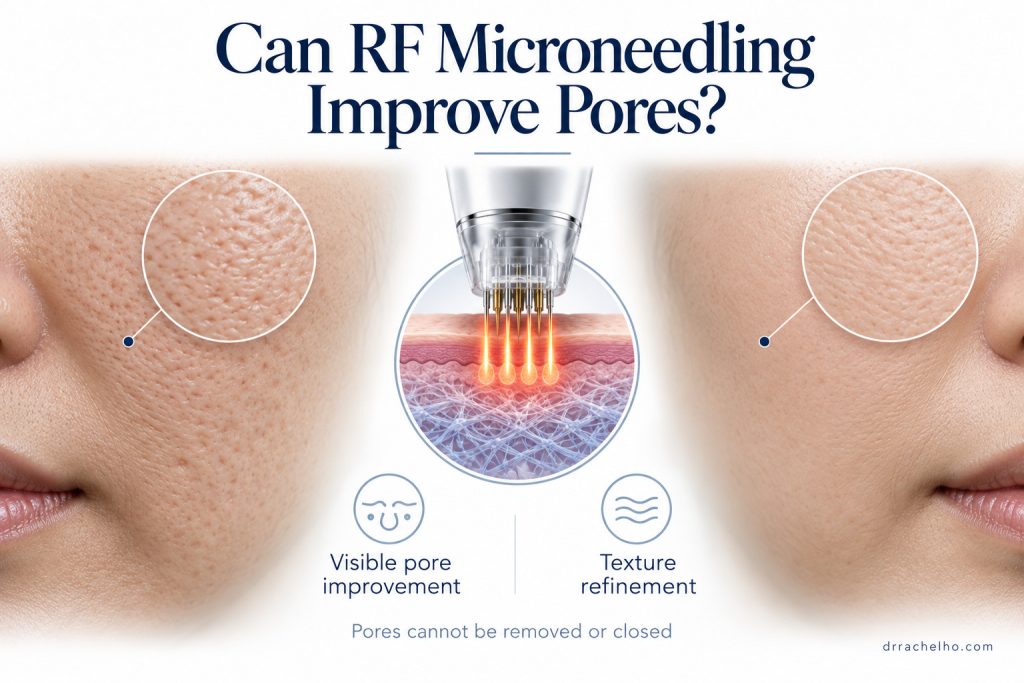
RF microneedling may improve the visible appearance of enlarged pores, but it cannot remove or close these normal skin openings. Evidence for pore improvement is more limited than for acne scars. These illustrations explain the concept and do not represent an actual patient’s treatment results
Does microneedling reduce enlarged pores?
RF microneedling can improve the visible appearance of enlarged pores in selected patients⁴˒⁷. Because pores are normal anatomical openings in the skin, it is impossible to remove or close pores in the skin. For more about the different causes of visible pores, please read my guide to large pores and their treatment.
A study of 31 Korean patients reported improvement in enlarged pores, acne scars and skin elasticity after four fractional RF sessions, alongside histological findings consistent with dermal remodelling⁴. A retrospective study of 75 patients also reported improvement in enlarged facial pores after fractional microneedle RF treatment⁷.
The evidence for enlarged pores remains less robust than the evidence for acne scars. Sebum production, follicular anatomy, acne and skin elasticity can all influence pore visibility, so RF microneedling represents only one possible treatment approach.
Can RF microneedling tighten skin?
RF microneedling can produce dermal remodelling and has been studied for changes in firmness and mild laxity². The degree of improvement depends on treatment depth, energy delivery, the device used and the amount of laxity present.
How many RF microneedling sessions are needed?
Many clinical studies use a series of approximately three to four sessions, although there is no universal number that applies to every patient²˒⁴˒⁵. Treatment intervals commonly extend over several weeks to allow tissue recovery and remodelling²˒⁴˒⁵.
Scar severity, treatment depth, energy settings and previous procedures influence how many treatments may be appropriate. Results should also be assessed over time because collagen remodelling continues for weeks to months after treatment.
When do RF microneedling results appear?
RF microneedling results develop gradually because tissue remodelling continues after the visible redness and swelling have resolved²˒⁵. Acne scar studies commonly assess improvement several weeks to months after a treatment course rather than during the immediate recovery period²˒⁵.
How long does RF microneedling take to work?
Early changes in skin texture may become noticeable during a treatment course, although collagen remodelling actually continues beyond the immediate recovery period²˒⁵. Acne scar studies commonly assess outcomes several weeks or months after the final treatment rather than immediately afterwards²˒⁵.
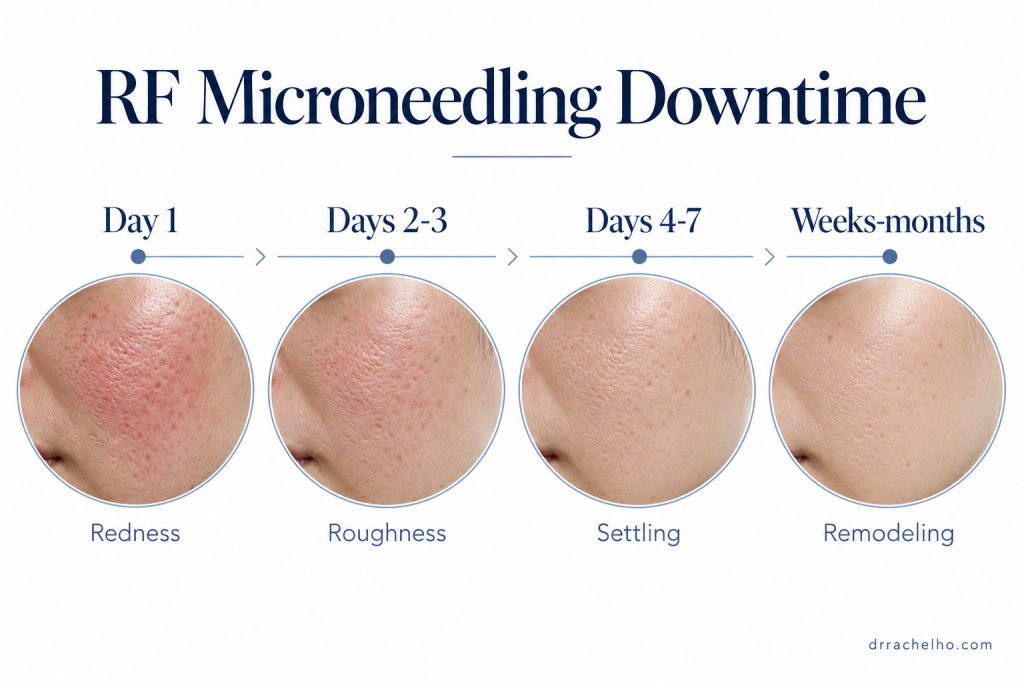
RF microneedling downtime commonly involves several days of redness, swelling or temporary roughness, while skin remodelling continues over weeks to months. This illustrated timeline is a general guide rather than a guaranteed recovery schedule; treatment settings and individual skin response affect recovery.
What is the downtime after microneedling?
Redness, swelling, warmth and temporary roughness are commonly reported after microneedling and RF microneedling¹˒²˒⁵. Pinpoint bleeding, superficial crusting and temporary pigment changes can also occur depending on treatment depth and intensity⁵.
Many clinical studies describe visible reactions that settle over several days¹˒²˒⁵. Recovery varies according to the device, needle depth, RF energy, treatment density and individual skin response.
Typical recovery timeline for RF microneedling
Timeline for recovery after RF microneedling
| Timeline | Appearance and symptoms |
|---|---|
| First day | Redness, warmth and mild swelling |
| Following days | Temporary roughness, dryness or mild crusting can occur |
| After visible recovery | Skin texture gradually normalises while dermal remodelling continues |
| Weeks to months | Collagen remodelling and scar improvement continue to evolve |
This timeline is a general guide rather than a guarantee for every device or treatment setting.
Is RF microneedling painful?
Discomfort varies according to needle depth, RF energy, anatomical area and the individual treatment protocol. Clinical acne scar studies report treatment related pain, although severity varies substantially between devices and protocols²˒⁵. In my clinic, topical anaesthesia with numbing cream is used to reduce discomfort during the treatment.
Is RF microneedling safe?
RF microneedling has been evaluated in numerous clinical studies and systematic reviews, with transient redness, swelling and discomfort among the commonly reported reactions². Safety also depends on anatomical knowledge, needle depth, RF energy, device design and operator technique.
In October 2025, the United States FDA issued a safety communication after receiving reports of serious complications associated with certain uses of RF microneedling devices, including burns, scarring, fat loss and nerve injury¹¹. The FDA advised patients to seek appropriately trained licensed healthcare providers and stated that RF microneedling devices should not be used at home¹¹.
This update reinforces why RF microneedling should be regarded as a medical procedure rather than simply a facial treatment.
Can RF microneedling cause pigmentation?
Post inflammatory hyperpigmentation can occur after procedures that create inflammation or thermal injury in the skin⁵˒⁶. The risk varies with skin type, treatment intensity and individual pigment response.
Comparative studies in Asian patients suggest that RF microneedling may carry a lower pigmentary risk than some fractional laser treatments, although this does not eliminate the possibility of pigmentation⁶.
Patients with a history of persistent pigmentation after acne, lasers or other procedures should mention this during treatment planning.
Can microneedling be performed when acne is still active?
Acne scar treatment is usually planned once significant inflammatory acne is under control because continuing acne can produce additional scars and post inflammatory marks⁹. My approach to treating patients with acne and acne scars is to stabilise the inflammatory acne first before embarking on acne scar treatments. My clinic’s guide to acne assessment and medical treatment will take you through how I treat acne in Singapore. My guide to adult and hormonal acne treatment explains the treatment of active acne in more detail.
What determines the cost of RF microneedling in Singapore?
RF microneedling prices vary because devices, treatment areas, needle configurations and the number of sessions differ. A consultation should establish what is being treated and whether RF microneedling is actually the appropriate procedure before the number of sessions is decided. For specific treatment information about RF microneedling in my clinic please refer to The Skin Longevity Clinic’s guide to RF microneedling in Singapore.
What should you consider when choosing microneedling in Singapore?
The term microneedling can describe different procedures, so I would first establish whether the proposed treatment is conventional microneedling or RF microneedling. For RF treatments, the device, needle design, treatment depth, RF energy and treatment density can influence the tissue response².
I would also ask:
- What skin concern is being treated? Acne scars, enlarged pores and skin laxity require different treatment planning.
- What scar types are present? Rolling, boxcar and ice pick scars may require different procedures⁹.
- Who performs the procedure? RF microneedling should be treated as a medical procedure rather than a home skincare treatment¹¹.
- How are treatment depth and energy selected? Anatomical area, skin thickness and treatment objective matter.
- What is the recovery plan? Pigment tendency and previous post inflammatory hyperpigmentation should be discussed beforehand.
- Which device is being used? Clinical evidence and regulatory status are device specific.
Is RF microneedling worth considering for acne scars?
RF microneedling is one of the evidence based option for selected atrophic acne scars²˒⁵. It offers a different balance of dermal remodelling, downtime and pigmentary risk compared with fractional laser resurfacing⁶˒⁸˒¹⁰.
Its effectiveness and value depends on scar morphology being treated. Deep ice pick scars and tethered rolling scars may require other procedures, while broader areas of atrophic texture can be more suitable for collagen remodelling treatments⁹.
Frequently asked questions about microneedling
Is RF microneedling better than normal microneedling?
RF microneedling adds controlled thermal energy to the mechanical effect of needling². Conventional microneedling still has evidence for acne scars, so RF should not automatically be assumed to be superior for every patient¹˒³.
How many microneedling sessions are usually needed for acne scars?
Clinical studies commonly use a series of approximately three to four treatments, although protocols and scar severity vary²˒⁴˒⁵. Treatment planning should therefore be individualised.
Does microneedling permanently remove acne scars?
Microneedling can improve the appearance of atrophic acne scars but does not guarantee complete removal¹˒³. Residual scars may remain, particularly when several scar types coexist.
Can RF microneedling make pores smaller?
Clinical studies report improvement in the visible appearance of enlarged pores after fractional RF treatment⁴˒⁷. The anatomical pore remains present.
Is RF microneedling suitable for darker skin?
RF microneedling has been studied successfully in Asian and darker skin phototypes⁵˒⁶. Post inflammatory pigmentation remains possible, so treatment parameters and previous pigment responses should still be considered.
How long is the downtime with RF microneedling?
Visible redness and swelling commonly settle over several days, although recovery depends on treatment depth, RF energy and individual response¹˒²˒⁵.
Does RF microneedling build collagen?
RF microneedling produces controlled mechanical and thermal injury within the dermis, and histological studies have demonstrated changes consistent with collagen and elastin remodelling after treatment²˒⁴. The degree of visible clinical improvement depends on the condition treated and treatment protocol.
Is microneedling good for deep acne scars?
Microneedling can improve selected atrophic acne scars, but deep ice pick scars and tethered rolling scars may require different treatment mechanisms⁹. Scar morphology should therefore be assessed before choosing a procedure.
RF microneedling or fractional CO2 laser: which has less downtime?
Comparative studies generally show shorter erythema duration and a lower pigmentary risk with RF microneedling than fractional CO2 laser, while some analyses show greater scar improvement with fractional CO2 laser⁶˒⁸˒¹⁰.
Can RF microneedling make acne scars worse?
Temporary redness, swelling, crusting and pigment changes can occur after treatment¹˒²˒⁵. The FDA has also received reports of uncommon but serious complications from certain RF microneedling uses, reinforcing the importance of appropriate device use and medical supervision¹¹.
Can I do RF microneedling if I have active acne?
Scar treatment is generally planned after significant inflammatory acne is controlled because new inflammatory lesions can continue to create marks and scars⁹.
What is the difference between RF microneedling and fractional laser?
RF microneedling delivers radiofrequency energy through needles within the skin, while fractional lasers deliver optical energy from the skin surface to create microscopic treatment zones⁸˒¹⁰. Their tissue interactions, recovery profiles and pigmentary risks therefore differ.
Does RF microneedling build collagen?
RF microneedling produces controlled mechanical and thermal injury within the dermis, and histological studies have demonstrated changes consistent with collagen and elastin remodelling after treatment²˒⁴. The degree of visible clinical improvement depends on the condition treated and treatment protocol.
Is microneedling good for deep acne scars?
Microneedling can improve selected atrophic acne scars, but deep ice pick scars and tethered rolling scars may require different treatment mechanisms⁹. Scar morphology should therefore be assessed before choosing a procedure.
RF microneedling or fractional CO2 laser: which has less downtime?
Comparative studies generally show shorter erythema duration and a lower pigmentary risk with RF microneedling than fractional CO2 laser, while some analyses show greater scar improvement with fractional CO2 laser⁶˒⁸˒¹⁰.
Can RF microneedling make acne scars worse?
Temporary redness, swelling, crusting and pigment changes can occur after treatment¹˒²˒⁵. The FDA has also received reports of uncommon but serious complications from certain RF microneedling uses, reinforcing the importance of appropriate device use and medical supervision¹¹.
Can I do RF microneedling if I have active acne?
Scar treatment is generally planned after significant inflammatory acne is controlled because new inflammatory lesions can continue to create marks and scars⁹.
What is the difference between RF microneedling and a fractional laser?
RF microneedling delivers radiofrequency energy through needles within the skin, while fractional lasers deliver optical energy from the skin surface to create microscopic treatment zones⁸˒¹⁰. Their tissue interactions, recovery profiles and pigmentary risks therefore differ.
Microneedling: what the current evidence supports
Evidence is strongest for
- conventional microneedling for atrophic acne scars¹˒³
- RF microneedling for selected atrophic acne scars²˒⁵
- RF microneedling for improving the appearance of enlarged pores⁴˒⁷
Evidence also suggests
- RF microneedling may have a lower post inflammatory hyperpigmentation risk than fractional laser treatment in some Asian populations⁶
- fractional CO2 laser may provide greater acne scar improvement in some comparative analyses, at the cost of greater pigmentary risk and recovery⁸˒¹⁰
Evidence does not establish
- one universal microneedling protocol for every acne scar³
- that RF microneedling is superior to conventional microneedling for every indication
- that one device’s results can automatically be extrapolated to another²
Dr Rachel Ho’s takeaway on RF microneedling treatments in Singapore
Microneedling is a useful category of collagen remodelling treatment, but the term covers procedures with meaningfully different mechanisms. Conventional microneedling relies principally on controlled mechanical injury, while RF microneedling adds thermal energy within the dermis¹˒².
For acne scars, I would start identifying the scar morphology first before selecting the treatment modality. t. Tethered rolling scars, deep ice pick scars and shallow boxcar scars represent different structural problems, so they should not receive the same treatment⁹.
Current evidence supports RF microneedling for selected atrophic acne scars and provides smaller but credible evidence for enlarged pores and texture²˒⁴˒⁷. Choosing between RF microneedling, fractional CO2 laser, fractional pico laser, subcision and focal scar treatments involves balancing the anatomy of the scar with recovery, pigment risk and the degree of improvement being sought.
About Dr Rachel Ho
This article is an evidence review by Dr Rachel Ho, an aesthetic doctor in Singapore whose clinical work includes acne scar assessment and energy based treatments. Treatment specific information for patients is published separately by The Skin Longevity Clinic.
Dr Rachel Ho is an aesthetic doctor in Singapore and founder of The Skin Longevity Clinic. Her clinical work includes acne scar assessment, energy based treatments, injectables and skin quality treatments. She writes about the evidence behind skincare and aesthetic medicine on drrachelho.com. Her approach to acne scars focuses on identifying scar morphology first and selecting treatments according to the structural problem being addressed.
References
- Juhasz MLW, Cohen JL. Microneedling for the Treatment of Scars: An Update for Clinicians. Clinical, Cosmetic and Investigational Dermatology. 2020;13:997 to 1003. doi:10.2147/CCID.S267192.
- Niaz G, Ajeebi Y, Alshamrani HM, Khalmurad M, Lee K. Fractional Radiofrequency Microneedling as a Monotherapy in Acne Scar Management: A Systematic Review of Current Evidence. Clinical, Cosmetic and Investigational Dermatology. 2025;18:19 to 29. doi:10.2147/CCID.S502295.
- Shen YC, Chiu WK, Kang YN, Chen C. Microneedling Monotherapy for Acne Scar: Systematic Review and Meta Analysis of Randomized Controlled Trials. Aesthetic Plastic Surgery. 2022;46(4):1913 to 1922. doi:10.1007/s00266-022-02845-3.
- Kim JE, Lee HW, Kim JK, et al. Objective Evaluation of the Clinical Efficacy of Fractional Radiofrequency Treatment for Acne Scars and Enlarged Pores in Asian Skin. Dermatologic Surgery. 2014;40:988 to 995. doi:10.1097/01.DSS.0000452625.01889.c3.
- Vejjabhinanta V, Wanitphakdeedecha R, Limtanyakul P, Manuskiatti W. The Efficacy in Treatment of Facial Atrophic Acne Scars in Asians With a Fractional Radiofrequency Microneedle System. Journal of the European Academy of Dermatology and Venereology. 2014;28(9):1219 to 1225. doi:10.1111/jdv.12267.
- Dai R, Xie H, Hua W, Li XH, Li L. The Efficacy and Safety of the Fractional Radiofrequency Technique for the Treatment of Atrophic Acne Scar in Asians: A Meta Analysis. Journal of Cosmetic and Laser Therapy. 2017;19(6):337 to 344. doi:10.1080/14764172.2017.1314507.
- Ren K, Liu H, Li B, Zhou B. Fractional Microneedle Radiofrequency Treatment for Enlarged Facial Pores: A Real World Retrospective Observational Study on 75 Patients. Journal of Cosmetic Dermatology. 2022;21(12):6742 to 6753. doi:10.1111/jocd.15339.
- Argobi Y, Tobeigei F, Alasiri FI. Fractional CO2 Laser Versus Micro Needling Radiofrequency for Post Acne Scarring: A Meta Analysis of RCTs. Journal of Cosmetic Dermatology. 2026;25(3):e70765. doi:10.1111/jocd.70765.
- Kim EY, Wong JH, Hussain A, Khachemoune A. Evidence Based Management of Cutaneous Scarring in Dermatology Part 2: Atrophic Acne Scarring. Archives of Dermatological Research. 2024;316(1):19. doi:10.1007/s00403-023-02737-9.
- Batool A, Abbas MS, Mahin FE, et al. Comparing Fractional CO2 Laser and Needling Based Modalities in Facial Acne Scar Treatment: A Comprehensive Systematic Review and Meta Analysis. Lasers in Medical Science. 2026;41:124. doi:10.1007/s10103-026-04905-5.
- US Food and Drug Administration. Potential Risks With Certain Uses of Radiofrequency RF Microneedling: FDA Safety Communication. Issued 15 October 2025.

No Comments