


05 Nov Laugh Lines: Nasolabial Filler, Results and Alternatives
Laugh Lines and Nasolabial Folds: A Doctor’s Review of Nasolabial Fillers and Alternatives
For a name so joyful, laugh lines aren’t so funny after all. Laugh lines or nasolabial folds are the lines around the mouth that are accentuated when we smile or laugh, hence their names. Their appearance reflects a combination of upper cheek sagging, reduced skin elasticity, changes in facial fat and repeated facial movement¹,²,³. This review on nasolabial fillers is a guide to everything you need to know about nasolabial folds and non-surgical treatments for laugh lines including laugh line fillers.
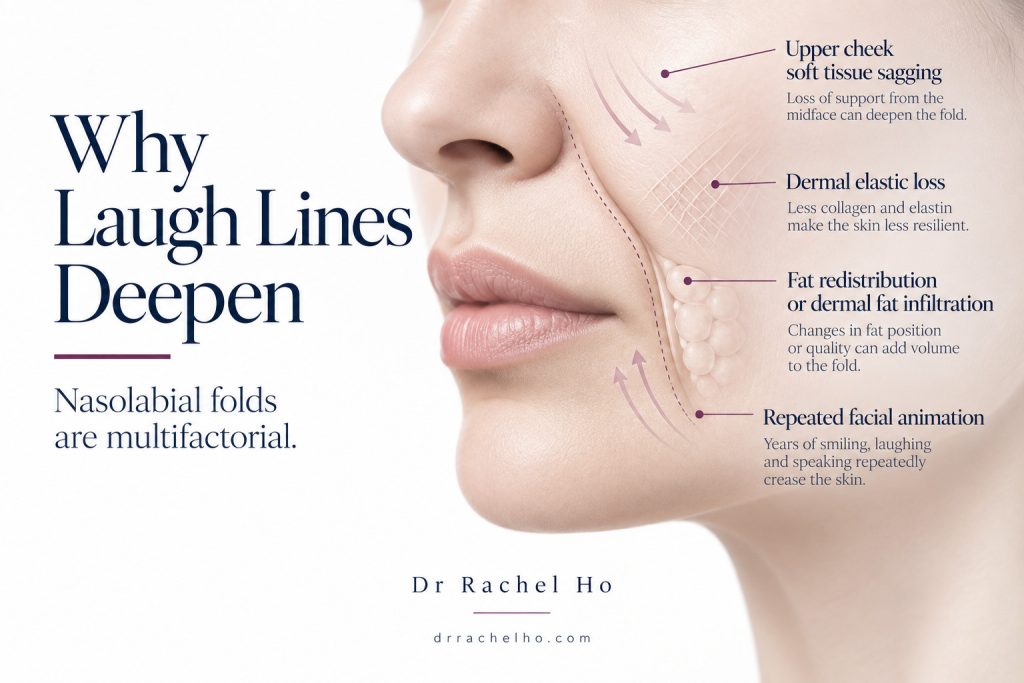
Nasolabial folds reflect changes in cheek position, skin elasticity, facial fat and movement¹,²,³. Studies have linked more pronounced folds with upper cheek sagging and reduced elasticity, including an association with fat infiltration into the dermis¹,².
Why do laugh lines become deeper?
Cheek fat redistribution and facial movement
The position of cheek fat and the supporting tissues influence the depth and appearance of the nasolabial fold¹. As we age, the structural fat pads in our midface naturally lose volume and gradually shift downward. Decades of everyday facial movements also place constant, repetitive stress on the connective tissues that anchor this fat in place. Over time, this cumulative stretching weakens the skin’s internal support network, causing the cheek fats to descend. This descent of facial fat pads results in a hollowed, tired appearance beneath the eyes, with a fuller lower face and deeper nasolabial folds.
Fat infiltration into the dermis
Fat can also extend from the subcutaneous layer into the dermis, where collagen and elastic fibres support the skin³. Ultrasound research in thirty Japanese women found that greater infiltration was associated with more severe nasolabial folds and reduced dermal elasticity³.
Collagen and elastin fibre changes
Independent of fat compartment shifts, the dermis itself loses structural integrity and support with age. Skin ageing also affects the density, thickness and organisation of collagen, while elastin fibres become fragmented and disorganised⁴. Cumulative ultraviolet exposure contributes to these changes, including the abnormal elastic tissue accumulation called solar elastosis⁴.
How can nasolabial filler reduce laugh lines?
Nasolabial fillers improve laugh-line appearance through both an immediate mechanical volumising effect and a delayed, longer-lasting biological effect on the dermis, depending on the type of dermal filler(s) administered.
Nasolabial fillers can immediately reduce laugh lines by immediate volume replacement. For example, hyaluronic acid when injected as a cross-linked filler into the nasolabial fold, adds volume and restores hydration to the treated area, directly filling the depression created by fat pad displacement, midface flattening, and loss of skin elasticity that occurs with aging.
Collagen biostimulators can have a delayed, but longer lasting lifting of the laugh lines. Collagen biostumulators such as Poly-L-Lactic Acid, Calcium Hydroxylapatite or Hybrid Cooperative Complex Injectable Moisturisers. Collagen biostimulators do not prop up the nasolabial fold , rather, they activate collagen building collagen mechanisms in the face to lift saggy skin and reposition the cheek fat pads. As a result, the cheeks and laugh lines look more lifted without the effects of volumisation. Some collagen biostimulators also improve skin hydration and skin texture as a secondary benefit. To learn more about collagen biostimulators in Singapore, please refer to my clinic page on Collagen Biostimnulators Singapore.
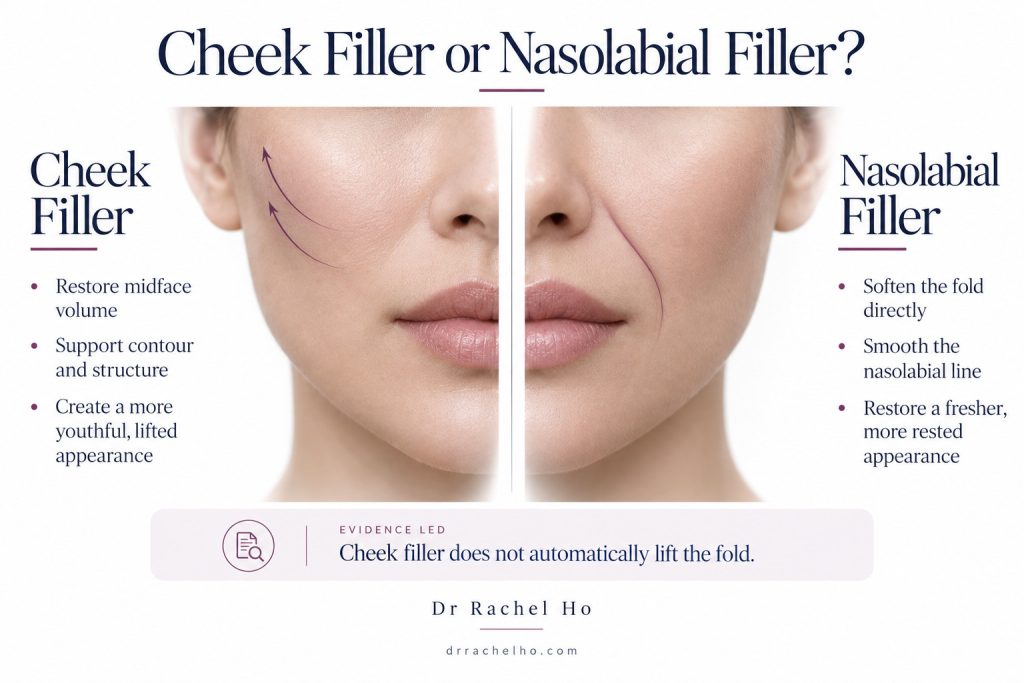
Restoring cheek volume and softening a nasolabial fold are different treatment objectives⁸.
Does cheek filler lift nasolabial folds?
Sagging of the cheeks contributes to severity of nasolabial folds. In some patients, cheek fillers, which lift and restore structural support in the midface, can have a distant lifting benefit on the laugh lines. My review of cheek fillers explains why restoring cheek volume and treating nearby smile lines should be discussed in combination with treatment of laugh lines.
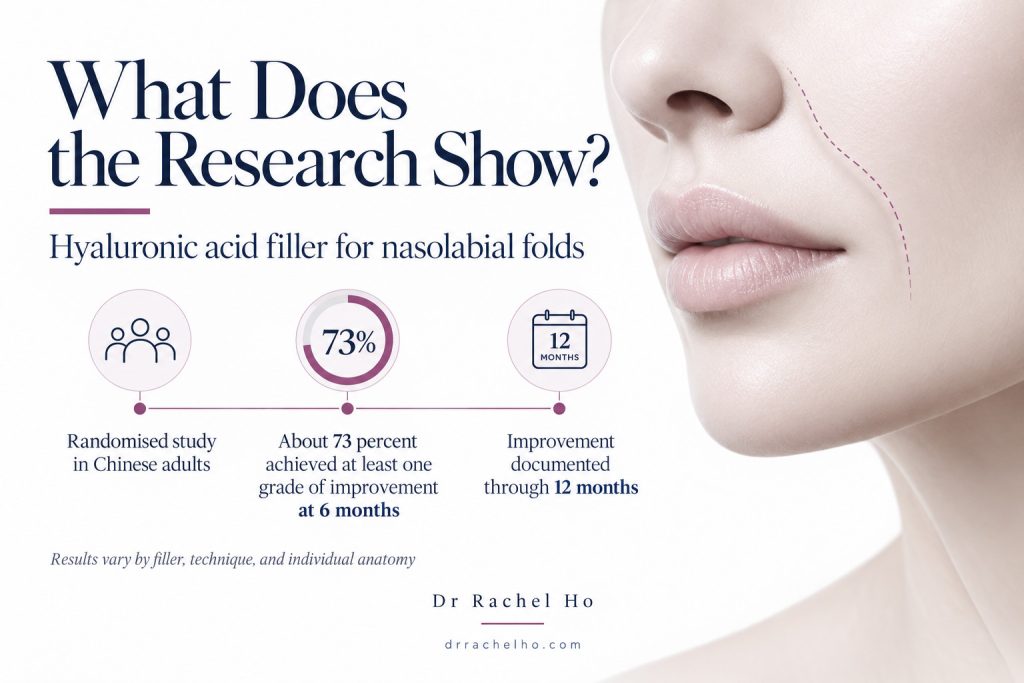
A 2022 randomised trial of 173 Chinese adults compared two HA fillers on opposite nasolabial folds⁷. About 73% met a threshold of at least one grade of improvement at six months, with improvement documented through twelve months⁷.
How well does nasolabial filler work, and how long does it last?
Hyaluronic acid fillers typically last 9-12 months. A randomised trial of 173 Chinese adults compared two HA fillers by treating a different nasolabial fold with each preparation⁹. At six months, approximately 73% achieved at least one grade of improvement in fold severity with each filler, according to a blinded evaluator⁹. Improvement was documented through twelve months of follow up⁹.
Is 1 ml of filler enough for laugh lines?
The amount of dermal fillers required to lift laugh lines is highly individualised due to variations in individual anatomy and skin support. While a minimum amount is required to produce a lift, it isn’t always the more the merrier with dermal fillers. Excess filler can create unwanted fullness or contour irregularity¹³. Laugh lines are natural in everyone, even children, and the objective of laugh line treatments should not be to obliterate them completely. My article on recognising excessive filler and changes in facial proportions explains more about how overfilling can distort facial anatomy.
What are the alternatives to HA nasolabial filler and collagen biostimulators?
XERF for laugh lines
XERF is a non-invasive, energy based device that delivers dual-frequency monopolar radiofrequency (6.78 MHz and 2 MHz) for uniform, volumetric heating deep into the dermal and subdermal layers. XERF induces the immediate denaturation and contraction of existing collagen fibers for an initial tightening effect, while simultaneously activating fibroblasts to initiate a sustained wound-healing cascade. Over the subsequent months, this cascade drives robust neocollagenesis and elastogenesis, fundamentally remodeling the extracellular matrix to lift the laugh lines and jawline. By structurally reinforcing the dermal architecture, restoring viscoelasticity, and optimizing cellular health, the treatment effectively resuspends the ptotic midfacial tissue that anchors and exacerbates nasolabial folds, resulting in a structurally supported, lifted appearance. For a full guide to XERF lifting treatments, please refer to my clinic’s treatment page on XERF.
What happens before and during nasolabial filler treatment?
As part of the facial assessment, the laugh lines are evaluated with the cheeks, skin health and over facial anatomy to ensure that any aesthetic treatment harmonises and does not distort my patient’s facial features. The nasolabial folds are highly mobile, so the facial assessment also includes an evaluation of their facial dynamics to ensure that the results are natural at rest and with movement.
Nasolabial fillers are administered via needle injection cannula approach after informed consent has been taken and photo documentation and numbing.
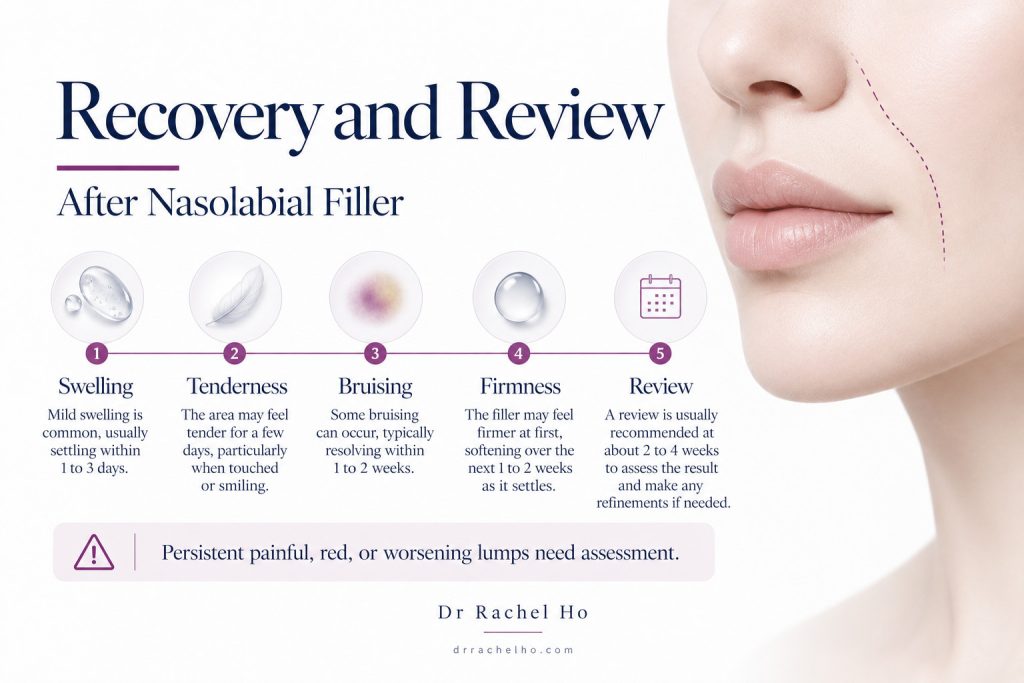
Swelling, bruising, tenderness and firmness can occur after nasolabial filler¹⁵. Expert consensus recommends review at approximately two to four weeks for a new treatment area, with earlier examination for concerning symptoms¹⁵
What should you expect during recovery?
Swelling, tenderness, bruising and firmness can occur after filler injections¹². A persistent lump deserves examination, particularly when it becomes painful, red or increasingly swollen¹³.
Although expert consensus recommends review at approximately two to four weeks for patients receiving treatment in a new area, I typically review my patients after dermal fillers in a week⁵. My clinic’s nasolabial filler recovery guide explains swelling, firmness, aftercare and when to seek help.
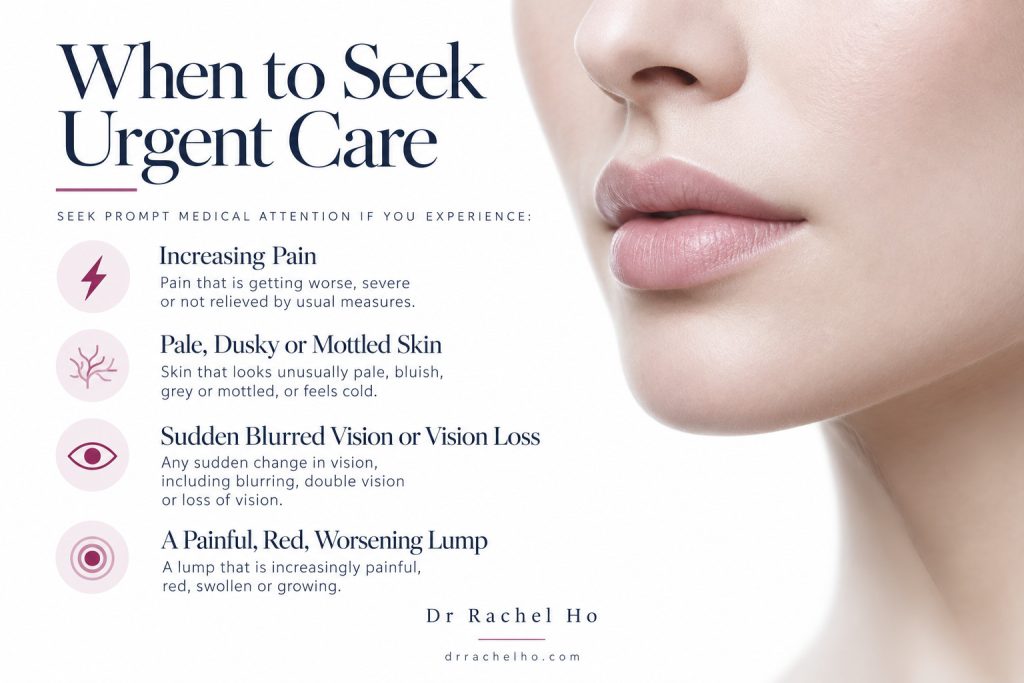
Increasing pain or unusually pale, dusky or mottled skin after filler requires immediate medical assessment¹⁶. Sudden blurred vision or loss of vision requires emergency care, while a painful, red or worsening lump also needs prompt examination¹⁷,¹⁸.
What are the risks of nasolabial filler?
Possible complications include an uneven contour, unwanted fullness, infection and delayed inflammatory nodules¹³. A serious complication occurs when filler compromises blood supply, potentially causing skin injury or vision loss¹⁴.
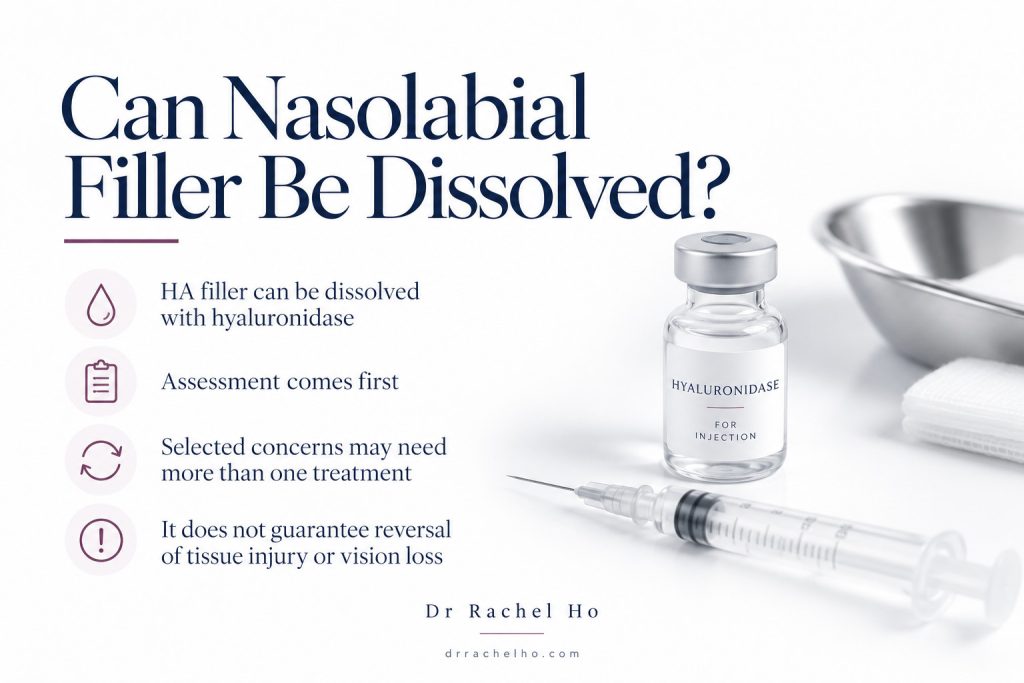
Hyaluronidase can break down HA filler for selected complications or unwanted results¹⁸. Treatment requires clinical assessment, may need repeating and carries risks including allergy; dissolving filler does not guarantee reversal of tissue injury or visual loss¹⁸.
Can nasolabial filler be dissolved?
Hyaluronidase can break down HA filler for selected complications or unwanted results¹³. My guide to dissolving fillers with hyaluronidase explains why this enzyme is not a universal reversal treatment for every filler material.
Choosing laugh line treatment in Singapore
Laugh lines are a natural part of human anatomy, even though they do look more obvious as we get older. To ensure natural looking results, the aim should be to lift the descended cheek folds and not to obliterate it totally. The nasolabial fold is also due to cheek fat descent, so treatment of the laugh lines should also be considered with the mid face complex.
My clinic’s guide to your first aesthetic consultation includes questions about consent, costs and ongoing care. Take time to consider the expected change, including the option to leave the area untreated.
Conclusion on nasolabial fold treatments
Laugh lines reflect changes in cheek fat, skin elasticity and facial movement, with neighbouring bone and ligament changes contributing to the broader appearance around the mouth¹,²,³,⁵,⁷. Nonetheless, laugh lines treatments should not aim to remove the nasolabial fold completely- it’s part of everyone’s natural anatomy. You can always for a natural, rejuvenated result without looking distorted!
References
- Owsley JQ, Roberts CL. Some anatomical observations on midface aging and long term results of surgical treatment. Plastic and Reconstructive Surgery. 2008;121:258 to 268.
- Kwon HJ, O J, Cho TH, Choi YJ, Yang HM. The Nasolabial Fold: A Micro Computed Tomography Study. Plastic and Reconstructive Surgery. 2020;145:71 to 79.
- Ezure T, Amano S, Matsuzaki K. Fat infiltration into dermal layer induces aged facial appearance by decreasing dermal elasticity. Skin Research and Technology. 2022;28:872 to 876.
- Assi A, Fischman S, Lopez C, et al. Evaluating facial dermis aging in healthy Caucasian females with LC OCT and deep learning. Scientific Reports. 2024;14:24113.
- Lynch B, Pageon H, Le Blay H, et al. A mechanistic view on the aging human skin through ex vivo layer by layer analysis of mechanics and microstructure of facial and mammary dermis. Scientific Reports. 2022;12:849.
- Jang SI, Kim EJ, Park H, et al. A quantitative evaluation method using processed optical images and analysis of age dependent changes on nasolabial lines. Skin Research and Technology. 2015;21:201 to 206.
- Hong GW, Kim SB, Park SY, Wan J, Yi KH. Why do marionette lines appear? Exploring the anatomical perspectives and role of thread based interventions. Skin Research and Technology. 2024;30:e13676.
- Nilforoushzadeh MA, Heidari Kharaji M, Fakhim T, et al. Efficacy evaluation of endolift laser for treatment of nasolabial folds and marionette lines. Skin Research and Technology. 2023;29:e13480.
- Xie Y, Wu W, Xu J, Wang X, Hu Z, Li Q. A randomized, multicenter study on a flexible hyaluronic acid filler in treatment of moderate to severe nasolabial folds in a Chinese population. Journal of Cosmetic Dermatology. 2022;21:4288 to 4293.
- Mowlds DS, Lambros V. Cheek Volumization and the Nasolabial Fold. Plastic and Reconstructive Surgery. 2018;141:1124 to 1129.
- Hong GW, Kim SB, Koppert E, et al. Filler Injection Techniques and Ultrasound Observations: Ultrasound Based Classification of Volume Deficiency in Nasolabial Folds. Aesthetic Plastic Surgery. 2026;50:350 to 357.
- Goodman GJ, Liew S, Callan P, Hart S. Facial aesthetic injections in clinical practice: Pretreatment and posttreatment consensus recommendations to minimise adverse outcomes. Australasian Journal of Dermatology. 2020;61:217 to 225.
- Kroumpouzos G, Treacy P. Hyaluronidase for Dermal Filler Complications: Review of Applications and Dosage Recommendations. JMIR Dermatology. 2024;7:e50403.
- Murray G, Convery C, Walker L, Davies E. Guideline for the Management of Hyaluronic Acid Filler Induced Vascular Occlusion. Journal of Clinical and Aesthetic Dermatology. 2021;14:E61 to E69.
- Walker L, Convery C, Davies E, Murray G, Croasdell B. Consensus Opinion for the Management of Soft Tissue Filler Induced Vision Loss. Journal of Clinical and Aesthetic Dermatology. 2021;14:E84 to E94.
- Alam M, Kakar R, Dover JS, et al. Rates of Vascular Occlusion Associated With Using Needles vs Cannulas for Filler Injection. JAMA Dermatology. 2021;157:174 to 180.

Pingback:Topic 1 : 8 จุดฮิต ฉีดตรงนี้ต้องใช้ฟิลเลอร์แค่ไหนกันนะ – Yvoire
Posted at 14:54h, 12 May[…] https://www.drrachelho.com/blog/laugh-lines-nasolabial-fillers-singapore/ […]