


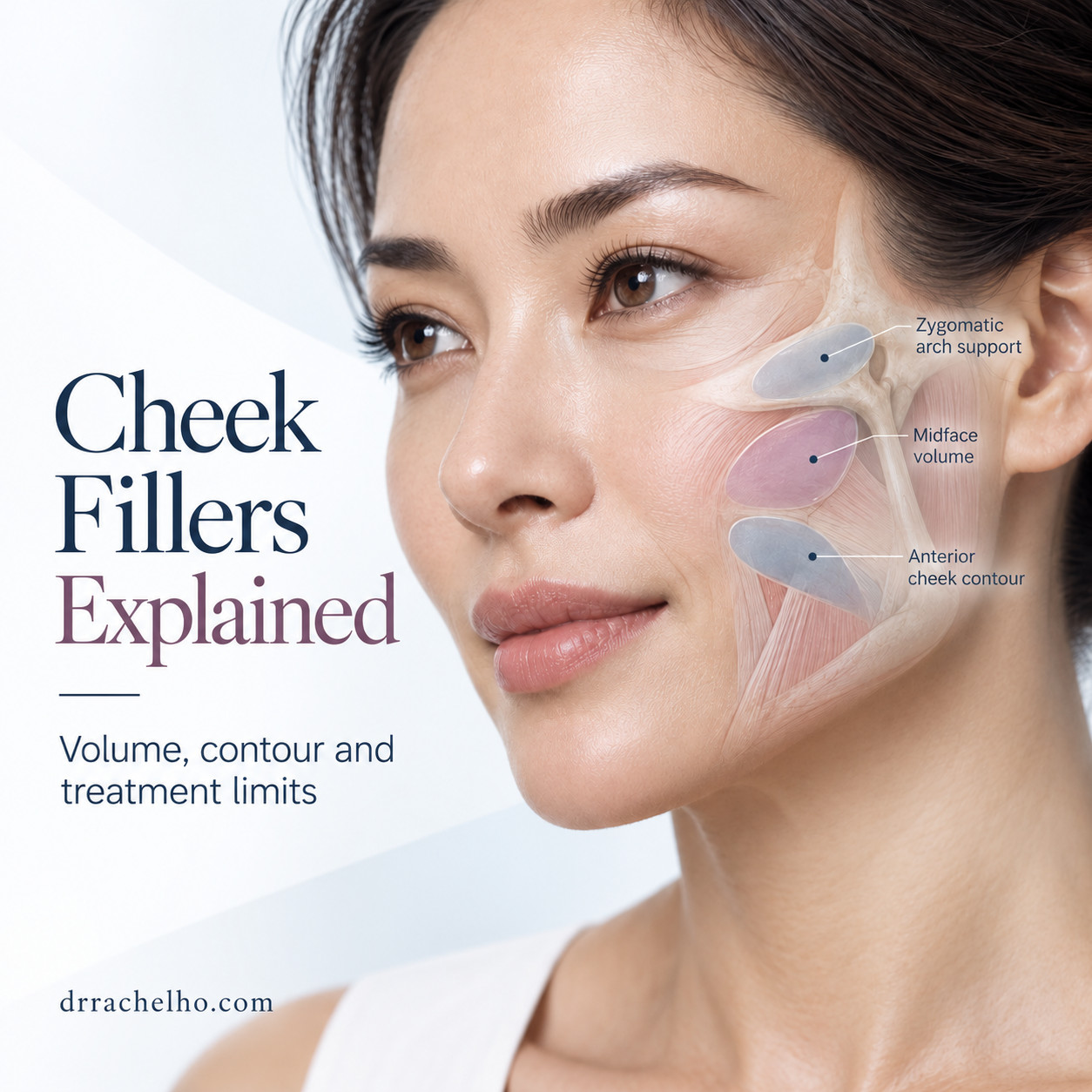
29 Jun Cheek Fillers Explained: Volume, Contour and Treatment Limits
Cheek Fillers Explained: Volume, Contour and Treatment Limits
The midface isn’t just the visual anchor of face- it’s also the structural anchor of the face. Over time, natural deep fat pad deflation and bone reabsorption can leave us looking tired or drawn leading to diminished structural support of the cheeks, laugh lines and jawline.
When it comes to non-surgical lifting of cheeks and laugh lines, hyaluronic acid (HA) cheek fillers have become one of the most versatile, evidence-based tools for midface rejuvenation. Restoring structural and support is one of the cornerstones of facial lifting, and contrary to popular belief, expertly placed cheek fillers do not distort and won’t leave you looking overfilled or prominent cheekbones. Allow my guide to cheek fillers bring you through some of the common questions about cheek fillers I get in my clinic in Singapore.
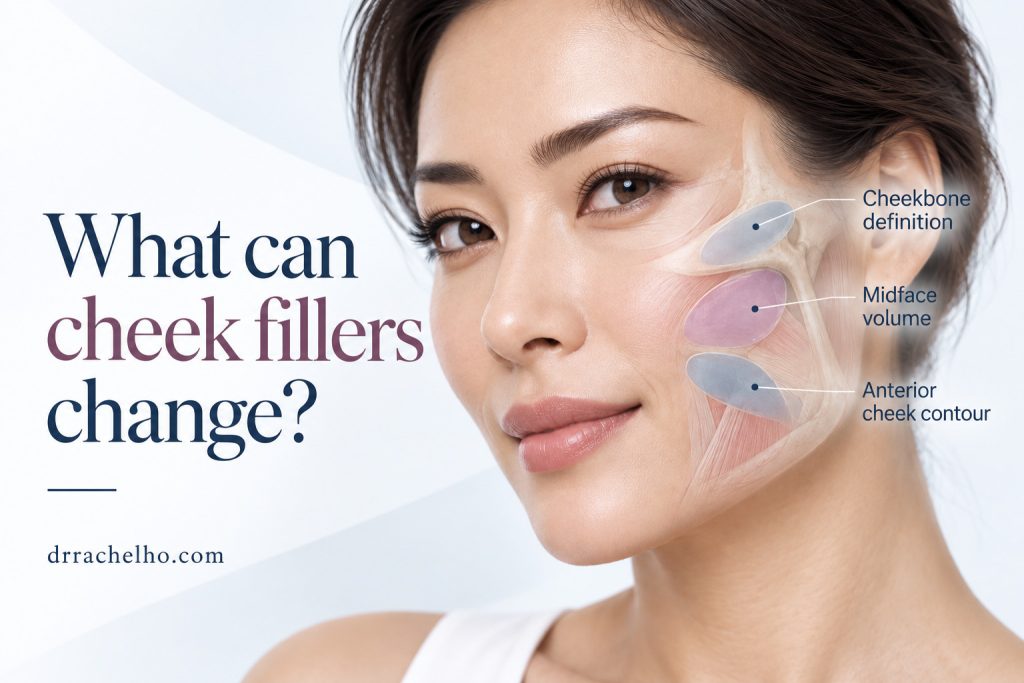
What can cheek fillers change. Cheek filler can be used to support cheekbone definition, midface volume and anterior cheek contour, depending on facial anatomy and treatment goals
What can cheek filler change?
The shape of the cheeks reflects the underlying contours and support from bones, fat compartments, muscles and skin². Changes in these layers with ageing can alter cheek projection and the transition between the lower eyelid and cheek². Hence the outcomes of ageing cheeks includes hollow cheeks, more obvious laugh lines and a eyelid and cheek seperation that can worsen tear trough hollows.
Besides replacing volume loss in hollow cheeks, cheeks filler placement can increase forward projection, and enhance cheek conotours². Due to the cheek’s central role in mid face support, cheek fillers can also lift the nasolabial folds and reduce the appearance of the tear trough hollowness to improve dark eye cirlces and eye bags. My clinic’s guide to facial hollowness and contour restoration provides more background on the benefits of contour resotoration and support in patients with volume loss across the face.
What are cheek fillers made of?
Most commonly, dermal fillers containing hyaluronic acid (HA fillers) are used in cheek fillers. HA fillers are gels with different rheologies and physical properties, including firmness, flexibility and tendency to swell². Those differences in the rheology of fillers influence how the filler performs in different subregions of the cheeks in a patientt².
Dermal fillers also consist of materials such as calcium hydroxylapatite and poly L lactic acid. For an overview of dermal fillers, please see my overview of dermal fillers. For patients who are new to aesthetic treatments or getting dermal fillers for their first time, I would recommend HA fillers as they can be reversed.
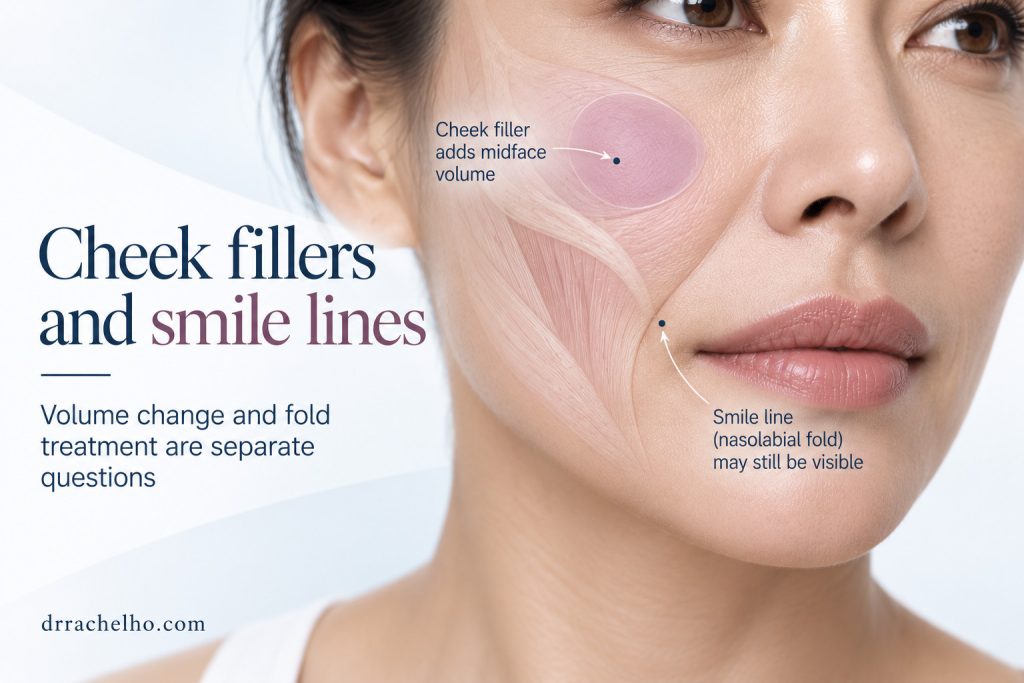
Cheek filler and smile lines are related but separate concerns. Adding volume to the cheeks may change facial proportions, but smile lines still need their own assessment
Do cheek fillers lift the face or improve smile lines?
Yes, cheek filler have a distant effect on the nasolabial folds or laugh lines³. Nasolabial folds, commonly called smile lines or laugh lines, are related. Descent of the cheek fat pads due to ageing directly contributes to obvious laugh lines- and lifting the cheeks can reduce the appearance of your laugh lines.
If you’re also interested in understanding more about laugh lines and their non-surgical treatments, my article on nasolabial folds and their treatment goes into depth for this topic.
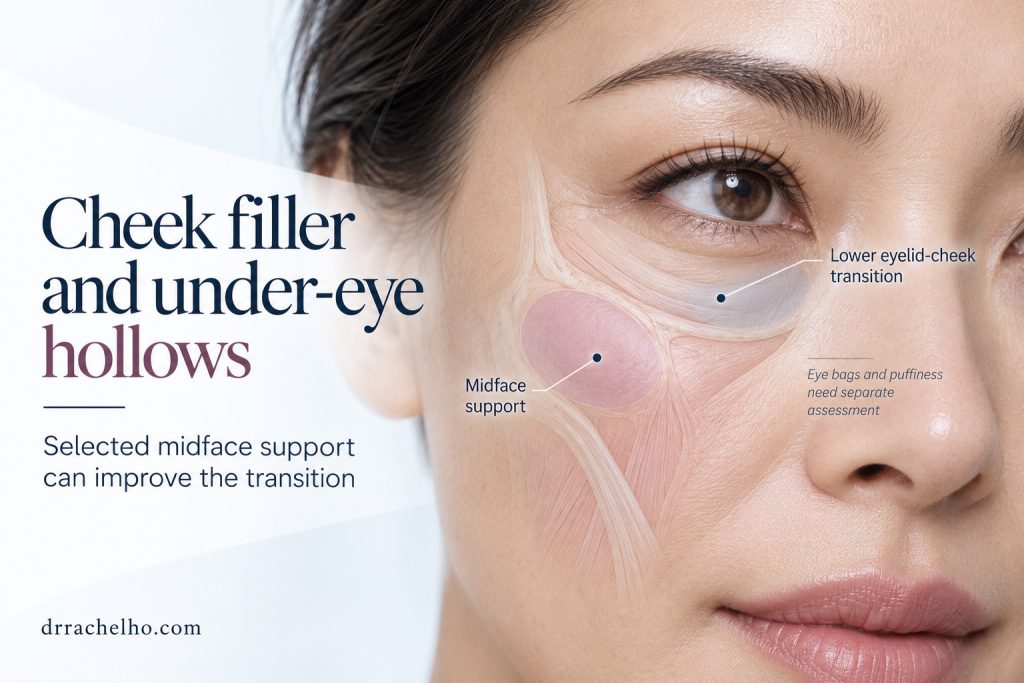
Midface support can influence the lower eyelid cheek transition. Under eye hollows, puffiness and eye bags still require a separate clinical assessment
Can cheek filler improve under eye hollows?
In selected patients, addressing deficient midface volume can improve the transition between the lower eyelid and cheek⁴. For some of my patients who lack a midface support and also have tear trough hollows, dark eye circles and eyebags, restoring the midface support is a priority to improve the mid face before embarking on dedicated under eye treatments.
That said, not every patient with eye bags or dark eye circles are candidates for cheek fillers. Patients who have persistent swelling, particularly where lymphatic drainage is compromised, or a condition known as malar festoons can find their under eyes looking more swollen after cheek fillers⁴.
What does the research show about cheek filler results?
A 2024 randomised study involving 148 Chinese adults compared one HA preparation with an initially untreated control group¹. At six months, 76% of treated participants achieved at least one grade of improvement in midface fullness on both sides, compared with 8% of controls¹.
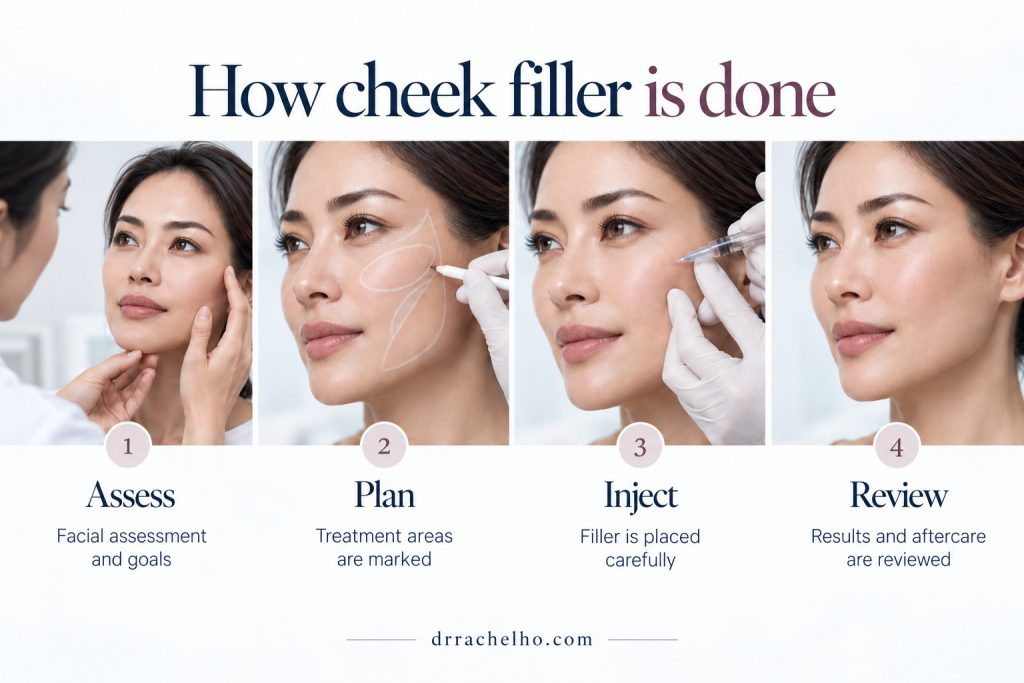
How cheek filler is done. A careful treatment plan usually involves assessment, facial marking, injection technique and follow up review rather than a one size fits all approach
How are cheek filler injections performed?
After a facial assessment, the face is first numbed and disinfected. Cheek fillers can be introduced by a needle or cannula, depending on your doctor’s preference. As part of the facial assessment, the upper and midface anatomy is evaluated with the cheeks to ensure that the cheek augmentation is harmonious and does not distort my patient’s facial features. The cheeks are highly mobile, so the facial assessment also includes an evaluation of their facial dynamics to ensure that the results are natural at rest and with movement.
How much cheek filler is needed?
The amount of cheek filller required really depends on the patients’ structural anatomy and the intended results². For example, a younger patient who wants slightly fuller apple cheeks usually requires lesser cheek fillers than an older patient who has cheek descent and wants to addres her hollow cheeks and sagging.
My take on fillers as well as botulinum toxin treatments is to aim for a natural looking outcome that makes you refreshed and still recognisably you. Less is more with dermal fillers so I tend to encourage underfilling in patients.
How do you avoid an overfilled appearance?
If the cheeks are overfilled, patients can have the appearance of a pillow face or sunset eyes that makes them look distorted or even older. This is a look that I highly discourage for my patients, and it can also increase the risk of dermal fillers such as filler migration. My article on recognising excessive filler and unwanted changes in facial proportions explores these concerns in more detail.
My pro-tip for patients is to speak to your aesthetic doctor about the intended outcomes and where the dermal fillers will be distributed. For all my patients, the expected outcomes are simulated with a clear understanding of the minimum of dermal fillers required before embarking on the treatment.
How long do cheek fillers last?
The results of HA fillers can last 9-12 months.
Aftercare and recovery for cheek fillers?
Swelling, bruising, tenderness and firmness are recognised reactions after cheek filler injections⁶. In a randomised cheek augmentation study involving 60 participants, most recorded injection reactions resolved within two weeks⁶.
Although expert consensus recommends review at approximately two to four weeks for patients receiving treatment in a new area, I typically review my patients after dermal fillers in a week⁵.
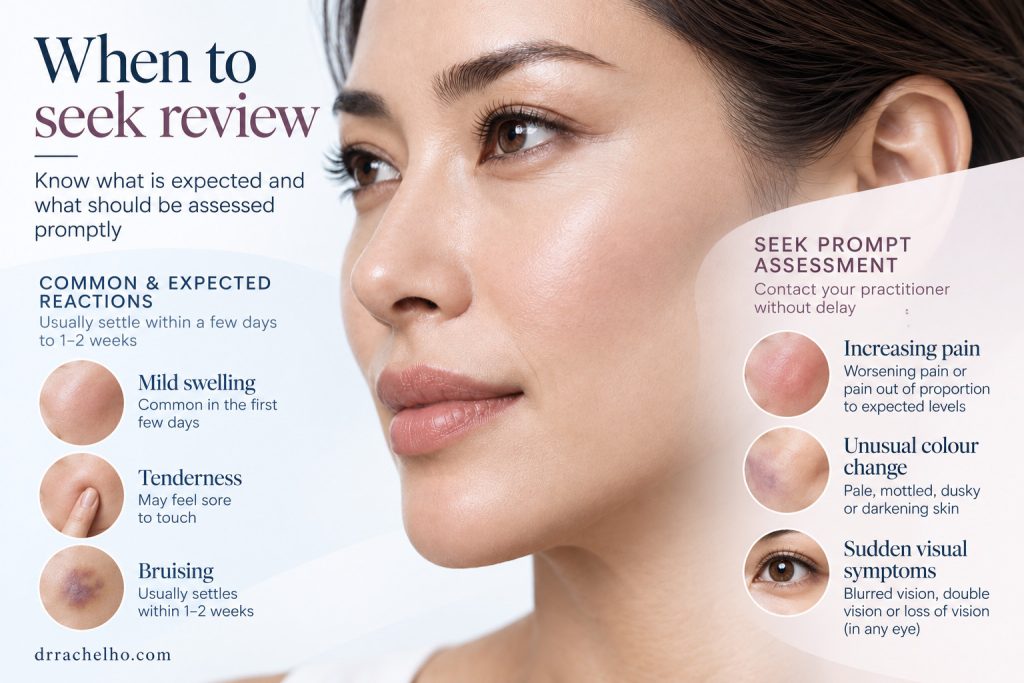
What are the risks of cheek filler?
Complications of dermal fillers include infection and delayed inflammatory nodules⁹. More rarely, but catastrophically, when filler obstructs blood supply, skin injury or tissue loss can occur⁸.
Can cheek filler be dissolved?
Hyaluronidase is an enzyme used by clinicians to break down HA filler in complications⁹. The response of HA fillers to hyaluronidase varies, and more than one treatment may be required⁹.
Read my guide to dissolving fillers with hyaluronidase for more details about dermal filler removal.
What are the alternatives to cheek filler?
An non-surgical alternative approach to facial volume restoration would be collagen biostimulators such as Poly-L-Lactic Acid, Calcium Hydroxylapatite or Hybrid Cooperative Complex Injectable Moisturisers. Collagen biostimulators do not restore facial volumes, rather, they activate collagen building collagen mechanisms in the face to lift saggy skin and reposition the fat pads. As a result, the cheeks and laugh lines look more lifted without the effects of volumisation. Some collagen biostimulators also improve skin hydration and skin texture as a secondary benefit. To learn more about collagen biostimulators in Singapore, please refer to my clinic page on Collagen Biostimnulators Singapore.
What should you ask before cheek filler treatment in Singapore?
Cheek fillers are one of the non-surgical modalitys for lifting and rejuvenating the midface. The results are dependent on the volume of dermal fillers and distribution of the cheek filler placement. My tip for patients is to have a sense of the kind of aesthetic result that you’re looking for- something natural, undetectable or a more pronounced, projected look? This sense of aesthetic also shapes the consultation and amount of fillers used in the treatment. For more about cheek fillers, please refer to my clinic’s guide Cheek Fillers: Volume, Contour and Suitability.
References
- Ren R, Xue H, Gao Z, et al. Restoring long lasting midface volume in the Asian face with a hyaluronic acid filler: A randomized controlled multicenter study. Journal of Cosmetic Dermatology. 2024;23:1985 to 1991.
- Trévidic P, et al. Injection Guidelines for Treating Midface Volume Deficiency With Hyaluronic Acid Fillers: The ATP Approach. Aesthetic Surgery Journal. 2022;42:920 to 934.
- Mowlds DS, Lambros V. Cheek Volumization and the Nasolabial Fold. Plastic and Reconstructive Surgery. 2018;141:1124 to 1129.
- Woodward J, et al. Infraorbital Hollow Rejuvenation: Considerations, Complications, and the Contributions of Midface Volumization. Aesthetic Surgery Journal Open Forum. 2023;5:ojad016.
- Goodman GJ, Liew S, Callan P, Hart S. Facial aesthetic injections in clinical practice: Pretreatment and posttreatment consensus recommendations to minimise adverse outcomes. Australasian Journal of Dermatology. 2020;61:217 to 225.
- Jones D, Palm M, Cox SE, et al. Randomised study of HA cheek augmentation using cannulas and needles. Dermatologic Surgery. 2021;47:1590 to 1594.
- Alam M, Kakar R, Dover JS, et al. Rates of Vascular Occlusion Associated With Using Needles vs Cannulas for Filler Injection. JAMA Dermatology. 2021;157:174 to 180.
- Murray G, Convery C, Walker L, Davies E. Guideline for the Management of Hyaluronic Acid Filler Induced Vascular Occlusion. Journal of Clinical and Aesthetic Dermatology. 2021;14:E61 to E69.
- Kroumpouzos G, Treacy P. Hyaluronidase for Dermal Filler Complications: Review of Applications and Dosage Recommendations. JMIR Dermatology. 2024;7:e50403.
- Sansome S, et al. Consensus Guidelines for the Management of Tissue Filler Induced Vision Loss in the United Kingdom. Aesthetic Surgery Journal. 2026;46:563 to 568.

No Comments