


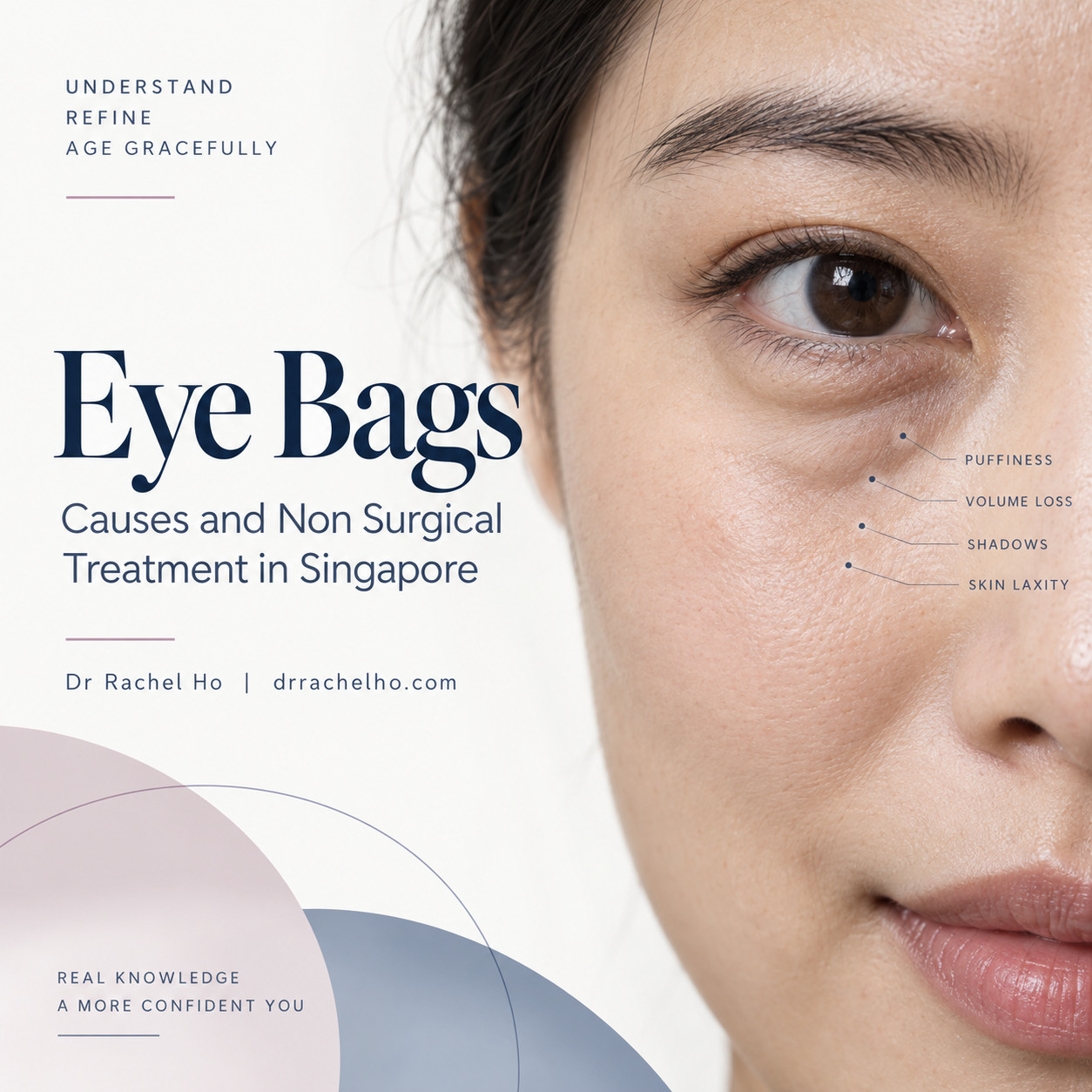
30 Jul Eye Bags: Causes and Non Surgical Treatment in Singapore
Eye Bags: Causes and Non Surgical Treatment in Singapore
By Dr Rachel Ho, MBBS, MMed (ENT)
Aesthetic Doctor and Founder, The Skin Longevity Clinic, Singapore
Written and last clinically reviewed: 5th Sept 2026
Eye bags can remain noticeable even when you sleep well, because their appearance often reflects changes in fat, skin and the contours between the lower eyelid and cheek¹,². Understanding these changes helps explain why filling a hollow improves some eye bags, while others need treatment directed at skin laxity, swelling or protruding fat¹,².
Tear trough filler, ECM skin boosters and RF microneedling have different roles in under eye rejuvenation⁵,⁸,¹⁰. This guide explains how they may improve the appearance of eye bags, what treatment involves and where their limitations lie.
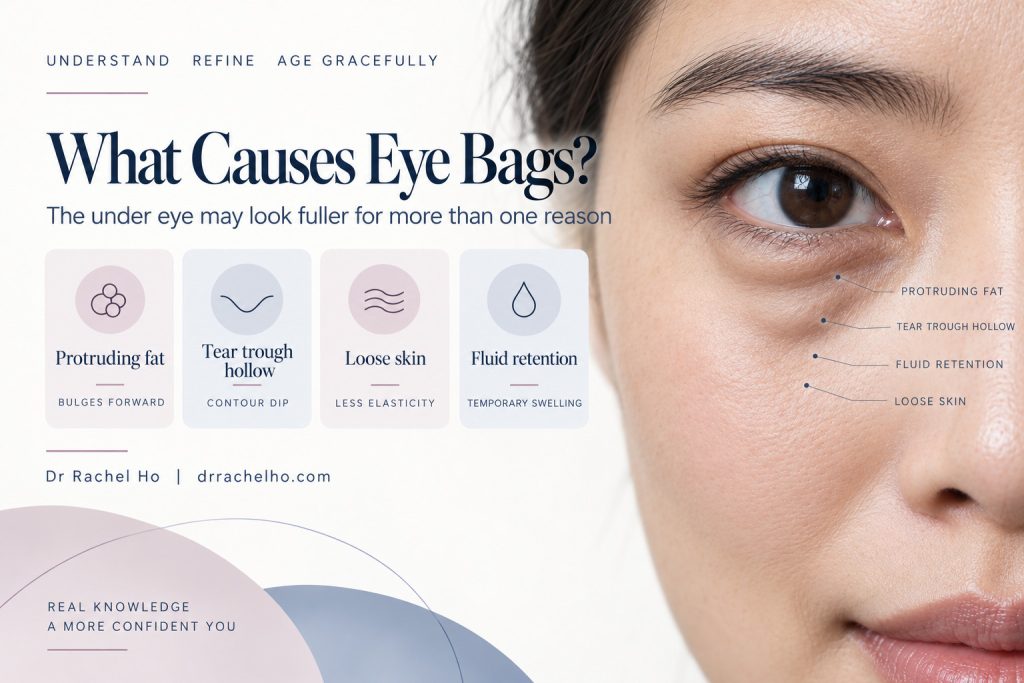
Protruding fat, loose skin and fluid retention can contribute to under eye fullness. A deeper tear trough can make an eye bag more noticeable by increasing the contrast between the bulge and the hollow below it.
What causes eye bags?
Herniation of lower eyelid fat pads
Fat around the eye socket cushions and supports the eye. Changes in the tissues supporting and holding the fat can cause the fat pads to bulge forwards, producing the rounded fullness i.e. true eye bag¹,¹⁴.
Ageing in the skin and facial layers contributes to these changes, although eye bags can also run in families⁴.
Tear trough hollowing and reduced cheek support
The tear trough is a depression extending from the inner corner of the eye towards the cheek. When this hollow deepens, the contrast between the groove and the fuller eyelid above can make an existing eye bag look more prominent¹,². As we age, our cheeks lose volume and the underlying facial support also diminishes to increase hollowness in the tear trough²,⁵.
Loose skin and fine wrinkles
Reduced skin collagen and elasticity contributes to folds and a less smooth lower eyelid surface¹. These changes can accompany fat protrusion, compounding the severity of eye bags¹.
Fluid retention, allergies and irritation
Fluid accumulation can create puffiness that varies throughout the day, particularly after waking or a salty meal³,⁴. Allergies, eyelid inflammation, medications and certain medical conditions can also contribute to swelling³.
Persistent puffiness requires medical assessment before embarking on aesthetic treatments like³. Where inflammation or an allergy is responsible, addressing that cause may be more effective than cosmetic treatments³.
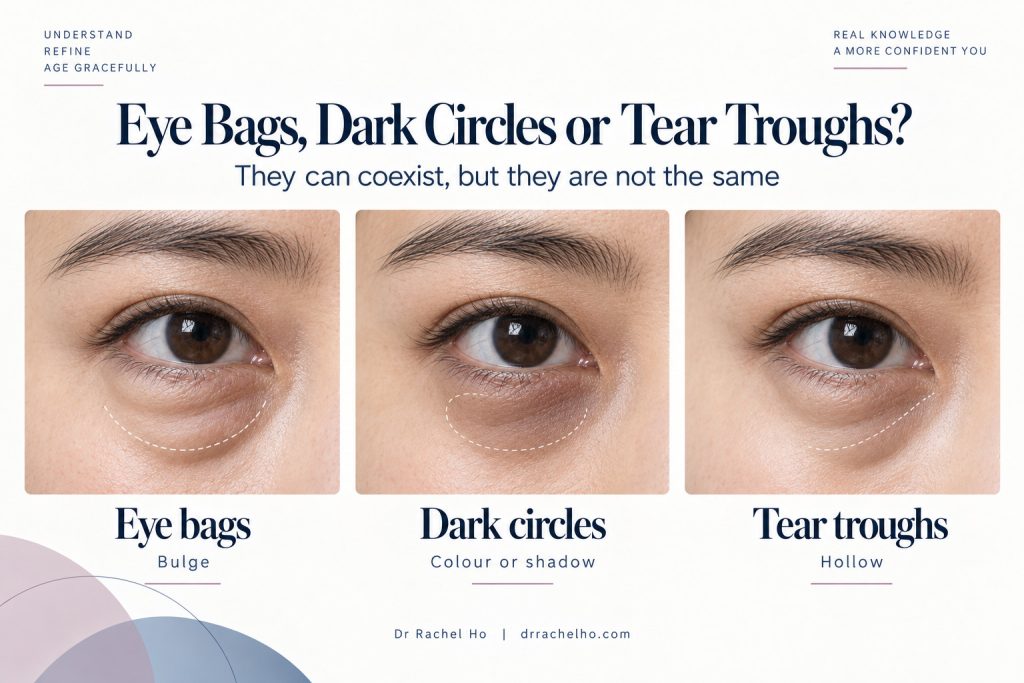
An eye bag is a bulge, a tear trough is a hollow, and dark circles describe under eye colour or shadow. These features can coexist and require different treatment targets.
Are eye bags the same as dark circles?
Eye bags are very different from dark eye circles; although both these conditions can exist in the same patients. Eye bags fullness due to the herniation of fat pads, whereas dark circles describe a darker appearance beneath the eyes¹,². Pigmentation, visible vessels and shadows from tear trough deformity can all contribute to that darkness².
These features often overlap, but their treatments differ². My article on dark eye circles explains how pigmentation, vascular colour and structural shadowing are assessed.
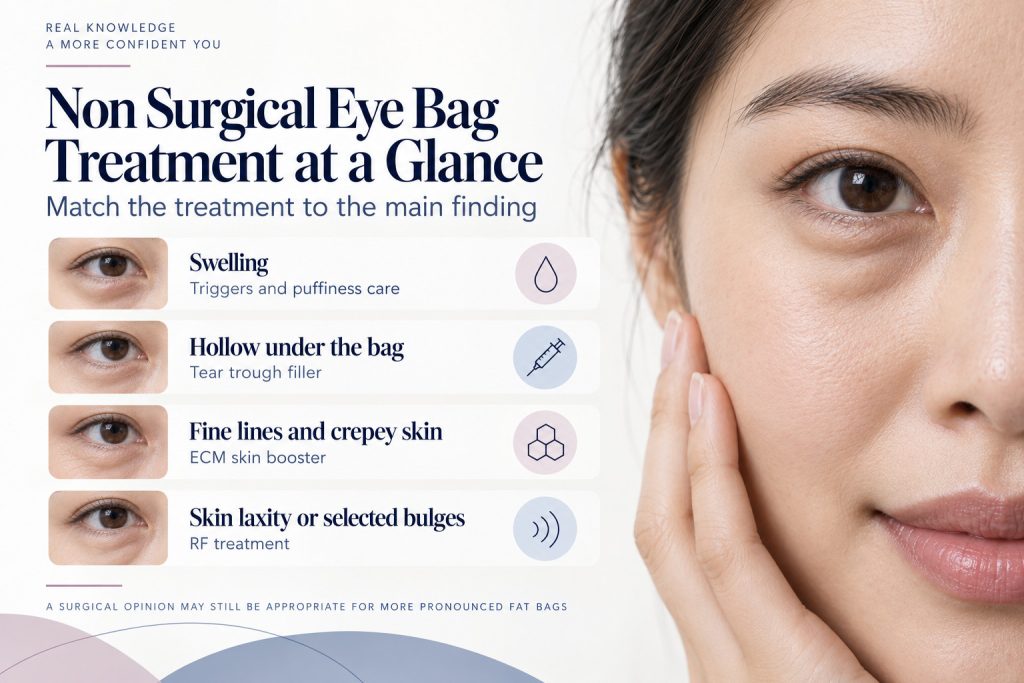
Eye bag treatment should match the main finding: swelling, hollowing, skin quality changes or a selected fat bulge. More pronounced fat protrusion and excess skin may warrant a surgical assessment instead of camouflage or skin quality treatment alone.
Can eye bags be improved without surgery?
The appearance of selected cases of eye bags can be improved without surgery⁵,¹². Tear trough fillers can reduce undereye hollowness and support prolapsed orbital fat, under eye skin rejuvenation treatments can address laxity, crepiness and wrinkling and microneedling radiofrequency (RF) have been used to treat eye bags⁵,¹⁰,¹².
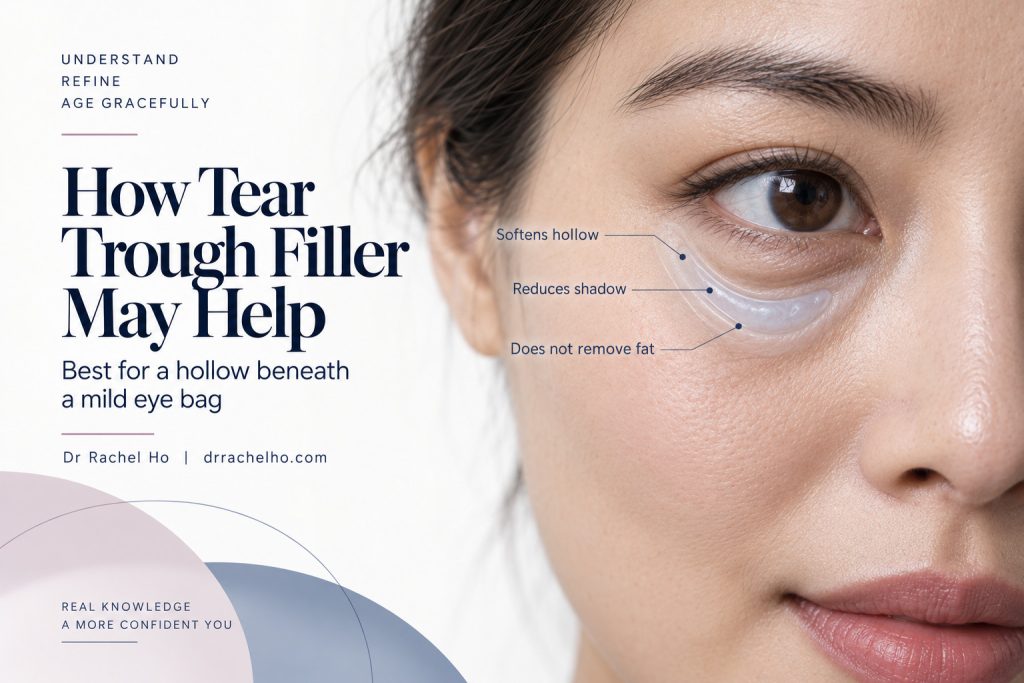
Tear trough filler can make a mild eye bag less noticeable by softening the hollow beneath it and reducing contour related shadowing. It adds volume rather than removing fat, so suitability depends on the existing eyelid and cheek anatomy.
Tear trough filler for eye bags
How do tear trough fillers improve the appearance of eye bags?
Tear trough fillers, typically hyaluronic acid fillers, replenish volume to hollowness or depression beneath the lower eyelid. In patients with under eye hollowness or sunkeness, restoring this volume loss with tear trough filler creates a smoother transition between the eye bag and cheek, reducing the contrast and shadow around the bulge⁵.
Cheek support may also need correction when volume loss below the eyelid contributes to the appearance²,⁵.
What do tear trough filler injections for eye bags involve?
As part the consultation, the lower eyelid, cheek support and skin quality are assessesd²,⁷. After cleansing and numbing, the doctor places small amounts of filler carefully using a needle or cannula⁵,⁷.
The outcomes of volume replacement are immediate with tear trough fillers, although early swelling can affect how the result looks⁷. Reviewing the area after it settles helps avoid unnecessary additional filler².
A systematic review and meta analysis of 31 reports involving 2,556 participants found a pooled satisfaction rate of 91 per cent after hyaluronic acid treatment for tear trough deformity⁶.
What are the risks and side effects of tear trough fillers for eye bags?
Reported complications from tear trough fillers for eye bags include temporary swelling, bruising, lumps, asymmetry and Tyndall’s effect (bluish appearance from superficially placed filler)⁶,⁷. Rarer complications of tear trough fillers include vascular complications such as skin necrosis and vision loss⁷.
My guide to dissolving fillers with hyaluronidase explains when filler removal may be considered. The decision to add or dissolve filler should be made after the risks and benefits have been weighed²,⁷.
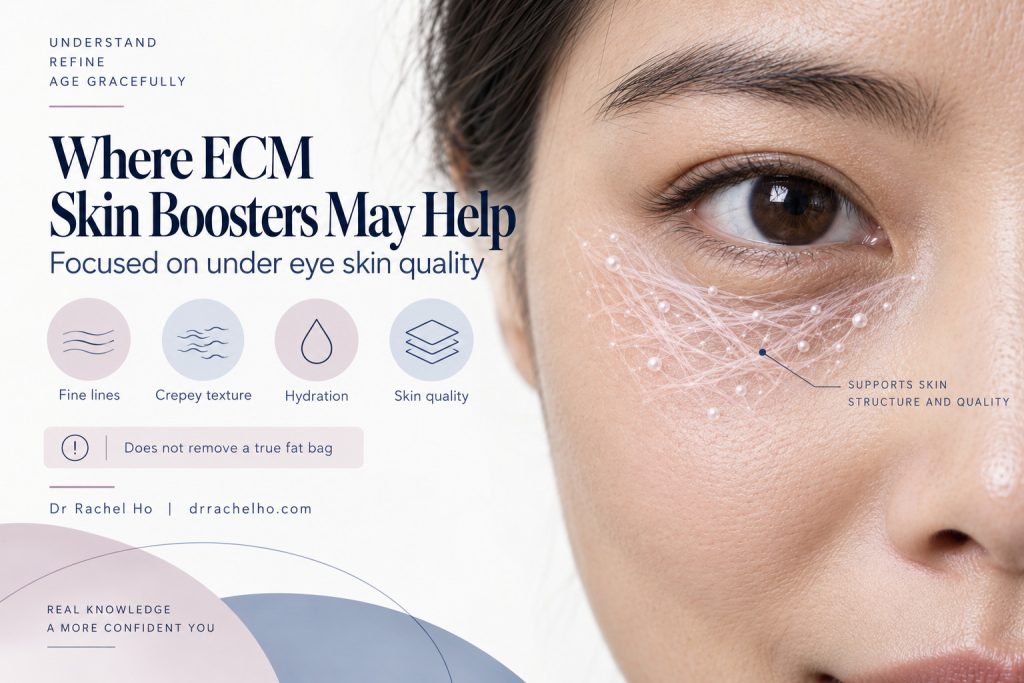
The ECM skin booster study discussed in this guide examines skin quality, including hydration and wrinkle measurements. It does not establish removal of protruding orbital fat, and findings from one formulation should not be extended to every ECM product.
ECM skin boosters for under eye skin quality
How can ECM skin booster help an eye bag?
ECMstands extracellular matrix, the material surrounding cells that contributes to tissue structure and function⁸.ECM skin boosters that have received Singapore Health Science Authority approval contain processed human acellular dermal matrix, derived from donated skin with its cellular components removed⁸. For older patients with under eyes skin that is crepye, saggy and wrinkled, ECM skin boosters to the under eye can improve the quality of support and tighten the under eye skin to reduce the appearance of the eye bagt⁸,¹⁶.
What does the evidence for ECM skin boosters show?
A 2026 randomised trial involving 20 adults with cheek roughness compared one injectable human acellular dermal matrix preparation with hyaluronic acid on the opposite facial side⁸. The investigators reported improvements in several skin measurements over 20 weeks, including density, elasticity, hydration and wrinkles⁸.
What do ECM skin boosters for eye bags involve?
My clinic’s post on ECM skin booster under eye guide describes the processes involved in ECM skin boosters to the undereyes¹⁶. I typically administer the ECM skin boosters to the under eye in small precise amounts in a retrograde technique, with a cannula.
For more background on ECM skin boosters, please read my article on ECM skin boosters and the extracellular matrix.
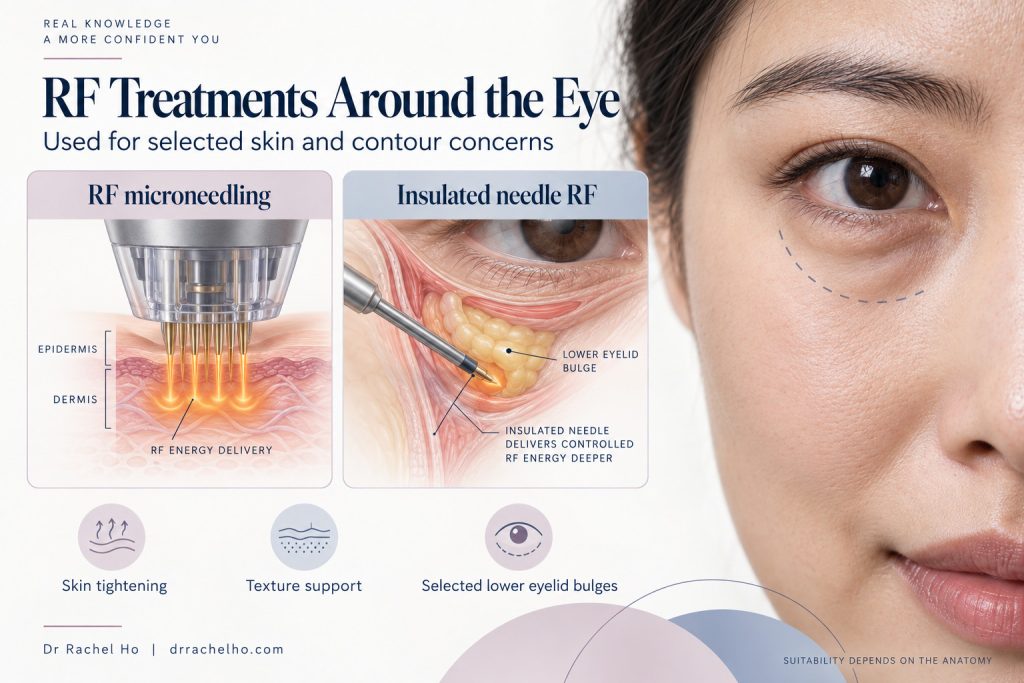
RF diagrams comparing dermal microneedling for skin concerns with targeted insulated needle treatment for a lower eyelid fat bulge.
RF microneedling for eye bags
RF microneedling delivers radiofrequency energy through fine needles, producing heat within the targeted tissue¹³. Around the eyes, its purpose depends on whether treatment is directed at the skin or at a selected fat bulge¹⁰,¹².
Dermal RF microneedling for wrinkles and skin laxity
When directed at the dermis, RF microneedling aims to stimulate collagen remodelling and improve wrinkles and skin texture¹⁰. This may improve the surface appearance of a lower eyelid with mild skin changes, while a substantial underlying fat bag can remain¹⁰,¹⁴.
Treatment generally involves cleansing, numbing and repeated placement of a microneedle applicator over the selected area¹¹. Device choice, treatment parameters and eye protection must be appropriate for the area being treated¹¹,¹³.
A 2026 observational study of 32 adults reported improvements in periorbital wrinkles and elasticity after three treatments spaced four weeks apart¹¹. These were wrinkle and skin elasticity outcomes, so they should not be presented as evidence of equivalent improvement in protruding orbital fat¹¹.
Targeted insulated needle RF for eye bags
A different approach uses specialised insulated needles to deliver RF energy to selected lower eyelid tissues, with the intention of reducing fat bulging¹². This is distinct from a dermal microneedling session focused on texture described about¹⁰,¹².
In using needle RF for eyebags, the insulated needle and RF energy are introduced through the skin to reach the prolapsed orbital fat¹². In a study of 22 participants, two treatments four weeks apart reduced measured lower eyelid bulging, with improvement maintained through the 24 week assessment¹². Swelling and bruising lasted approximately one week, although the study did not include a separate untreated control group or establish permanent results¹².
What are the risks of RF treatment for eye bags?
RF microneedling carries risks beyond temporary redness and swelling¹³. The US FDA has warned of reports of burns, scarring, unwanted fat loss, disfigurement and nerve damage with certain uses of these devices¹³.
The Skin Longevity Clinic’s skin tightening guide discusses the broader differences between tightening treatments. Its RF microneedling page provides further information about dermal treatment.
Tear trough filler, ECM skin booster and RF for eye bags compared
Non-surgical eye bag treatments compared
| Treatment | Main concern it addresses | What treatment involves | Important limitation |
|---|---|---|---|
| Tear trough filler | A hollow that emphasises an adjacent eye bag | Injection of filler to improve the eyelid and cheek contour⁵ | Adds volume rather than removing orbital fat; swelling or excess volume can worsen puffiness²,⁷ |
| ECM skin booster | Fine wrinkles, crepiness and reduced skin quality | Injections of an ECM preparation into selected areas¹⁶ | Evidence is emerging⁸ |
| Dermal RF microneedling | Periorbital wrinkles and selected skin laxity | Fine needles deliver RF energy within the skin¹⁰,¹¹ | Skin improvement differs from correction of a substantial fat bulge¹¹ |
| Targeted insulated needle RF | Selected lower eyelid fat bulges | An insulated needle delivers RF energy to selected tissues¹² | Small studies and limited follow up; outcomes depend on the technique and anatomy¹² |
The cited studies assessed different concerns, patient groups and outcomes⁶,⁸,¹¹,¹². Their results cannot be used to declare one treatment universally better for every person seeking non surgical eye bag removal.
When is eye bag surgery (blepharoplasty) better than non-surgical eye bag removal?
Lower eyelid blepharoplasty may be more appropriate when prominent fat protrusion, substantial excess skin or poor eyelid support is the dominant concern¹⁴. A surgeon can remove or reposition fat and address excess skin where indicated¹⁴.
Some approaches use an incision inside the lower eyelid, avoiding an external skin incision in suitable patients¹⁴. This remains surgery, even when described as scarless eye bag removal, and risks such as dry eye, bleeding and changes in eyelid position still require discussion¹⁴.
What can help eye bags at home?
Cool compresses may temporarily reduce puffiness, while identifying allergy triggers and addressing inadequate sleep can help when these contribute⁴. Structural eye bags caused by protruding fat or changes in eyelid support can nevertheless persist despite these measures¹,⁴.
Eye creams have a different role from procedures that change deeper facial contours. My article Do Eye Creams Work? explains the distinction between caring for the skin and correcting the structures beneath it.
Choosing eye bag treatment in Singapore
As part of the consultation, your doctor should assess your lower eyelid and cheek anatomy together, including fat protrusion, hollowing, skin quality, swelling and previous filler²,⁷. The treatments should address the pathologies contributing to the eye bag in you, with a plan for review²,⁷.
For a treatment focused overview of eye bags, read the eye bag treatment guide at The Skin Longevity Clinic. Bring details of previous under eye injections or procedures so that these can be considered during assessment⁷.
Conclusion on eye bag and non-surgical eye bag removal in Singapore
Eye bag treatment works best when the intended correction matches the anatomical finding¹,². Tear trough filler changes contour, ECM skin boosters are considered for skin quality, and RF procedures have different roles depending on whether they target the dermis or selected lower eyelid fat bulges⁵,⁸,¹¹,¹².
Scientific and clinical references
- Goldberg RA, McCann JD, Fiaschetti D, Ben Simon GJ. What causes eyelid bags? Analysis of 114 consecutive patients. Plastic and Reconstructive Surgery. 2005;115(5):1395 to 1402.
- Liew S, Doreian S, Kunathathorn W, et al. Lower eyelid dark circles: Tear trough and lid cheek junction. A stepwise assessment framework. Aesthetic Surgery Journal. 2024;44(7):NP476 to NP485.
- Sami MS, Soparkar CNS, Patrinely JR, Tower RN. Eyelid edema. Seminars in Plastic Surgery. 2007;21(1):24 to 31.
- Mayo Clinic. Bags under eyes: Symptoms and causes. Updated November 2024. Patient guidance.
- Kato K, Kajiwara T, Furuyama N, Liew S. Filler based correction of tear trough depressions and eye bags in Japanese patients: A classification system and treatment algorithm. Journal of Cosmetic Dermatology. 2023;22(2):439 to 448.
- Liu X, Gao Y, Ma J, Li J. The efficacy and safety of hyaluronic acid injection in tear trough deformity: A systematic review and meta analysis. Aesthetic Plastic Surgery. 2024;48(3):478 to 490.
- Zein M, et al. Complications after cosmetic periocular filler: Prevention and management. Plastic and Aesthetic Research. 2020;7:44.
- Lee YI, Chau NH, Nguyen NH, et al. Injectable particulated human acellular dermal matrix booster for skin restoration: An integrated randomized, split face, double blinded clinical trial and preclinical study. International Journal of Molecular Sciences. 2026;27(5):2193.
- Sung SW, Lee SY, Seok J, Kim BJ. Vascular complication following injection of particulated human acellular dermal matrix: A case report. Journal of Cosmetic Dermatology. 2026;25:e71049.
- Kim KE, Park JH, Seul TW, Kim IH, Ryu HJ. Periorbital skin rejuvenation of Asian skin using microneedle fractional radiofrequency. Annals of Dermatology. 2023;35(5):360 to 366.
- Bae KT, Park SY, Park Y, Yi KH. Dual depth 25 pin insulated microneedle radiofrequency for moderate to severe periorbital wrinkles. Lasers in Medical Science. 2026;41:153.
- Shin JW, Park JT, Chae JB, et al. The efficacy of micro insulated needle radiofrequency system for the treatment of lower eyelid fat bulging. Journal der Deutschen Dermatologischen Gesellschaft. 2019;17(2):149 to 156.
- US Food and Drug Administration. Potential risks with certain uses of radiofrequency microneedling. Safety communication, October 2025.
- Bhattacharjee K, Ghosh S, Ugradar S, Azhdam AM. Lower eyelid blepharoplasty: An overview. Indian Journal of Ophthalmology. 2020;68(10):2075 to 2083.
- NHS. Eyelid problems. Patient guidance on symptoms requiring medical assessment.
- The Skin Longevity Clinic. ECM skin booster under eye Singapore: Fine lines and dark circles. Clinic information on assessment, procedure and recover

Alice schaefer
Posted at 07:13h, 22 OctoberThanks for sharing this! It answered many of my questions about eye fillers.
Pingback:A review of Dark Eye Circle Treatments with Before and After • Dr Gerard Ee
Posted at 06:09h, 30 July[…] set orbital rim as in the Caucasian population. A lady with a lack of soft tissue under the eyes. Tear trough filler with a course of 5 V beam lasers were the solution to these dark eye circles. Results were achieved […]