


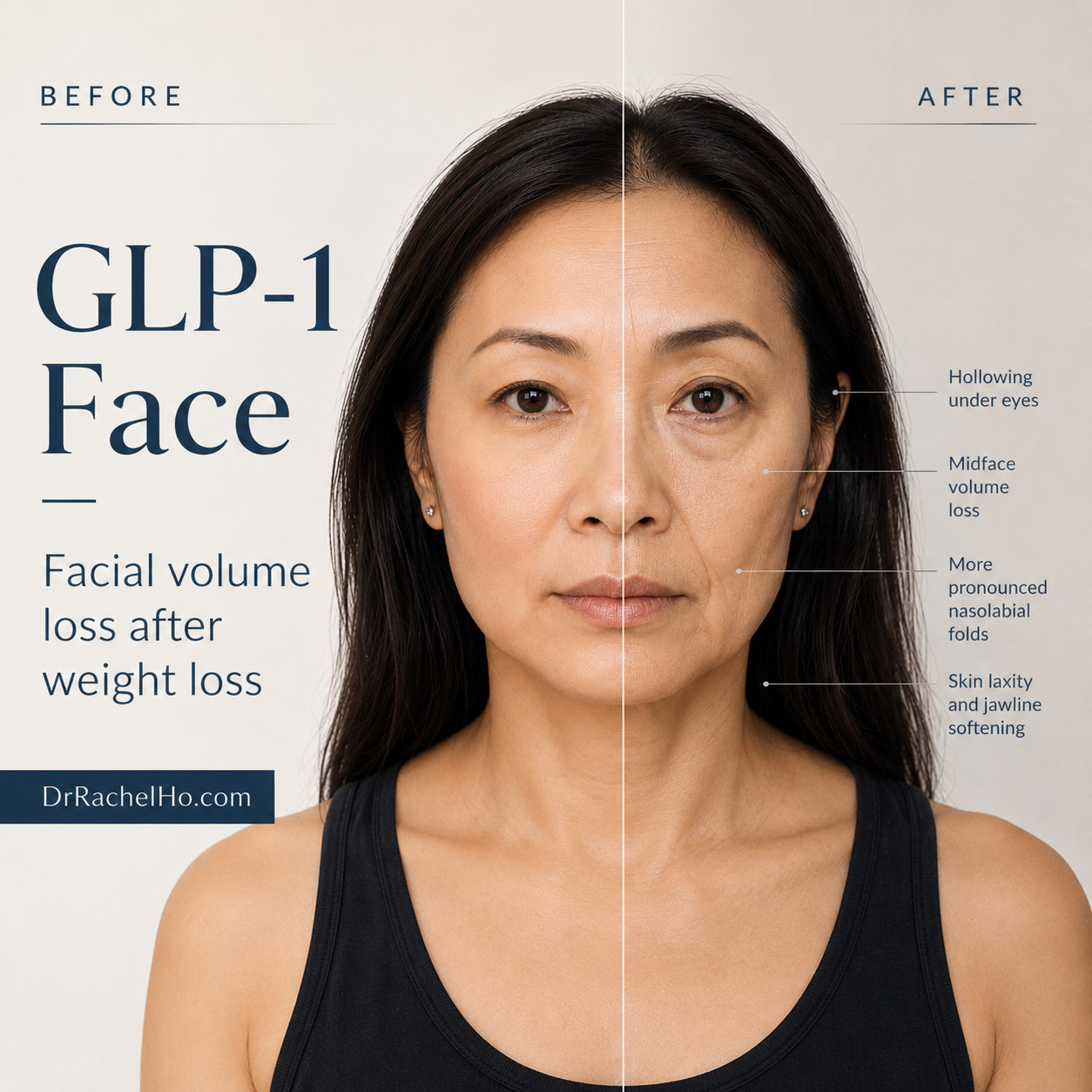
15 Jul GLP-1 Face: Why Weight Loss Can Change Facial Volume and Skin Laxity
GLP-1 weight loss has changed the way many patients view obesity treatment, body shape and metabolic health. As a result of weight loss that improves health markers, the face can also change such as a slimmer lower face, flatter cheeks, deeper folds, looser skin or a more tired appearance. This change in appearance after weight loss with GLP-1 agonist medications is often referred to as “GLP-1 face”. This review is part of a series of GLP-1 medications and their effects in dermatology. You can read the other articles on seperate topics here:

GLP 1 agonists mimic the natural GLP 1 hormone and can support blood sugar control, appetite regulation and medically supervised weight loss.
What are GLP-1 agonist medications?
GLP 1 receptor agonists are a class of medications that treat type 2 diabetes and promote weight loss by mimicking the natural GLP-1 hormone to regulate blood sugar, increase feelings of fullness, and slow stomach emptying1.
In the STEP 1 trial, once weekly GLP-1 agonist at 2.4 mg with lifestyle intervention led to a mean body weight reduction of 14.9 percent at 68 weeks, compared with 2.4 percent with placebo2. Another dual GIP and GLP 1 receptor agonist, produced weight reductions of up to 20.9 percent at 72 weeks in the SURMOUNT 1 trial3.
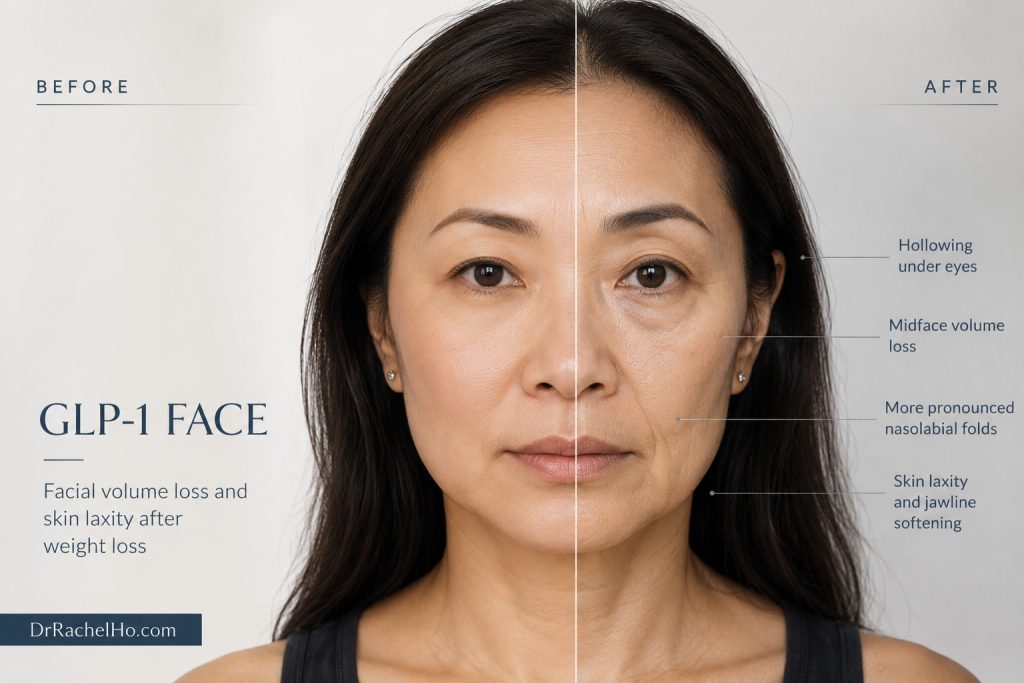
Common signs of GLP 1 face include flatter cheeks, under eye hollowing, deeper folds and looser skin along the jawline and neck.
What is the GLP-1 face?
GLP-1 face refers to the facial volume loss, skin laxity, and accelerated signs of aging observed in patients using GLP-1 receptor agonists for weight loss or diabetes management.
The characteristic changes of GLP-1 face include4,5:
- Facial volume loss, particularly in the midface
- Periocular hollowing and periorbital volume depletion
- Dermal thinning with loss of collagen and elastin fibers
- Decreased skin elasticity leading to redundant skin folds
- Accelerated appearance of aging
As a result of these facial changes, GLP-1 agonist medications can result in an older, haggard and tired looking appearance.
Related blogposts:
Dark Eye Circles: Putting Tired Eyes to Rest
Why do GLP-1 medication cause GLP-1 face
The face is sensitive to weight and metabolic changes because of facial fat compartments that support facial contours. When body fat reduces, facial fat can also reduce. This change may be welcomed when heaviness in the lower face improves, but it can also cause hollowing, folds and skin laxity, which accentuate sagging and a tired look. Sagging and laxity result when the rate of fat loss exceeds the rate of skin retraction, especially when weight loss is rapid, collagen quality is reduced, or the patient already has early laxity.
Besides weight loss, GLP-1 face is due to direct effects on skin biology and adipose tissue dynamics. Some of these cechanisms of GLP-1 agonist medications on skin and tissue dynamics include5-7:
- Adipose (fat) tissue effects: GLP-1 receptors are present on adipose-derived stem cells (ADSCs) and fibroblasts. Receptor stimulation reduces ADSC production of protective cytokines, promotes reactive oxygen species (ROS) production causing oxidative damage to fibroblasts, and reduces glucose uptake by ADSCs leading to decreased ATP production and apoptosis.
- Hormonal changes: GLP-1 receptor stimulation on ADSCs indirectly reduces estrogen production from dermal white adipose tissue (DWAT), which decreases fibroblast stimulation to produce collagen.
- Preferential fat loss: Radiologic studies demonstrate preferential superficial midface fat loss rather than uniform facial fat reduction.
GP-1 agonist medications & weight loss effects on the skin
In addition, histological studies have also showed significantly thinning of collagen fibres in the dermis and damage to the elastic fibre network in individuals with massive weight loss8.

Facial changes after GLP 1 weight loss may be more visible in patients with rapid weight loss, older age, poor hydration or insufficient protein intake.
Risk factors for GLP-1 face
All patients who take GLP-1 agonist medications or embark on weight loss are at risk of these facial changes. However, more severe skin and structural changes are seen in GLP-1 agonist patients with these risk factors4:
- Advanced age
- Prolonged obesity history
- Rapid weight loss
- Poor hydration
- Insufficient protein intake

Treatment for GLP 1 face should be personalised according to whether the main concern is volume loss, skin laxity, wrinkles or neck banding.
Treatments for GLP-1 face and skin
GLP 1 face affects the composite of facial structure, from skin, volume to muscles. Because of this, most publications recommend a combination of nonsurgical modalities for GLP-1 patients. In my practice in The Skin Longevity Clinic, plans for patients are personalised according to the specific deficits and their personal priorities.
Some of the key issues in GLP-1 face and skin can be addressed with the following treatments:
View this post on Instagram
Volume loss and hollowness
Volume loss or hollowness, in the temples, cheeks and undereyes, worsens laugh lines, dark eye circles and eye bags. Targeted placement of dermal fillers in these deflated superficial fat compartments alone or in combination with collagen biostimulators (for moderate-severe changes) can provide immediate volumisation and structural support, with the stimulation of collagen support from the collagen biostimulators.
The amount of filler required will depend on the degree of volume loss. For some patients with significant volume loss, full correction may be best achieved by performing the treatment over sequential sessions to minimize the risk of overcorrection and reduce the potential for adverse events and complications.
Sagging and loose skin
A second priority for patients with GLP-1 facial changes would be skin tightening for skin laxity, particularly in the cheeks, jawline and neck. For GLP-1 skin changes with mild-to-moderate laxity, energy-based device (EBD) treatments are often useful, such as radiofrequency treatments, with or without microneedling, such as XERF. These technologies work primarily by stimulating collagen contraction in the deep dermis, leading to the development of new collagen and the shrinking of high-elasticity tissues to lift and tighten the skin.
View this post on Instagram
Related blogpost:
Collagen biostimulators are another treatment option for this purpose. Examples of collagen biostimulator injectables include hybrid cooperative complexes, PDLLA and PLLA biostimulators.

Wrinkles and banding
Wrinkles and bands in the lower face and neck are another common concern among GLP-1 patients. For vertical turkey bands, botulinum toxin is the main treatment modality. One of the brands of botulinum toxin containing, OnabotulinumtoxinA, has received approved by the US Food and Drug Administration for the treatment of moderate-to-severe platysma bands. For fine wrinkles and horizontal necklace lines, collagen biostimulators containing hyaluronic acid, extracellular matrix and PLLA are my preferred modality to efface these lines.
Related blogposts:
How to Treat Neck Lines and Wrinkles
Sleep Wrinkles: How to Prevent Aging While You Sleep

Timing matters in GLP 1 face treatment. Early support comes first, while aesthetic planning is more accurate after facial changes become clearer.
Timing for treatment of GLP-1 face changes
Timing for treatment of GLP-1 faces is important to minimise excessive and unnecessary treatments. This is because in the first three months of weight loss with GLP-1, supportive measures such as resistance training and sufficient protein intake can mitigate some of the sagging, hollowing and wrinkling and skin quality changes.
After the first 3 months, some of the facial change due to GLP-1 medications are clearer and more stable. At this stage, aesthetic planning becomes more accurate. A detailed facial analysis helps my patients understand their issues and dominant pathology in their facial changes. Identifying volume loss from laxity and skin quality concerns is crucial for treatment planning and staging treatments, be it the sequence of collagen biostimulators, dermal fillers, ECM skin boosters, PDLLA skinboosters, XERF, and radiofrequency microneedling.
The aim of treating patients with GLP-1 faces is not to overfill. Overcorrection can make the face look puffy and distorted from the rest of the body. A measured, approach that prioritises skin health and structures that require support, is in my opinion, a safer and more natural looking approach. Do you agree with this approach?
Related blogposts:
Fillers Gone Wrong: Tell Tale Signs of Too Much Fillers
Too Much BTX: Botulinum Toxin Gone Wrong
References
- FDA’s Concerns with Unapproved GLP 1 Drugs Used for Weight Loss. Updated 2026.
- Wilding JPH, et al. Once Weekly Semaglutide in Adults with Overweight or Obesity. New England Journal of Medicine. 2021.
- Jastreboff AM, et al. Tirzepatide Once Weekly for the Treatment of Obesity. New England Journal of Medicine. 2022.
- Effects of GLP-1 Receptor Agonists on Skin Quality: A Comprehensive Literature Review. Barone et al. Aesthetic Plast Surg. 2026 May 20.
- GLP-1RA and the possible skin aging. Paschou et al. Endocrine. 2025 Sep;89(3):680-685.
- Decoding the Implications of Glucagon-like Peptide-1 Receptor Agonists on Accelerated Facial and Skin Aging. Ridha et al. Aesthet Surg J. 2024 Oct 15;44(11):NP809-NP818
- Functional and Aesthetic Periorbital, Ocular Adnexal and Ocular Surface Changes Linked to GLP-1 Receptor Agonists. Kapantais et al. J Clin Med. 2025 Dec 12;14(24):8792.
- Image analyzer study of the skin in patients with morbid obesity and massive weight loss. Sami et al. Eplasty. 2015;15:e4.

No Comments