


13 Dec Sleep Wrinkles: How to Prevent Aging While You Sleep

Is sleeping on your face or sides the cause of your wrinkles?
Sleep may be important for rest and repair of your skin, but what if your beauty sleep is the cause of your wrinkles? Most of us may be familiar with wrinkles related to facial animation or expressions- the crows’ feet at the outer corners of our eyes when we smile; glabella lines (“number eleven”) between our brows when we frown and the forehead wrinkles when we raise our brows.
There is another type of wrinkles that is completely distinct from these wrinkles of facial expression or animation. These wrinkles, known as sleep wrinkles, are used to describe creases on the face related to sleeping positions. Sleep wrinkles differ in their location and mechanism of origin from wrinkles from facial expressions1.

The description of sleep wrinkles is not new. As early as 1999, dermatologists have described wrinkles and lines on the face related to sleeping positions2. Initially described as “sleep lines”, sleep wrinkles were initially noticed in younger patients; with creases that were located in regions of the face and had directions of lines that were different from the wrinkles due to ageing3.
Sleep wrinkles are now recognised as a type of wrinkles; which can appear as we age, just like wrinkles of facial expressions. Here’s everything you need to know about sleep wrinkles, so you don’t lose your beauty sleep!

External forces on the skin and soft tissues of the face when sleeping sideways. Credit: Anson et al.
How do our sleeping positions cause wrinkles? Sleep wrinkles on the face can be easily reproduced by placing one’s hand against the face to imitate the compressive forces caused by sleep. When a person sleeps on his/her side or on their stomach, the tissues of the face are subject to shear, compression and tensile mechanical forces1. These forces pull and stretch the skin and tissues of the face in all directions.
Considering the cumulative amount of time spent sleeping these positions, these forces can be a significant dynamic in altering skin texture and folds1. The greatest impact of these forces on the skin is located where the skin is most strongly anchored to underlying attachment, where retaining ligaments in the face attach the skin to underlying bone1. This is observed in where sleep wrinkles are usually seen in the face- at sites where there are retaining ligaments under the skin1. Another factor in sleep wrinkles: ageing1. With ageing, the skin loses elasticity and extensibility, which has been associated with formation of wrinkles4-7. A few studies show that compressive forces on the face (such as those due to sleeping) form wrinkles on the face parallel to the direction of skin movement8-10.
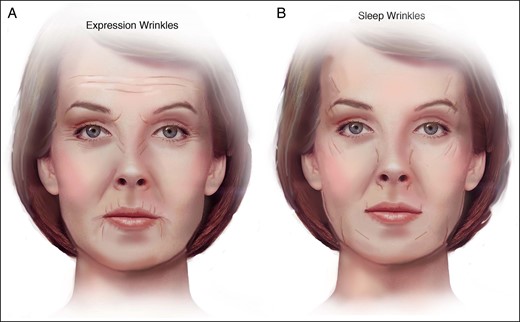
Expression wrinkles vs Sleep wrinkles. Credit: Anson et al.
What do sleep wrinkles look like? How are they different from wrinkles due to expression?
Lines due to sleep wrinkles can occur on the upper, middle and lower parts of the face- depending on how one’s sleep position causes compression and shear to the face. Wrinkles from animation and expression are localised to the upper face. You will notice these as crows’ feet (at the outer corners of the eyes), glabella lines (the “number eleven” between the brows) and horizontal forehead lines.
The direction of lines of sleep wrinkles are also different from wrinkles from facial animation. The axis of sleep lines are often oblique and perpendicular to the wrinkles of facial expression3. To reproduce sleep lines on the face, place a hand against the face to imitate the compression forces caused during sleep. These lines are the most common sleep wrinkles1. Animation- smiling, frowning or raising your eyebrows- does not reproduce sleep wrinkles.

Sleep wrinkles identified. Credit: Anson et al.
What’s the best sleeping position to prevent sleep wrinkles? The best way to avoid getting sleep wrinkles?
Sleeping on your back ;with your face center and facing upwards. In this position, the shear, compression and tensile mechanical forces on the face are kept to a minimum; so facial distortion is the least1. However this can be a difficult position to maintain throughout the night.
Do silk pillow cases or soft pillows prevent sleep wrinkles?
An online search for the treatment of sleep wrinkles will reveal countless advertisements for silk pillow cases. Supposedly, silk pillow cases reduce friction, tugging and scratching on the skin that standard cotton or polyester pillow cases cause. Some of these silk pillow cases also contain copper nanoparticles- that are said to have antibacterial and collagen boosting effects on the skin.
Before you splurge on silk pillowcases, clinical evidence in medical literature that shows silk pillowcases can reduce sleep wrinkles is non-existent. There are no published studies that show that sleeping on silk pillow cases resolves or prevents sleep wrinkles; and the causative relationship is not established. Same goes for silk pillow pillowcases that contain copper ions.
Sleep wrinkles are formed by mechanical pressure and shear forces exerted on the face from sleeping positions. Lying on silk pillow cases may reduce a little of the friction on the skin but it is not going to remove the pressure and contact from sleep positions causing sleep wrinkles.
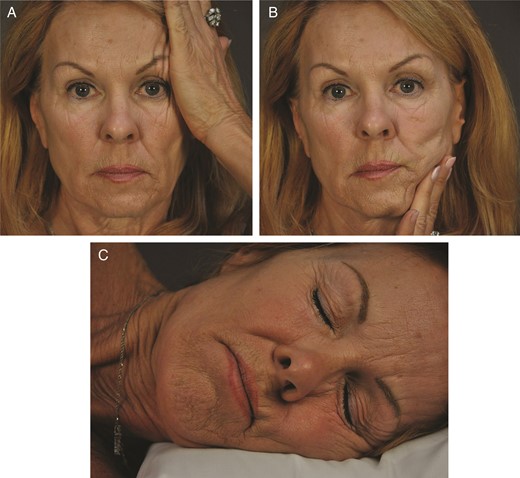
(A, B) Recreation of distortion with hand compression and (C) simulation of lateral sleep posture demonstrates causal forces in this 65-year-old woman. Anson et al.
How can sleep wrinkles be prevented?
To prevent sleep wrinkles, adopting a supine position where one sleeps on the back with one’s face looking upwards is ideal. However, maintaining this position throughout the night can be very challenging. There are pillows that are designed to minimise deformation of the face when one sleep sideways; and pillows that keep the head and neck supported during sleep to allow the user to have a more comfortable rest in the supine position.
How can sleep wrinkles be treated?
Unlike wrinkles due to facial animation, the lines from sleep wrinkles do not respond to Botulinum toxin. Depending on the depth and region of the creases of sleep wrinkles, some of the treatment options include resurfacing laser treatments such as fractional CO2 laser; as well as dermal fillers1. You can also tweak your skincare routine to minimise wrinkles in the skin, from sleep wrinkles or facial expressions. One tried and tested active ingredient for this purpose is retinoids. This collagen building ingredient family can also refine the skin texture for smoother skin and reduced fine wrinkles.
Related blogposts:
Retinol Serums & Creams Review 2023
Retinol Alternatives: Are They As Good as Retinol?

Conclusion on sleep wrinkles
Beauty sleep, or more specifically sleeping positions, is emerging as one of the causes of wrinkles in the face! The lines caused by sleep wrinkles are very different from wrinkles of facial expressions; but don’t lose sleep over it because sleep wrinkles can be treated with resurfacing skin treatments and dermal fillers.
References:
1. Sleep Wrinkles: Facial Aging and Facial Distortion During Sleep. Anson et al. Aesthet Surg J. 2016 Sep;36(8):931-40.
2. Sleep lines. Fulton and Gaminchi. Dermatol Surg. 1999 Jan;25(1):59-62.
3. A new phenomenon: “sleep lines” on the face. Sarifakioğlu et al. Scand J Plast Reconstr Surg Hand Surg. 2004;38(4):244-7.
4. Effect of Sleep Position on Perceived Facial Aging. Kotlus. Dermatol Surg. 2013 Sep;39(9):1360-2.
5. Loss of skin elasticity precedes to rapid increase of wrinkle levels. Fujimura et al. J Dermatol Sci. 2007 Sep;47(3):233-9.
6. An in vivo study of the mechanical properties of facial skin and influence of aging using digital image speckle correlation. Staloff et al. Skin Res Technol. 2008 May;14(2):127-34.
7. The biomechanical properties of the skin. Hussain et al. Dermatol Surg. 2013 Feb;39(2):193-203.
8. Skin wrinkling morphology changes suddenly in the early 30s. Kuwazuru et al. Skin Res Technol. 2012 Nov;18(4):495-503.
9. Mechanics of wrinkle formation: micromechanical analysis of skin deformation during wrinkle formation in ultraviolet-irradiated mice. Matsumoto et al. Skin Res Technol. 2010 May;16(2):179-89.
10. A novel method to investigate the relationship between facial movements and wrinkle formation using particle image velocimetry. Fujimura and Hotta. Skin Res Technol. 2013 Feb;19(1):e54-9.

No Comments