


27 Oct Ferritin Face: Can Your Face Tell You That Your Iron Is Low?
Ferritin Face: What Low Iron Can Tell Us About Skin, Hair and Health
By Dr Rachel Ho
Aesthetic doctor and founder of The Skin Longevity Clinic, Singapore
Has your social media feed served up videos about “ferritin face” lately? This TikTok viral term has given a common clinical condition a new popularity with posts pinning their pale skin, dark under-eye circles, and an overall exhausted complexion, pinning on low iron stores¹.
Related blogposts:
5 Worst TikTok Skincare & Beauty Trends to Avoid
Is Your Visual Weight High or Low? TikTok’s Glow Up Trend Explained
It is true that low iron levels and stores in our bodies can be reflected in our skin and the appearances of our face,hair and nails². That said, diagnosing low iron or ferritin levels on the basis of these symptoms would be an oversimplification of the conditions and its underlying causes³,⁴. This doctor’s guide to understanding “ferritin face” will take you through the science of low iron stores and the dermatological myths.
What Is “Ferritin Face”?
“Ferritin face” is an informal social media term that lumps aesthetic concerns thought to be caused by low iron stores in the body together, such as dark circles, pale skin, and hair shedding¹,². Ferritin face is not a recognised dermatological or medical diagnosis¹. Some of these symptoms related to ferritin face may be due to completely different physiological causes⁵,⁶.
How are low iron stores or levels diagnosed?
True iron deficiency is diagnosed through a medical evaluation of your symptoms and specific blood tests which measure your ferritin levels, serum iron, total iron binding capacity and full blood counts²,³. For patients who truly have low iron levels, it is also important to determine the cause of this deficiency⁷.
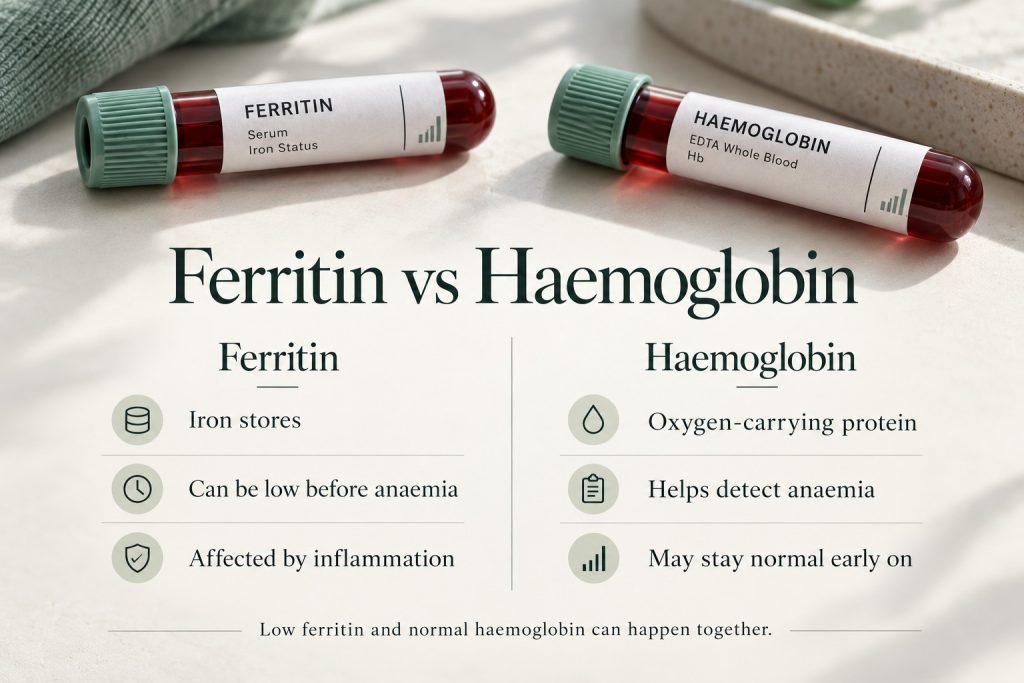
Ferritin and haemoglobin measure different parts of iron status. Low ferritin can be present before anaemia develops, which is why proper testing matters when assessing possible iron deficiency.
What is ferritin, and how does it relate to iron?
Ferritin is an intracellular protein that stores iron in your tissues⁵. Hence to measure your body’s iron levels, blood ferritin level is one reliable marker³,⁵. Haemoglobin, on the other hand, is the oxygen-carrying protein inside your red blood cells⁴. Because they measure different stages of iron availability, haemoglobin and ferritin provide different pieces of information about an individual’s iron levels³,⁵.
Crucially, your iron stores can drop significantly before your haemoglobin levels ever fall³. This situation is known as non-anaemic iron deficiency³. In other words, you can have depleted ferritin stores while your standard blood counts appear completely normal²,³. Hence, relying on the signs of “ferritin face” to establish iron or ferritin deficiency can be inaccurate³,⁴.
Can ferritin be normal despite low iron?
Interpreting ferritin levels can sometimes be complex because ferritin acts as an acute-phase reactant that can naturally spike in the presence of inflammation or acute illness, which can mask an underlying deficiency³,⁵. To help distinguish whether ferritin levels are artificially raised, we also use other markers such as transferrin saturation to get a more accurate picture of available iron stores³,⁵.
What are the symptoms of low iron?
Even before full-blown anaemia develops, low iron stores can cause persistent fatigue, reduced exercise stamina, brain fog, and restless legs syndrome³. If anaemia does occur, classic signs like noticeable paleness, shortness of breath, and heart palpitations often present².
Low iron levels can also present in our skin, hair and nails as pale skin, brittle nails, increased hair shedding and dark eye circles. Below is a table of dermatological symptoms related to low iron levels.
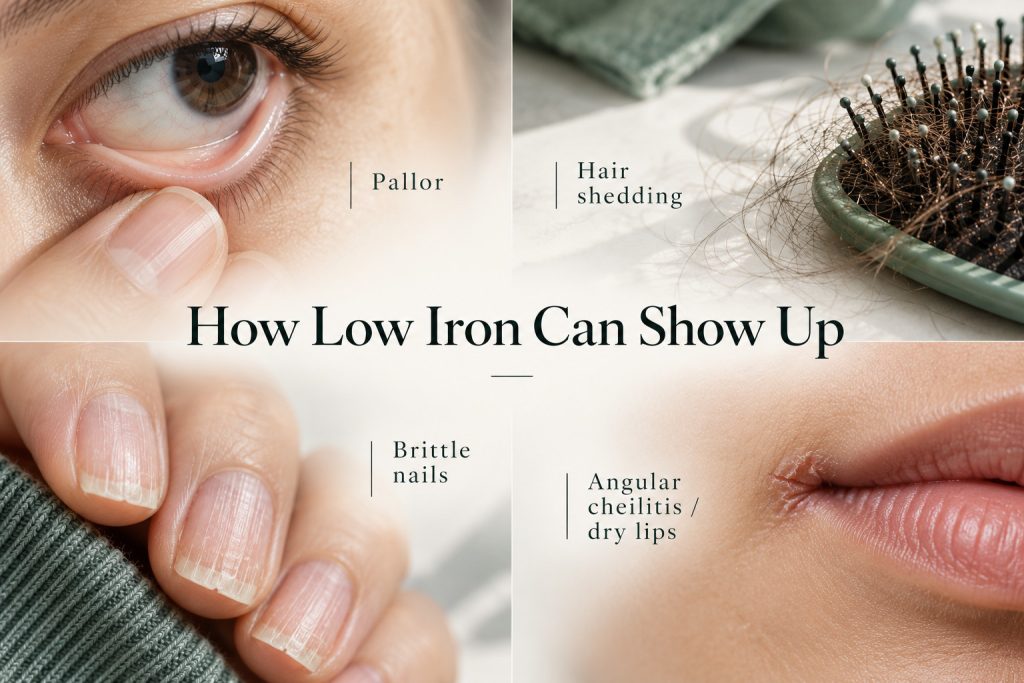
Low iron can show up in several ways, including pallor, hair shedding, brittle nails and changes around the lips or mouth. These signs are clues, not a diagnosis on their own.
How low iron shows in the skin, hair, nails, and mouth
Dermatological symptoms of low iron
| Region | Symptoms |
|---|---|
| Skin Colour | Pallor (paleness), particularly noticeable in the inner eyelids and palm creases³. |
| Skin Comfort | Persistent dryness, roughness, or generalised itching³. |
| Hair | Increased diffuse hair shedding (telogen effluvium), dry texture, or brittleness³. |
| Nails | Brittle nails or spoon-shaped indentations (koilonychia)³. |
| Mouth | Cracks at the corners of the lips (angular cheilitis) or a smooth, tender tongue³. |
I’ll use this opportunity to discuss two often mentioned symptoms of ferritin face: hair loss and dark eye circles.
Can low ferritin or low iron cause hair loss?
There is an association between iron deficiency and diffuse hair shedding known as telogen effluvium⁵. Systematic reviews show that women experiencing non-scarring hair loss frequently have lower average ferritin levels compared to those without shedding⁵,⁸.
However, low iron is not the sole cause of all causes of hair thinning or hair loss explanation for every case of thinning⁵,⁸. Hair loss is multi-factorial, and different patterns and causes of hair loss require specific treatments⁵,⁸.
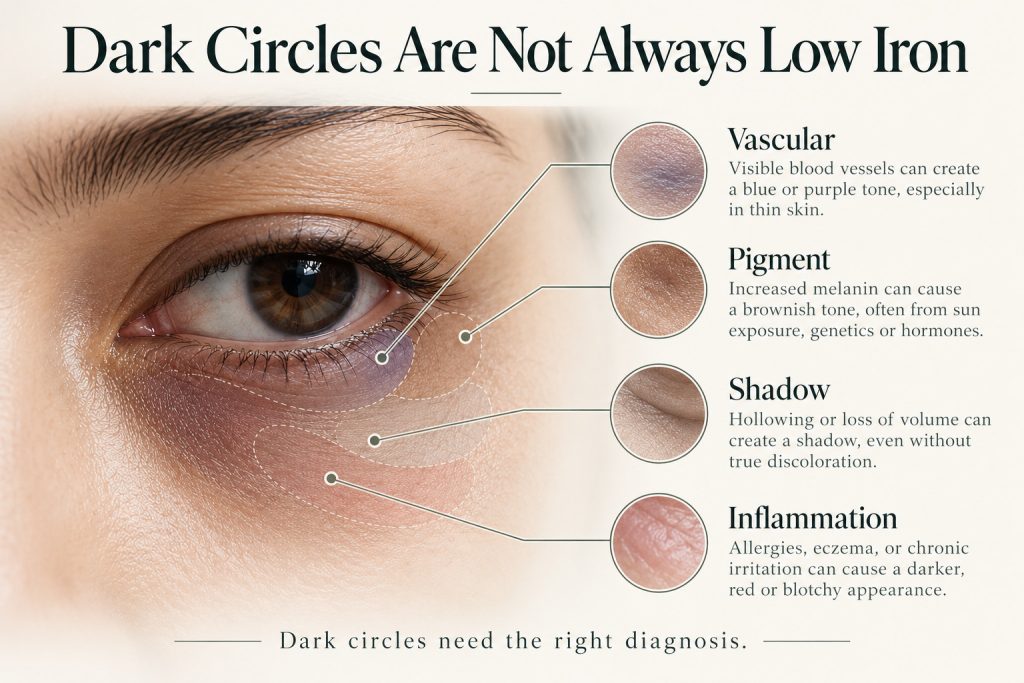
Dark circles are not always caused by low iron. Common contributors include visible blood vessels, pigmentation, shadowing and inflammation, so the right diagnosis is essential.
Are dark circles caused by low iron?
Dark circles can be indirectly associated with low iron levels. This is because the skin surrounding the eyes is thin and relatively translucent, overlying a vascular orbicularis oculi muscle⁶. When blood is less oxygenated or circulation is sluggish, as can occur with fatigue, sleep deprivation, or anemia, the underlying venous plexus becomes more visible through this thin skin, producing a bluish-dark discoloration. This is also known as the vascular type of dark circles and is reported as the predominant type in Asian populations, where it is specifically linked to lack of sleep, fatigue, endocrine disorders, and anemia.
Dark under-eye circles alone also do not establish a diagnosis of iron deficiency³,⁴,⁶. Landmark research conducted at Singapore’s National Skin Centre revealed that periorbital hyperpigmentation is multi-faceted, stemming from several distinct causes⁹:
- Vascular: Prominent underlying blood vessels beneath thin lower eyelid skin⁶.
- Constitutional Pigmentation: Naturally higher melanin distribution in the eye area⁶,⁹.
- Post-Inflammatory Pigmentation: Darkening triggered by eczema, allergies, or chronic eye rubbing⁶.
- Shadow Effects: Structural hollowing or tear trough contour changes due to anatomy⁶.
That study of 200 local patients demonstrated just how varied dark circles can be⁹. While low iron might make pale skin look slightly translucent, it is rarely the primary cause of dark circles. You can certainly have low ferritin and under-eye circles at the same time without one directly causing the other³,⁶. For an in-depth read at how these indivual causes of dark eye circles can be treated, please refer to my guide to dark eye circles treatments.
What causes low ferritin?
If blood tests confirm that your iron stores are low, the next important step is identifying why your reserves have dropped³,⁷. The main factors generally come down to blood loss, inadequate dietary intake, increased physiological demand, or poor gut absorption³.
1. Heavy periods and blood loss
For women of reproductive age, heavy menstrual bleeding is one of the most common causes of iron depletion, alongside gastrointestinal bleeding or frequent blood donations³,⁷. In men and post-menopausal women, unexplained iron deficiency anaemia warrants a thorough medical evaluation to exclude hidden gastrointestinal blood loss⁷.
2. Diet, pregnancy, and absorption challenges
Higher physiological demands during pregnancy or diets low in iron can drain your iron reserves³. Conditions affecting the gut such as coeliac disease or previous bariatric surgery can also impair how well your body absorbs iron from food³.
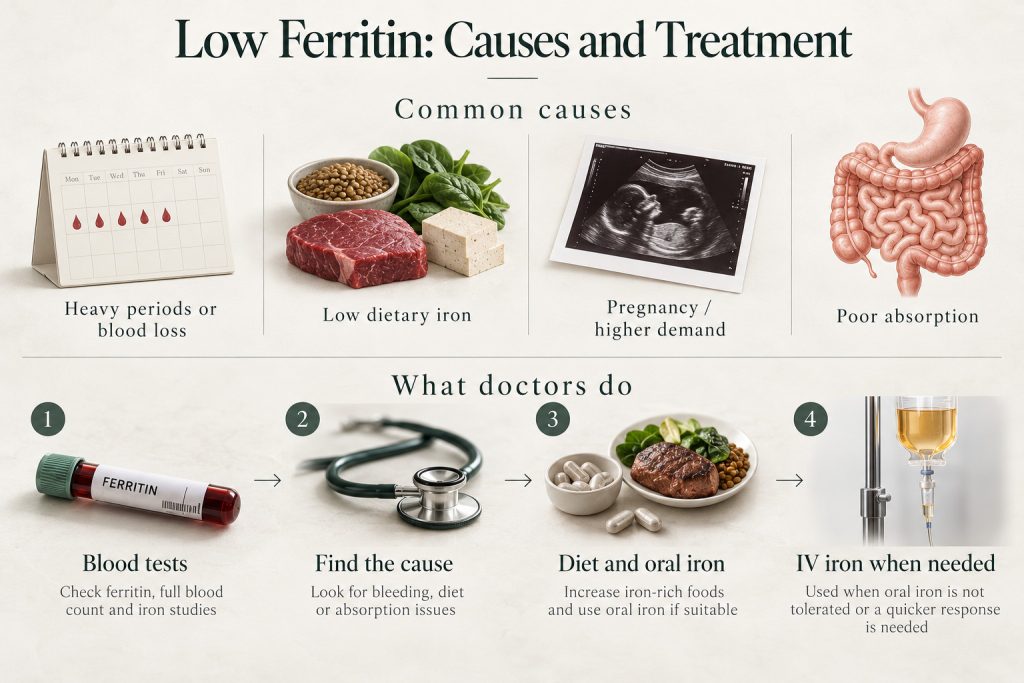
Low ferritin should prompt two questions: why iron stores are low, and how best to correct them. Causes can include blood loss, inadequate intake, higher demand and poor absorption.
How is low iron treated?
Effective management requires a two-part approach: replenishing your body’s iron stores and treating the underlying cause of the loss⁷. Depending on your lab results, symptoms, and digestive tolerance, your doctor may recommend dietary changes, oral iron supplements, or an intravenous (IV) infusion³,¹⁰.
Dietary iron comes in two forms: haem iron (found in meat, poultry, and seafood) and non-haem iron (found in plant sources like tofu, tempeh, lentils, and dark leafy greens like kailan)¹¹. Pairing plant-based iron with vitamin C-rich fruits such as guava, papaya, or oranges helps your body absorb non-haem iron more efficiently¹¹.
Summary: the pitfalls of the “Ferritin Face” trend
Labels like “ferritin face” oversimplify complex symptoms like dark circles, dry skin, and hair shedding which can stem from different factors²,⁵,⁶. Pinning these symptoms solely on self diagnosed iron deficiency risks missing the real cause or delaying proper treatment¹,³,⁷. If you suspect that you have an iron deficiency based on your symptoms, please seek a medical evaluation and laboratory tests to confirm or exclude the diagnosis and underlying causes³,⁷.
Dr Rachel Ho’s conclusion and takeaway on “Ferritin face”
One benefit that’s come from the “ferritin face” trend is that it encourages people to pay attention to subtle health signals they might otherwise ignore. The downside, however, is that these symptoms of ferritin face do not establish a medical diagnosis of iron or ferritin deficiency³,⁴. If you suspect that you have an iron deficiency based on your symptoms, please seek a medical evaluation and laboratory tests to confirm or exclude the diagnosis and underlying causes³,⁷.
References
- H. Adams, Heard about ferritin face? Here’s what a dietitian wants you to know about iron, Medical University of South Carolina, Sep. 21, 2026. Accessed: Oct. 27, 2026.
- V. Ngan, Iron deficiency, DermNet, updated by S. de Menezes, Jul. 2016. Accessed: Oct. 27, 2026.
- S. Balendran and C. Forsyth, Non-anaemic iron deficiency, Australian Prescriber, vol. 44, no. 6, pp. 193–196, 2021, doi: 10.18773/austprescr.2021.052.
- American Society of Hematology, ASH Sets New Standards for Diagnosing Iron Deficiency, Sep. 16, 2026. Accessed: Oct. 27, 2026.
- D. Zhang, C. LaSenna, and B. E. Shields, Serum Ferritin Levels: A Clinical Guide in Patients With Hair Loss, Cutis, vol. 112, no. 2, pp. 62–67, 2023, doi: 10.12788/cutis.0837.
- R. Sarkar, R. Ranjan, S. Garg, V. K. Garg, S. Sonthalia, and S. Bansal, Periorbital Hyperpigmentation: A Comprehensive Review, Journal of Clinical and Aesthetic Dermatology, vol. 9, no. 1, pp. 49–55, 2016.
- J. Snook et al., British Society of Gastroenterology guidelines for the management of iron deficiency anaemia in adults, Gut, vol. 70, no. 11, pp. 2030–2051, 2021, doi: 10.1136/gutjnl-2021-325210.
- Y. Treister-Goltzman, S. Yarza, and R. Peleg, Iron Deficiency and Nonscarring Alopecia in Women: Systematic Review and Meta-Analysis, Skin Appendage Disorders, vol. 8, no. 2, pp. 83–92, 2022, doi: 10.1159/000519952.
- H. Ranu, S. Thng, B. K. Goh, A. Burger, and C. L. Goh, Periorbital hyperpigmentation in Asians: An epidemiologic study and a proposed classification, Dermatologic Surgery, vol. 37, no. 9, pp. 1297–1303, 2011, doi: 10.1111/j.1524-4725.2011.02065.x.
- T. G. DeLoughery, C. S. Jackson, C. W. Ko, and D. C. Rockey, AGA Clinical Practice Update on Management of Iron Deficiency Anemia: Expert Review, Clinical Gastroenterology and Hepatology, vol. 22, no. 8, pp. 1575–1583, 2024, doi: 10.1016/j.cgh.2024.03.046.
- Health Promotion Board, Low In Energy? You Could Be Low In Iron, HealthHub. Accessed: Oct. 27, 2026.

No Comments