


12 Dec Back Acne: Causes, Treatment and Prevention
Back Acne and Bacne: Causes, Treatment and Prevention
Back acne—frequently referred to as “bacne”—is a common condition characterized by breakouts on the back, often appearing alongside body acne on the chest and shoulders¹,⁷. Finding the right back acne treatment usually involves topical medicines, while extensive, painful, or scarring back pimples require oral medications and in-clinic treatments⁵,⁸.
Whether you are picking out a gym top or dressing up for a special event, bacne can be frustrating. This guide to back and body acne explores the underlying cause of back acne, how to distinguish bacne from similar-looking skin conditions, and what the latest clinical evidence supports for treatment. Finally, I’ll also cover how to treat residual bacne hyperpigmentation (post inflammatory hyperpigmentation) and back acne scars once the active acne has finally settled.
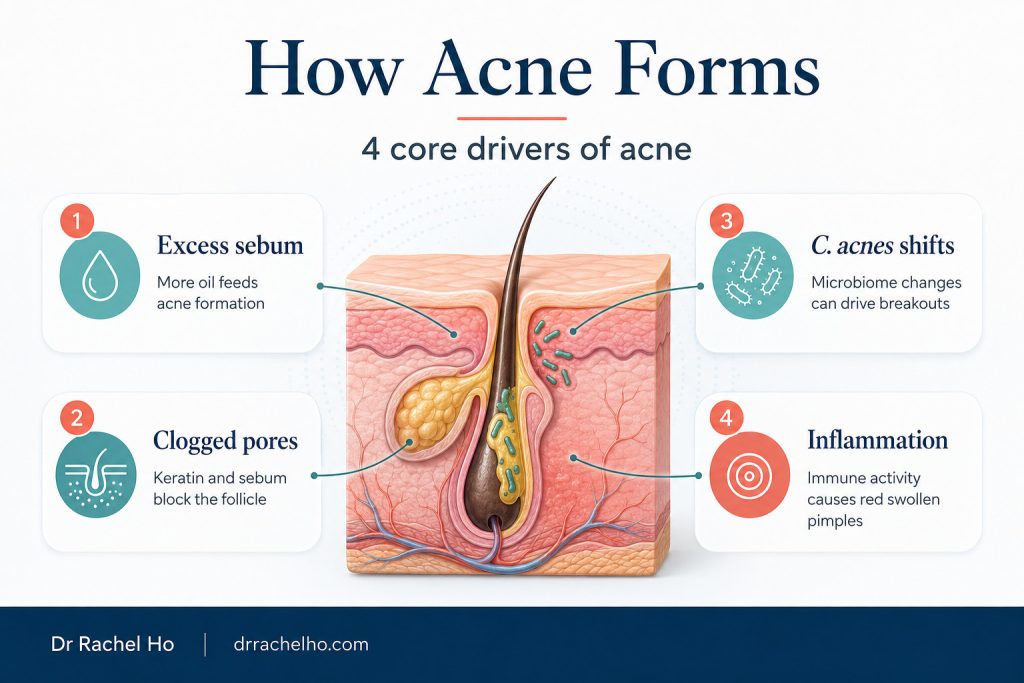
How acne forms. Acne develops through excess sebum, follicular blockage, microbiome changes involving Cutibacterium acnes, and inflammation. Understanding these four drivers helps explain why acne treatment often needs more than one approach.
What causes back acne?
Back acne develops within the pilosebaceous unit, which consists of a hair follicle and its connected oil (sebaceous) gland². It occurs when there is a shift in oil production, an accumulation of dead skin cells within the follicle, microbial changes, and underlying inflammation²,³.
The bacterium Cutibacterium acnes (C. acnes) naturally resides on human skin³. Interestingly, research links acne more to the changing behavior and imbalance of specific bacterial strains rather than just the mere presence of this organism³.
Approximately half of patients struggling with facial acne also experience trunk acne, yet the back and chest are often overlooked during clinic assessments¹,⁷. If you’re consulting a doctor for your acne on your face and neck, it’s always worth mentioning your body breakouts if you notice them.
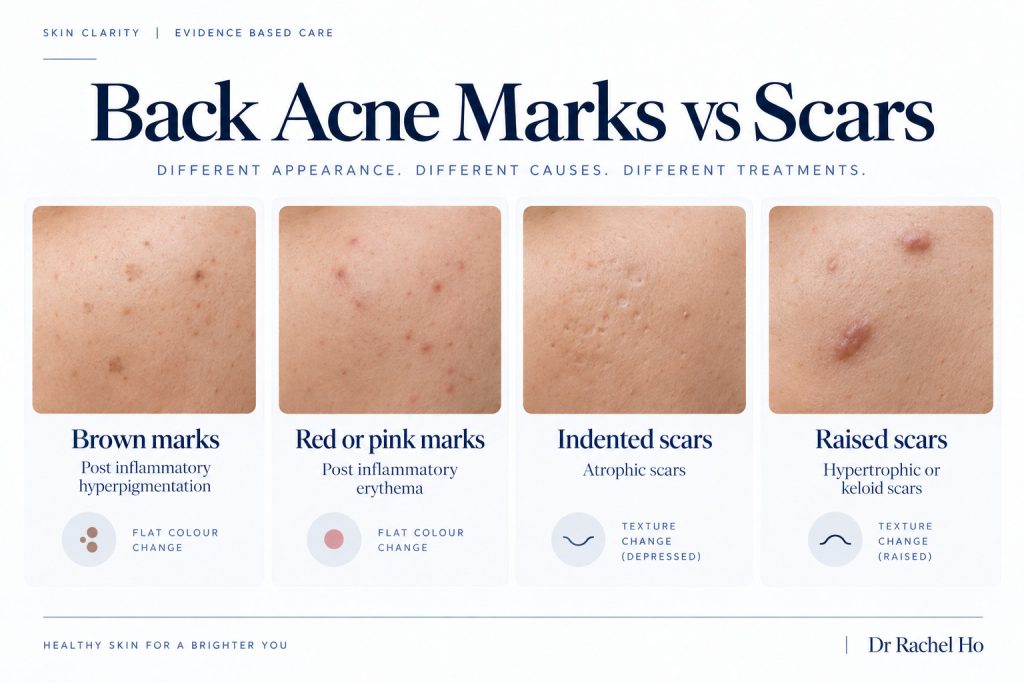
Brown and red marks involve colour changes, while indented and raised scars alter the skin’s texture. Distinguishing these findings helps guide the treatment discussion, because pigment treatments and scar treatments address different concerns.
How is back acne different from facial acne?
Treating the back is not quite the same as treating the face. First of all, the face represents a much larger surface area, and clinical visualisation of the magnitude of acne on the body can be difficult¹⁵. Furthermore, environmental factors like clothing friction, continuous pressure, and trapped heat heavily influence truncal acne compared to the face¹⁶.
Sebum (oil) production alone doesn’t tell the whole story. A study involving 35 Korean women with acne revealed that the trunk actually has lower sebum levels than the face, with no significant relationship between truncal sebum measurements and the number of acne lesions⁹.
This highlights why aggressively trying to make the back feel “drier” isn’t always the best treatment goal. Instead, focus on the pathogenesis of acne and contributing triggers such as follicular blockages, skin inflammation, and your everyday environmental exposures.
What can trigger or worsen back acne?
Exercise, sweat and clothing
Friction and occlusion (blockage) from clothing or sports equipment can significantly aggravate body acne in susceptible skin¹⁶. This frequently happens when tight activewear, bra straps, or protective gear repeatedly rub against the exact same area of your body¹⁴.
For my patients managing bacne in Singapore’s humid climate, practical habits like changing out of sweaty gym clothes immediately, washing activewear after every use, and using a gentle cleanser can immensely support your back acne treatment¹⁴. You can read more in my dedicated guide to exercise and skin. The goal is to make your skincare routine work seamlessly around your active lifestyle—not to suggest you give up exercising to clear your acne!
Hormones, family history and medicines
Hormonal fluctuations and your family history strongly influence your susceptibility to acne². Additionally, certain medications such corticosteroids, lithium, and specific anticonvulsants can trigger or worsen acne-like eruptions².
For women experiencing recurring acne alongside irregular periods or increased facial hair, a deeper hormonal assessment may be necessary². See my adult female acne guide for when hormonal factors take center stage in the discussion.
Whey protein and diet
While some case reports have linked whey protein supplements to sudden acne flares, broader research remains mixed¹⁰. For example, a 2024 randomised trial of 49 men with mild-to-moderate facial or truncal acne found that whey protein supplementation over six months did not worsen their breakouts compared to a control group¹⁰. Similarly, a systematic review noted an association between a higher dietary glycaemic load and acne, though evidence varied between studies¹¹.
However, because this trial was small, it doesn’t rule out individual sensitivities¹⁰. For my patients, I recommend watching for trends and correlations between starting a supplement and breaking out, simply because not everyone’s susceptibility to acne is due to diet or supplements.
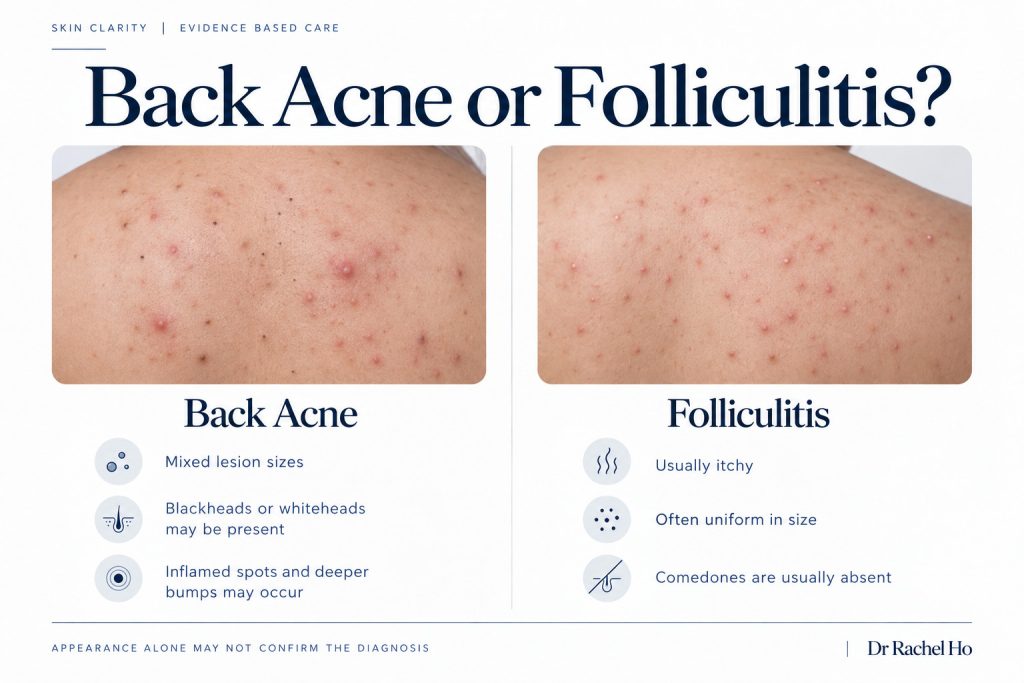
Back acne often includes a mixture of lesions, while Malassezia folliculitis commonly produces similar sized, itchy bumps without comedones. The conditions can coexist, and appearance alone cannot confirm the diagnosis.
Is it back acne or folliculitis?
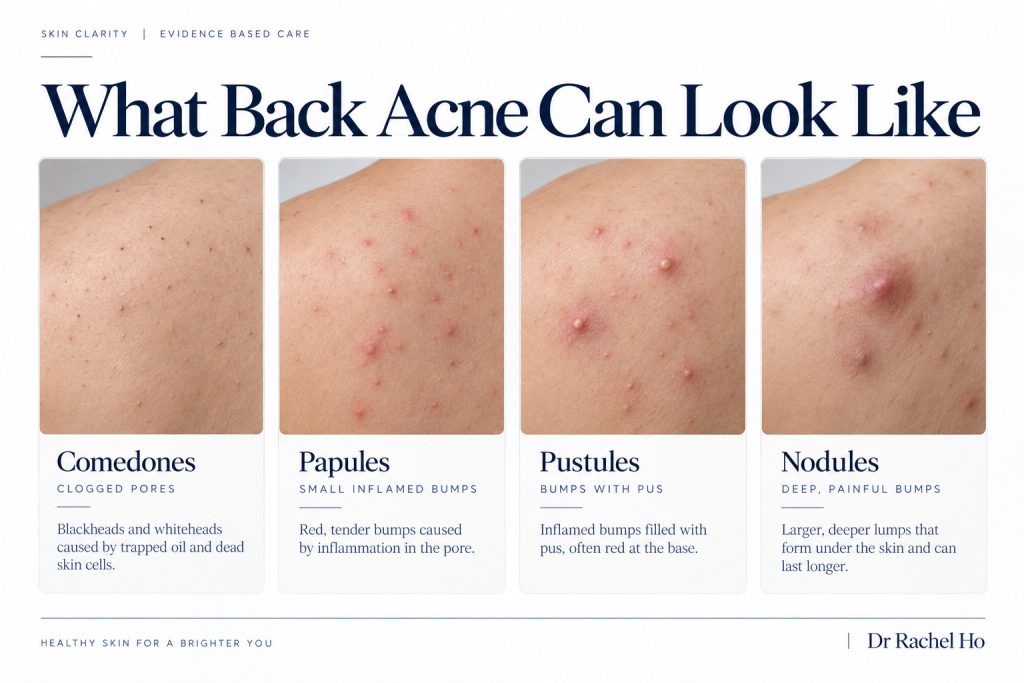
True back acne typically presents as a mix of blackheads, whiteheads (comedones), inflamed red bumps, pustules, and sometimes deeper, painful nodules¹⁶.
In contrast, Malassezia folliculitis (often colloquially referred to as “fungal acne”) usually shows up as intensely itchy, uniform-sized bumps or pustules. Crucially, it generally lacks comedones (blackheads and whiteheads)¹²,¹⁶. Check out my guide to Malassezia folliculitis to understand the distinction.
While these visual cues help guide assessment, appearance and itchiness alone cannot confirm the diagnosis¹². To complicate matters, acne and folliculitis can co-exist, which is why treating just one component often yields an incomplete response¹⁶.
Persistently itchy back bumps deserve a proper medical review rather than endlessly cycling
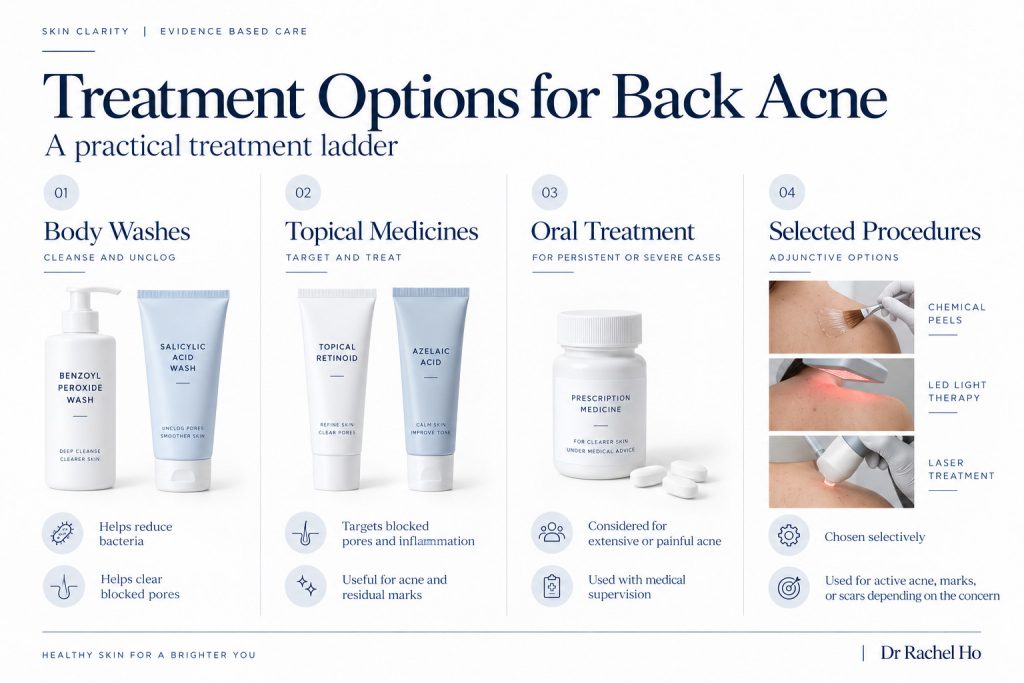
Back acne treatment considers the extent and severity of breakouts, developing scars and the practicality of applying topical medicines. This graphic summarises the treatment categories discussed in the guide, with the plan selected after assessment.
Which body washes and skincare can help back acne?
Benzoyl peroxide washes
Benzoyl peroxide works by reducing C. acnes bacteria and is a highly established acne treatment⁵,⁸. Using a benzoyl peroxide body wash for back acne is incredibly convenient for covering a large surface area. Remember that benzoyl peroxide can cause skin irritation and bleach your towels and fabrics, so tolerability and careful rinsing matter¹⁴.
Salicylic acid washes
Salicylic acid is excellent for dissolving follicular blockages (dead skin and oil) within the pores and is highly effective for selected acne concerns⁸. Because it works differently than benzoyl peroxide, the two ingredients should not be described as interchangeable antibacterial treatments⁸.
I prefer to select a wash based on your specific breakouts and the rest of your routine. Adding several exfoliating acids at once can irritate your skin barrier, making it impossible to tell which product is actually helping and which is causing harm.
Gentle cleansing and moisturising
Please avoid abrasive scrubs, harsh back brushes, and vigorous washing, as these can severely aggravate acne-prone skin¹⁴. Stick to gentle cleansing and a non-comedogenic (pore-clearing) moisturiser, especially to counteract the dryness often caused by active acne medicines¹⁴.
What medical treatments work for back acne?
Topical retinoids and benzoyl peroxide form the cornerstone of medical acne therapy, frequently used in combination to tackle more than one part of the condition⁵,⁸. When selecting a treatment, I look at how extent and severity of the patient’s bacne, if back acne scars are developing, and how easily you can physically apply topical products¹⁵.
Topical retinoids and combination treatment
Topical retinoids powerfully reduce follicular blockage and underlying inflammation⁵. Pairing them with benzoyl peroxide can drastically improve acne control, provided we manage any resulting skin irritation⁵,⁶.
Encouragingly, newer research specifically evaluates the trunk, rather than relying entirely on facial acne studies. For instance, two randomised trials demonstrated that the topical retinoid trifarotene successfully improved both inflammatory and non-inflammatory truncal acne compared to a placebo vehicle over 12 weeks¹³.
Still, the choice of preparation must account for skin tolerance and practicality. For my guide to retinoids, check out Retinol vs Retinal vs Tretinoin: Which Should You Use?
Topical antibiotics
A topical antibiotic might be prescribed for angry, inflammatory acne. To prevent antibiotic resistance, it is usually paired with benzoyl peroxide⁸. Antibiotics should have a strictly defined role and review plan, rather than becoming an indefinite standalone treatment⁸.
Azelaic acid
Azelaic acid is another topical option, particularly when active breakouts are accompanied by lingering brown marks (bacne hyperpigmentation)⁵,⁸. Check out my guide to azelaic acid products and to use them for an in-depth look at this ingredient.
Oral medicines: antibiotics, hormone regulators and isotretinoin
More extensive or inflammatory back acne may require an oral medicine in addition to an appropriate topical treatment⁵. Options include selected oral antibiotics, hormonal regulators for suitable patients, and isotretinoin for severe, scarring, or treatment resistant acne⁵,⁸.
Oral antibiotics are generally used alongside topicals for a limited course⁸. Hormonal treatments like combined oral contraceptives or spironolactone may be considered for selected female patients following a review of medical history and pregnancy plans⁵.
Isotretinoin is a powerful oral prescription medication used to treat severe acne that has not responded to other treatments like antibiotics. Isotretinoin shrinks oil glands to reduce sebum production. This medication requires careful medical supervision and must absolutely not be used during pregnancy⁵. My guide to understanding isotretinoin, pros and cons and alternatives in Isotretinoin Singapore: Benefits, Side Effects and Safety.
Important Note: Please always mention pregnancy, plans to conceive, or fertility treatments before starting acne medicines. These circumstances dramatically change which treatments are appropriate⁵.
Do chemical peels, LED or lasers help back acne?
Chemical peels for back acne
Superficial chemical peels can help clear selected mild-to-moderate acne and fade associated pigmentation, although much of the published evidence comes from facial treatment¹⁶,¹⁷. The studies also vary widely in the acids used, treatment schedules, and outcome measures¹⁷.
A chemical peel for the back or body should therefore be carefully selected for your skin type and acne severity. My chemical peel review explains the benefits and limitations, while my clinic’s chemical peel guide covers assessment and recovery after chemical peels.
LED and other light treatments
While blue and red light approaches have been investigated for acne, findings depend heavily on the specific equipment and treatment protocol⁶.
Laser treatment
Laser acne treatment uses focused light energy to target active acne, reduce oil production, and heal acne scars. Some lasers can also lighten the post acne marks as a secondary benefit. The wavelength, treatment method, and your unique skin characteristics all influence the choice of laser⁷.
Back acne can include blackheads, whiteheads, inflamed bumps, pustules and deeper nodules. Different lesion types may appear together, so the assessment considers more than the number of visible spots.
Why do marks or dark spots remain after back acne clears?
Post inflammatory hyperpigmentation or erythema and depressed scars are fundamentally different outcomes of acne⁷. Understanding this distinction matters because a lightening treatment that improves pigmentation will have little to no effect on a raised or indented scar⁷.
Back or body acne sequelae
| What remains | What it may represent | Treatment discussion |
|---|---|---|
| Flat brown marks | Post inflammatory hyperpigmentation | Acne control, sun protection and appropriate pigment treatment |
| Flat red or pink marks | Persistent post inflammatory erythema | Review of ongoing inflammation and whether targeted treatment is warranted |
| Indented areas | Atrophic scars | Assessment of scar shape and depth before considering resurfacing or other procedures |
| Raised, firm areas | Hypertrophic or keloid scars | A separate scar treatment plan rather than routine exfoliation |
Truncal acne can leave both indented and raised scars, and the treatment evidence for the back is less extensive than for facial scarring⁷,¹⁶. Options may include fractional CO2 laser or radiofrequency microneedling approaches for appropriate indented scars, while raised scars typically require treatments such as intralesional corticosteroids⁷. My clinic’s scar treatment guide explains the treatment modalities for acne scars in greater detail.
How long does back acne treatment take to work?
Improvement in back or body acne often takes several weeks, with the six-to-eight-week mark providing a useful initial point to assess whether your routine is helping¹⁴. Achieving more complete clearance may take several months, depending on the severity of the acne and your treatment response¹⁴.
When should I see a doctor for back acne?
Seek a medical assessment if you are experiencing deep or painful lesions, developing scars, dealing with extensive breakouts, or if the acne is heavily affecting your confidence and daily activities⁵,¹⁵.
My clinic’s guide to back and body acne treatment explains what a consultation for back and body acne covers. Please bring your current skincare products, medicines, and supplement details to your appointment so our discussion can account for any possible aggravating factors.
Conclusion and doctor’s takeaway on body and back acne
Successfully treating back and body acne begins with an accurate diagnosis and then building a routine that can target the pathogenesis of acne. realistically be maintained. Post acne marks, post inflammatory erythema and scars are side effects of back and body acne; so please seek treatment early before these complications develop.
References
- Guerra-Tapia A, Martínez H, Nieto C, et al. A new topical biotechnological phytocomplex for truncal mild-to-moderate acne restores skin microbiota balance. Skin Research and Technology. 2024;30(7):e13806. doi:10.1111/srt.13806.
- Zaenglein AL. Acne Vulgaris. New England Journal of Medicine. 2018;379(14):1343-1352. doi:10.1056/NEJMcp1702493.
- Cavallo I, Sivori F, Truglio M, et al. Skin dysbiosis and Cutibacterium acnes biofilm in inflammatory acne lesions of adolescents. Scientific Reports. 2022;12:21104. doi:10.1038/s41598-022-25436-3.
- Zimmer A, Hodax JK, Zaenglein AL, Boos MD. Clinical Care of Acne Vulgaris for Transgender and Gender-Diverse Youth. Pediatrics in Review. 2024;45(11):613-624. doi:10.1542/pir.2024-006469.
- Eichenfield DZ, Sprague J, Eichenfield LF. Management of Acne Vulgaris: A Review. JAMA. 2021;326(20):2055-2067. doi:10.1001/jama.2021.17633.
- Mavranezouli I, Daly CH, Welton NJ, et al. A systematic review and network meta-analysis of topical pharmacological, oral pharmacological, physical and combined treatments for acne vulgaris. British Journal of Dermatology. 2022;187(5):639-649. doi:10.1111/bjd.21739.
- Daniele SG, Kim SR, Grada A, Moore AY, Suozzi KC, Bunick CG. Truncal Acne and Scarring: A Comprehensive Review of Current Medical and Cosmetic Approaches to Treatment and Patient Management. American Journal of Clinical Dermatology. 2023;24(2):199-223. doi:10.1007/s40257-022-00746-4.
- Reynolds RV, Yeung H, Cheng CE, et al. Guidelines of care for the management of acne vulgaris. Journal of the American Academy of Dermatology. 2024;90(5):1006.e1-1006.e30. doi:10.1016/j.jaad.2023.12.017. The Academy’s accompanying summary explains the evidence limitations for procedural treatment.
- Kim BR, Chun MY, Kim SA, Youn SW. Sebum Secretion of the Trunk and the Development of Truncal Acne in Women: Do Truncal Acne and Sebum Affect Each Other? Dermatology. 2015;231(1):87-93. doi:10.1159/000382125.
- Sompochpruetikul K, Khongcharoensombat T, Chongpison Y, et al. Whey protein and male acne: A double-blind, randomized controlled trial. Journal of Dermatology. 2024;51(7):1022-1025. doi:10.1111/1346-8138.17109.
- Meixiong J, Ricco C, Vasavda C, Ho BK. Diet and acne: A systematic review. JAAD International. 2022;7:95-112. doi:10.1016/j.jdin.2022.02.012.
- Henning MAS, Hay R, Rodriguez-Cerdeira C, et al. Position statement: Recommendations on the diagnosis and treatment of Malassezia folliculitis. Journal of the European Academy of Dermatology and Venereology. 2023;37(7):1268-1275. doi:10.1111/jdv.18982.
- Tan J, Thiboutot D, Popp G, et al. Randomized phase 3 evaluation of trifarotene 50 μg/g cream treatment of moderate facial and truncal acne. Journal of the American Academy of Dermatology. 2019;80(6):1691-1699. doi:10.1016/j.jaad.2019.02.044.
- American Academy of Dermatology. Back acne: How to see clearer skin. Patient guidance on topical treatment, skincare and expected response.
- Tan J, Alexis A, Baldwin H, et al. Gaps and recommendations for clinical management of truncal acne from the Personalising Acne: Consensus of Experts panel. JAAD International. 2021;5:33-40. doi:10.1016/j.jdin.2021.06.007.
- Woo YR, Kim HS. Truncal Acne: An Overview. Journal of Clinical Medicine. 2022;11(13):3660. doi:10.3390/jcm11133660.
- Chen X, Wang S, Yang M, Li L. Chemical peels for acne vulgaris: A systematic review of randomised controlled trials. BMJ Open. 2018;8(4):e019607. doi:10.1136/bmjopen-2017-019607.

No Comments